
Robotics 2030: How Automation Will Redefine Industries

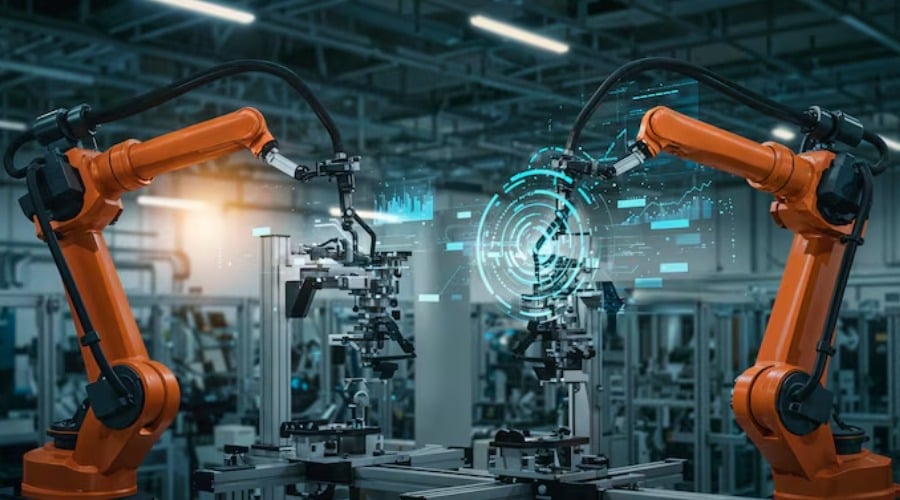
How Automation and Robotics Will Reshape Manufacturing, Logistics, Healthcare, Agriculture, and Employment by 2030
Robots are no longer confined to science-fiction movies or the assembly lines of automobile factories. They are already sorting packages in warehouses, assisting doctors, monitoring crops and helping businesses handle repetitive tasks.
As artificial intelligence (AI), sensors and machine vision continue to improve, robots are set to become an even bigger part of everyday work by 2030. The change is already happening.
According to the International Federation of Robotics, 542,000 industrial robots will be put into use worldwide in 2024, more than twice as many as there were ten years ago. India has also achieved its highest-ever installation of industrial robots, totaling 9,100 industrial robots in 2024, with 45% of them coming from the automotive sector.
Smarter Factories, Not Ghost Factories
Today’s robots are capable of assembling products, inspecting components, moving material, and performing tasks that require high-speed and high-precision. However, the factory of 2030 is likely not going to be a factory filled with machines but devoid of people. Rather, both robots and people are likely to coexist within the same factory.
While robots handle monotonous and physically demanding tasks, humans will handle the job of problem-solving, supervising, being creative and making decisions. According to PwC, it is expected that more industrial manufacturers will be using highly automated systems by 2030.
Warehouses are Getting a Robotic Makeover
Think about what happens after an online order is placed. The parcel might pass through an automated warehouse before making its way to a consumer’s door. Robots are gradually becoming popular as means of conveying goods and sorting inventory.
According to the International Federation of Robotics, about 200,000 service robots were sold in 2024, out of which more than half were used for transportation and logistics purposes.
By 2030, warehouses could become even more automated, with robots communicating with AI-powered systems to decide what needs to be moved, where it should go and when it should happen.
From Hospitals to Farms
Robotics is also moving into industries where the work is far less predictable. In healthcare, robots are being developed and used for surgery, rehabilitation, hospital deliveries and assistance for older people.
With the rising aging population and the increasing burden on health care services, such technologies might prove very handy in the future. Agriculture is yet another sector that may benefit from the application of robotics in the form of autonomous tractors, harvesters, drones, and crop monitoring robots.
What Happens to Human Jobs?
Perhaps the biggest question surrounding robotics is what it means for workers. Automation will definitely displace some functions, especially repetitive ones. However, this does not imply reduced employment opportunities.
According to the World Economic Forum, as many as 170 million jobs could be created worldwide by 2030, with 92 million jobs being displaced, leaving a net gain of 78 million jobs.
The bigger difficulty will lie in getting the people ready for the jobs that will arise. Workers will need capabilities in areas of technology, data, problem-solving, and managing automation.
Meanwhile, human strengths like creativity, communication, leadership, and critical thinking skills will continue to matter.
A Human-Machine Future
By 2030, the robotics revolution may not look like a world where machines simply take over human jobs. A more realistic picture is one where robots handle what they do best, repetitive, dangerous and highly precise tasks, while people concentrate on judgement, creativity and relationships.
The industries that benefit most will likely be those that understand this balance. Robotics is not simply about buying machines. It is about changing how work gets done. The real question for businesses, therefore, may not be whether they should adopt robotics, but how quickly they can learn to make humans and machines work better together.







Comment