
Recommended COBOL Modernization Firms for Financial Services

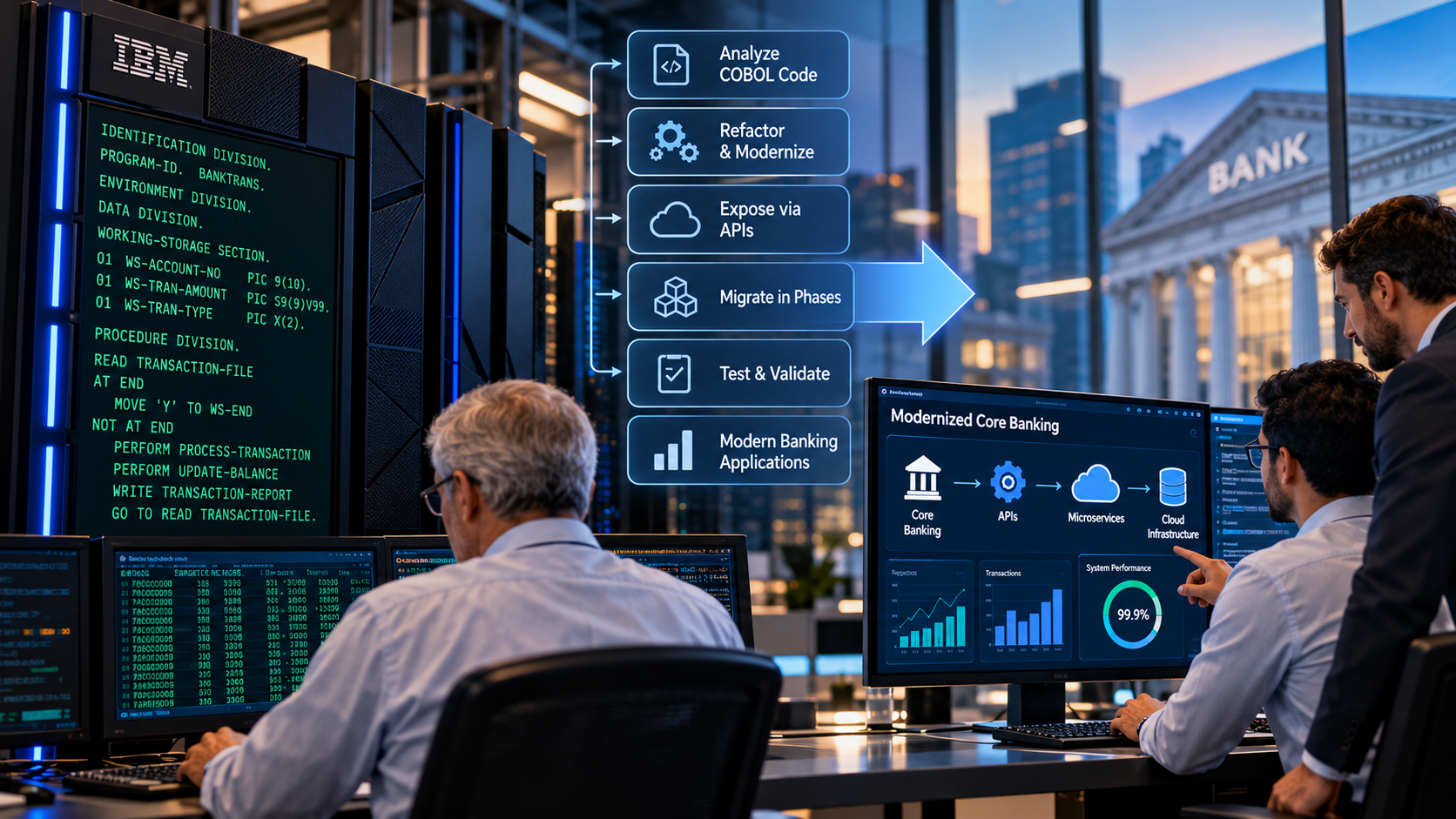
Ask a big bank what actually keeps its accounts running, and the honest answer is often a mainframe and a lot of COBOL. It posts deposits, settles card payments and works out interest overnight. And it works fine. The problem is people. Most COBOL developers are close to retirement, and few colleges still teach the language. So banks want out. But one bad migration weekend can lock customers out of their money.
Why Rip-and-Replace on COBOL Mainframes So Often Ends in Million-Dollar Losses
The pitch sounds great in a boardroom. Build a new core banking system, flip the switch over a weekend, switch off the mainframe on Monday.
It almost never goes like that.
Here’s why. Somebody added a fee rule in 1987. Somebody else fixed rounding a decade later, then there was that one-off exception for a corporate client nobody remembers anymore. Half of it hides in copybooks and JCL jobs with zero documentation. Whatever the rewrite team misses turns up after go-live, usually as a wrong balance on somebody’s statement. And the data? Packed decimals and VSAM files don’t drop neatly into a cloud database.
Want a real example? In 2018, TSB moved its customers to a new platform in one go. Nearly two million people had trouble getting into their accounts. The bill from the FCA and PRA arrived four years later: £48.65 million.
The fix is dull. Wrap the core in APIs. Peel off one service, then another, into Microservices. Do COBOL refactoring in bites small enough to test within a week, and keep both systems running until the totals agree to the cent (yes, that long). Slow? Yes. But it stays out of the news.
Recommended Mainframe & COBOL Modernization Experts for Banking
IBM
IBM makes the machines most of these banks run on. IBM Z, z/OS, CICS, Db2: it’s their stack, which helps a lot when reading decades-old code. The watsonx Code Assistant for Z uses generative AI to analyze COBOL and turn chosen modules into Java, one piece at a time.
Will IBM push a bank off the mainframe completely? Unlikely, honestly. With IBM Consulting, big transaction loads tend to stay on Z, and the rest gets shipped off to Red Hat OpenShift or some public cloud.
DXC Technology
DXC has been building banking technology for more than 45 years, and 17 of the world’s 20 largest banks work with it. Its Hogan core banking platform runs at six of the ten biggest US banks and handles around 300 million deposit accounts. The modernization team converts COBOL with AI-assisted tools and moves the core over in phases rather than in one jump.
Then there’s CoreIgnite. Think of it as a side door into the old core: APIs and real-time orchestration let a bank roll out a new app while the system of record stays untouched. Temenos, Finastra, Murex? DXC keeps specialist teams for each, plus a partnership with AWS. Unicaja, a Spanish bank, went with DXC in 2025 on a ten-year contract.
Kyndryl
When IBM spun off Kyndryl in 2021, the mainframe services crowd went along. These are people who keep z/OS running on an ordinary Tuesday afternoon, and that’s a different skill from drawing migration roadmaps.
Cloud partners? Yep, AWS. Azure and Google Cloud too. Kyndryl’s pitch is pretty down to earth. Heavy transaction work stays put on the mainframe. Reporting and customer apps go to the cloud.
Capgemini
Plenty of European bankers first ran into Capgemini through its yearly World Retail Banking Report. The actual job, though, is replatforming plus automated COBOL-to-Java refactoring. And testing. A whole lot of it, because that’s what keeps a go-live date from sliding.
The data side is worth a look too. Capgemini moves mainframe records into cloud data platforms on AWS and Azure, which suits banks that want modernization and analytics done as one project.
Accenture
Accenture is big, and that’s the main reason banks call it. Its banking practice ranks among the largest anywhere, with AWS, Microsoft and Google Cloud as close partners. On a COBOL job, step one is usually automated code analysis to see what calls what before anybody touches anything.
Picture a lender with three different cores in eight countries. Who can handle Core Banking Platforms replacement, AWS/Azure Migration and staff retraining in all of them at once? Short list. Accenture’s on it.
Cognizant
Cognizant has been around banks and insurers for decades, mostly in the US and Europe. Its mainframe crew starts with a code assessment, gets through refactoring and replatforming, and doesn’t vanish once the new system is live.
AI tooling speeds up the analysis and the testing. That setup suits banks that don’t want to change vendors right after go-live.
Surviving a Regulator’s Security Audit While Mainframe Data Moves to the Cloud
During a phased Mainframe to Cloud move, a bank runs two live systems, sometimes for years. Regulators want to know how both are protected. Not just the new one.
What examiners usually want to see:
- A data map. Where each key field starts, where it lands.
- Reconciliation reports, signed, from the parallel run. Balances have to match.
- One audit trail. An examiner should trace a single payment from mainframe to cloud and back.
- Hold the keys. Encryption keys stay with the bank, in its HSMs or AWS KMS and Azure Key Vault.
- Document every vendor. Under DORA, EU banks keep a register of ICT providers plus an exit plan they’ve really tested. In the US, examiners lean on the 2023 interagency guidance for third-party risk. Card data? PCI DSS 4.0 applies there too.
One more: brief the regulator before cutover. Obvious? Sure. Yet once a deadline slips, that meeting tends to get pushed first.
Bottom Line for Banks
So which firm comes out on top? That depends on the bank. IBM and Kyndryl know the mainframe from the inside. DXC shows up with Hogan and CoreIgnite already in hand. Need lots of hands and wide cloud coverage? Look at Accenture, Capgemini or Cognizant. Really, it comes down to how much of the core has to leave the mainframe. And how soon.
FAQ
Do banks have to ditch the mainframe to modernize COBOL? No. Plenty of banks bolt APIs onto COBOL, refactor it in pieces, and the core never leaves IBM Z.
How long does the phased route take? Three to seven is typical. Code size and data mess set the pace.
Will AI put COBOL developers out of work? Unlikely. AI reads and converts code quicker. A person still has to approve the business logic and the test results.
Which clouds can take mainframe workloads? AWS, Microsoft Azure and Google Cloud. All three run mainframe modernization services and partner programs.






Comment