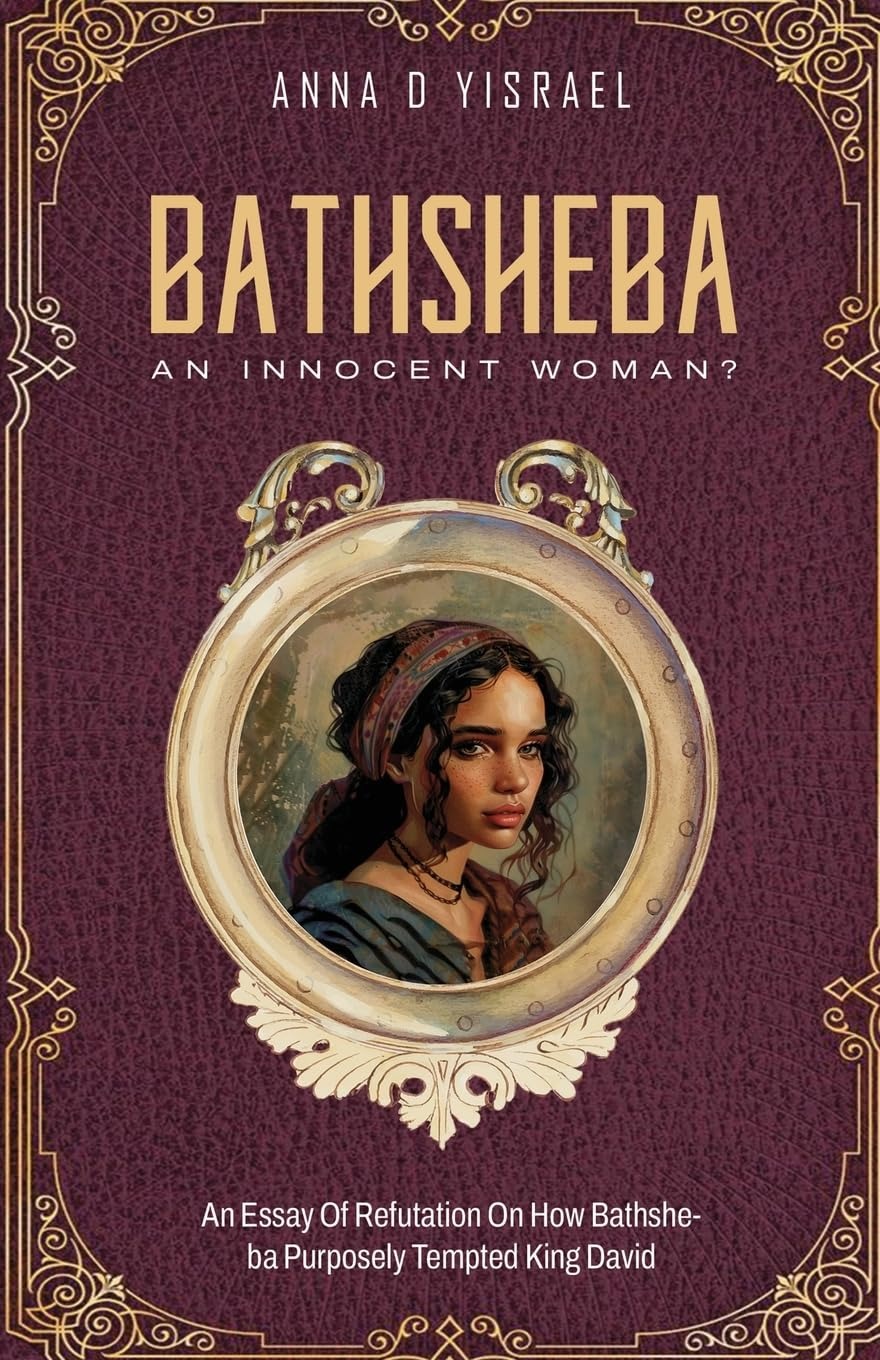
For centuries, biblical commentary has frequently cast Bathsheba in an unfavorable light, often labeling her as calculating, manipulative, or complicit in the downfall of King David. This persistent interpretation overlooks historical context, societal dynamics of the era, and the explicit text of the scriptures. Mischaracterizing her character reduces a complex figure to a one-dimensional trope, leaving readers with an incomplete understanding of her journey and faith.
Author Anna D Yisrael challenges this traditional narrative in her book, Bathsheba, an Innocent Woman? An Essay of Refutation on How Bathsheba Purposely Tempted King David. Drawing on detailed scriptural analysis and her academic background in psychology, education, and art history, Yisrael offers a defense of Bathsheba as an obedient, faithful woman who rose to become the Queen Mother of Israel. In this interview, we speak with Yisrael about re-evaluating biblical women, dismantling long-standing misconceptions, and finding modern relevance in ancient history.
Q: For generations, mainstream commentary has painted Bathsheba as a temptress who intentionally lured King David. What inspired you to challenge this narrative and write a defense of her innocence?
Anna D Yisrael:You said the truth about this generalized consensus of Bathsheba’s depiction as a seductress. According to most commentary about her, she would have allegedly tempted King David on purpose. In today’s modern society, in the 21st century, those accusations against Bathsheba probably would have been totally dismissed. Today, women’s rights have reached a peak that I suspect barely happened before. Now, I don’t exactly define myself as a so-called feminist, but I do believe that Bathsheba, King Solomon’s mother, terrifically deserved a female perspective on her case. With no intent to incriminate the male gender,it is verifiable that most commentary that came against Bathsheba are from a male perspective. So to answer your question, what inspired me to give another perspective to this Bathsheba case matter is my long known thirst for equity and justice, in a Christian literature that almost never gave her the benefit of the doubt.I think it’s unfair. As an ancestor of Jesus-Christ himself, Bathsheba deserved to have her name cleared of her accusations, also for the sake of Christ,literally! (laughter)
Q: In your book, you highlight Bathsheba’s submissive and cooperative nature as key factors in her survival and rise to Queen Mother (Gebirah). How did those traits function as strengths in an ancient, male-dominated society?
Anna D Yisrael: We could start by analyzing the only 2 women who have their own books in the 66 books of the Canonical Bible we have today. These women are Ruth and Esther. When we study their lives, we notice something: with cooperation and great submissiveness to their immediate authority figure ( Ruth’s mother in law (Naomi) and Esther’s cousin (Mordecai) as well as the prophet Nathan), these 2 women were able to follow direction until they had a chance to make that one bold move that would crown them with the honour of being an heroine. Now,are there other women in the Old Testament that are heroines? Absolutely, but they do not have a book in the Bible with their names as the title. This shows how, in an ancient male-dominated society, it is a strength for female leaders like Ruth and Esther to be able to follow their own leadership, which is the ultimate sign of their qualifications to lead others.Let’s not forget the books of Ruth and Esther were written by men in that same male-dominated society.
Q: Your background spans Catholic traditions, the Hebrew Israelite community, psychology, and art history. How did this interdisciplinary foundation shape your research and interpretation of the scriptures?
Anna D Yisrael:I never asked myself that question before, honestly ( laughter!) I also have a background in communication sciences which of course, was able to improve my writing skills.But to answer your question, my background in psychology and social sciences was able to give me a more sociological approach to those many biblical stories, which is something that might not necessarily come naturally to someone who approaches the Bible from a perspective of religious faith only. So yes, as a Torah keeping fervent Catholic, combining my passion for God, Jesus, the Saints and the Bible, to my academic journey, did wonders regarding the outcome of my research and also, on my perspective of biblical characters such as Bathsheba, King David and many other Saints.
Q: You host a podcast dedicated to examining women throughout biblical history. How does reframing Bathsheba’s story fit into your broader mission to educate and empower modern women of faith?
Anna D Yisrael: To answer your question, let me touch on my small connection to the Hebrew Israelite community, which is the foundational context of the creation of this podcast. Reframing Bathsheba’s story, only to use your words, was also a way to re-enforce what I’ve been teaching to my female followers for 3 years:submissiveness is more powerful than you think, it can turn you into a leader; in other words,if you want to lead, you must be able to be led. I must specify that the Hebrew Israelite community focuses a lot on women’s ability to be led by any authority figure (male or female) and many of these women, from what I’ve seen, crave a little bit of empowerment. My podcast insisted, on several of my podcast episodes, that the way to be empowered as a woman, according to the Holy Bible, is what I said before, knowing how to be led.Since myself, and the women who follow me, use the Holy Bible as an instruction manual of life, it just made sense to use women like Bathsheba, Ruth or Esther to scripturally support my teaching points,for women of faith. Those women of faith, as I said earlier, desire a bit more empowerment in their everyday lives.
Q: What key textual evidence from the scriptures do you find most readers overlook when assessing the events involving King David and Bathsheba?
Anna D Yisrael: Very good question. I would say the book of 2 Samuel chapter 1 verse 1, where it says at the end of the verse that King David “tarried in Jerusalem”, the very evening he saw Bathsheba. Now, the verb “tarried” can also be translated as “stayed longer than intended” or “delayed leaving”, which is for me a way to say that King David, accidentally saw Bathsheba; he was supposed to be away from home the night he saw her and that is, as you asked, my personal key textual evidence that is always overlooked by readers.
Q: What core lesson do you hope readers take away from your book when reflecting on historical figures whose stories have been distorted over time?
Anna D Yisrael:That there are always 2 sides to a story. I mentioned earlier something about my thirst for equity, justice, and how Bathsheba is mostly interpreted from only one perspective, the seductress one. I hope people will start to make sure to have all perspectives on someone’s case before pronouncing themselves on a matter. In everyday life, that could be translated as giving a pal, a family member or a coworker etc., a chance to explain themselves, after an argument we heard about (with someone we know or not ). That can easily clear someone’s name or more, a reputation, which is the only thing that we really take with us when we pass away. So hopefully, people will just learn to be willing to know both sides to a story. I hope this makes sense to you ( laughter!)
Anna D Yisrael’s reassessment of Bathsheba demonstrates the importance of returning directly to source texts with a critical and empathetic eye. By shifting the focus from blame to resilience, her work provides fresh clarity on a story often obscured by centuries of misinterpretation. It serves as a reminder that understanding ancient figures requires examining their actions through the realities of the world they navigated.
Revisiting historical and spiritual narratives with fresh scrutiny allows modern readers to uncover deeper truths about leadership, endurance, and grace. As scholarship continues to re-evaluate traditional characterizations of biblical women, works like Yisrael’s play a vital role in broadening public understanding. Correcting historical portrayals not only honors the legacy of these figures but also enriches our perspective on power, faith, and perseverance.
Get a copy at https://www.amazon.com.mx/Bathsheba-Innocent-Woman-Refutation-Purposely/dp/1962997758