
You have a game that works at your kitchen table, and friends keep asking for a copy. Before ordering boxes to sell, test whether people outside your group can play it without your help. Small-run printing can help you check a physical copy before committing to more stock.
Key takeaways
Test before you polish. Use a rough playable version to find rule problems before paying for finished artwork.
Approve a physical sample. Hold and play a printed copy before you order more.
Compare the complete order cost. A lower price per copy can still mean more cash committed and more unsold stock.
Decide whether on-demand printing fits your game
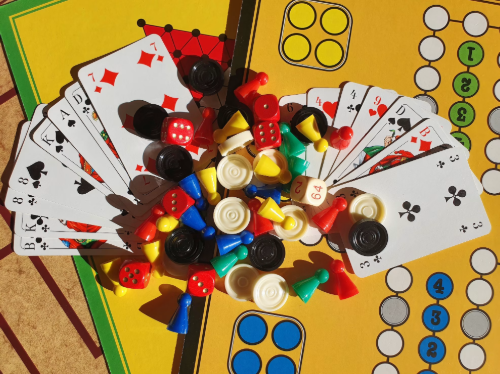
Board game self publishing includes production, launch planning, sales and delivery. A print order covers only part of that work.
Your publishing responsibilities. In an interview on author-led publishing, publisher Lotta Glybotskaia describes her work as covering project packaging, launch strategy, production, logistics and audience engagement. Her account reflects her own business, but it illustrates the tasks a self-publishing board game creator needs to assign. Decide what you can handle yourself and where you need help before taking orders.
Small orders. Suppliers serve different order sizes. Ad Magic’s prototyping page offers quantities of 1, 5 or 50 copies. Panda states a minimum of 1,500 units, rising to 2,000 for projects with custom plastics. These are supplier-specific requirements, so check each company’s minimum.
Also confirm how ordering works. You may need to place and pay for each batch yourself. If you want a service that prints a copy automatically whenever a customer buys one, ask whether it supports that model.
Prepare a prototype worth printing
Use the first physical copy to find problems while changes are still manageable.
Test the rules. Start with a rough version made from index cards, printed sheets or borrowed tokens. PledgeBox’s January 21, 2026 publishing guide describes an early prototype’s purpose as testing the game’s core mechanics. Once it plays through, give the rulebook to people who have never seen the game and ask them to play without your help. Note where they hesitate, misread a card or ask a question.
List every component. Before requesting a quote, write a complete component list. For each item, record the quantity, size, material and packaging needs, such as a tuck box for cards or an insert for tokens. Use the same list when checking quotes and samples.
Prepare files with your chosen supplier’s templates. Card sizes and print requirements differ between suppliers. Check the bleed, which extends artwork beyond the cut line, and the safe zone, which keeps text and essential details away from the edges.
Check a physical sample. Read the smallest text at normal playing distance. Count every piece against your list. Shuffle and deal the cards to see how they handle. Fold and unfold the board and check that it lies flat. Then put everything back in the box and close the lid. Fix problems before ordering more copies.
Launch Tabletop is an option for board game manufacturing, including prototypes and small-batch printing. Its Launch Lab lets you build a project by selecting and configuring components, and its estimator updates the unit cost as you add, remove or edit them. Account registration is free; printed copies are a separate paid order.
Check the full cost before you sell
Compare the total cost of the order and the amount you retain from each sale, as well as the price per copy.
Compare the same specification. Send each supplier the same component list and quantity. Include delivery to you, packaging, postage to customers, applicable sales or payment fees, and an allowance for replacing damaged copies in your budget. Keep one-off expenses, such as artwork and rulebook editing, separate from costs you pay on every order.
For an initial pricing check, subtract the costs of each sale from the selling price. The amount left must also help recover your one-off expenses before you can count it as profit.
A larger order may lower the price per copy while increasing the cash you commit and the stock you must store and sell. The Game Crafter notes that some components keep a fairly fixed cost at volume, so discounts vary by game. Any public price estimator built on a sample project is only a starting point; base your budget on a quote for your own components and quantity.
Decide who handles delivery. Fulfillment means storing copies, packing orders and sending them out. For a small run, you may be able to do that from home. Some production platforms also run a separate fulfillment service covering storage, packaging and shipping. Budget for fulfillment separately from printing.
Order-administration tools can help with the handoff to shipping. Kickstarter’s August 18, 2026 Pledge Manager update describes sending finalized orders to ShipStation. Confirm who will pack and send those orders, and which storage, packing and shipping charges your budget needs to cover.
Conclusion
Start with a playable prototype, approve a physical sample, and calculate your total cash commitment before ordering stock. Printing is only one part of publishing, alongside sales, fulfillment and customer communication. When your design, budget and delivery plan are clear, choose a production route that matches your evidence of demand and your ability to manage the next step.
FAQs
Can I order one copy?
Yes, from suppliers that offer it. Ad Magic’s prototyping page lists quantities of 1, 5 or 50, and MakePlayingCards states there is no minimum order. Confirm the minimum for your chosen supplier and product before preparing an order.
Do I need a crowdfunding campaign?
No. You can order a prototype without running a campaign. Crowdfunding can raise money and gather preorders, but you still need to arrange production and delivery.
What should I check in a printed sample?
Check text readability, component counts, card handling, board folds and box fit. Play through the game with the printed components to see whether any problems affect play.
When should I consider a larger run?
Consider it when you have evidence of demand, such as paid preorders, and somewhere to store the stock. Compare that demand with the complete order cost and the supplier’s minimum. Panda, for example, states a standard minimum of 1,500 units.