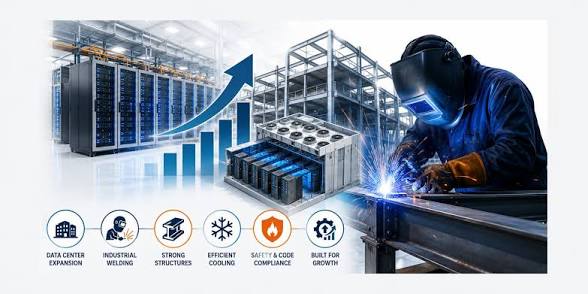
Think about a data center as a giant machine. Thousands of parts have to fit together, and there isn’t much room for a sloppy connection. Now add AI workloads, higher computing density, and increasingly demanding cooling systems. Things get complicated quickly.
That’s where precision welding in data center construction earns its place.
Welding might not be the first thing you think about when you picture a modern data center. Servers, racks, cooling units, and electrical systems usually get all the attention. But behind those systems are welded components that need to fit correctly and hold up under real operating conditions. This is where reliable data center welding services can make a real difference, helping ensure these critical components are fabricated with the accuracy and consistency the facility requires.
A small fabrication error can cause a surprisingly large problem later. A connection that doesn’t line up can slow installation. A weak or improperly made weld in a cooling circuit can lead to a leak. Fixing either issue after installation is far more frustrating than catching it in the shop.
Good welding isn’t just about joining two pieces of metal. It’s about making sure the finished component does its job when it matters.
Why Precision Welding Matters in Data Center Construction
Here’s the deal: data center components don’t get much room for error.
A fabricated rack, support frame, manifold, or section of process tubing has to match the design and work alongside everything else around it. If one part is slightly off, the installer may have to compensate for it on-site. Sometimes that means extra labor. Sometimes it means delaying the next stage of the project.
Imagine a cooling manifold arriving at a busy construction site. It looks fine at first glance. Then the crew discovers that a connection doesn’t quite line up with the equipment it needs to join. Now they’re measuring, adjusting, and figuring out a workaround that shouldn’t have been necessary in the first place.
That’s why precision matters before the component ever leaves the fabrication shop.
Good welding supports:
- Dimensional accuracy, so fabricated parts match the drawings and specified tolerances.
- Joint integrity, particularly where welded connections form part of a fluid or process system.
- Structural strength, for racks, frames, supports, and other fabricated components.
- Repeatability, so production parts don’t vary unnecessarily from one unit to another.
- Traceability, when the project requires records for materials, procedures, inspections, and testing.
The need becomes even more obvious as computing density increases. AI and high-performance workloads can put greater demands on cooling infrastructure, and liquid cooling is one approach used for managing those thermal loads.
But liquid cooling doesn’t magically solve the problem. The tubing, headers, manifolds, and other connections still need to be fabricated properly.
Precision welding is therefore part of the bigger construction picture. Get the fabrication right, and the pieces have a much better chance of coming together the way the design intended.
Precision Welding for Data Center Cooling Systems
Cooling is where welding quality can become especially important.
Picture a high-density computing environment running hard for hours. Heat builds up quickly, and the cooling system has to keep moving that heat away from the equipment. In systems that use liquid cooling, fluid has to travel through a network of components and connections without unwanted leaks or restrictions.
That puts some serious demands on fabrication.
Depending on the design, welded assemblies can include cooling distribution equipment, heat exchangers, process tubing, headers, manifolds, direct liquid cooling components, and custom cooling loops. Each application has its own geometry and fabrication requirements, so there isn’t one welding approach that fits every situation.
Orbital GTAW welding can be useful for certain tubing applications where consistent welds are needed across repeated joints. Manual GTAW or TIG welding can make more sense when the component has awkward geometry, limited access, or other details that call for hands-on control.
Material selection matters as well. Stainless steel, aluminum, copper, and copper alloys may all appear in different applications. Striking Precision Welding identifies 304L and 316L stainless steel, aluminum alloys, and copper alloys among the materials it works with.
Then there’s testing.
A fabricated cooling component shouldn’t simply be assumed to be leak-free because the weld looks good. Depending on the project’s requirements, pressure testing and leak testing can provide a much better check before the assembly reaches the data center.
And that’s the part people sometimes overlook. Finding a problem in the fabrication shop is inconvenient. Finding the same problem after installation can be a completely different story.
Quality Control, Testing, and Fabrication Accuracy
A weld can look great and still deserve a closer look.
That’s why quality control in data center fabrication goes beyond appearance. Measurements, welding procedures, inspections, testing, and documentation all have a role to play in showing whether a component meets the project’s requirements.
For example, a fabrication process may include qualified welding procedures, welder identification, material certifications, weld maps, inspection records, pressure testing, and leak-test documentation. These records give the project team something tangible to review instead of simply taking someone’s word that everything was done correctly.
Leak testing becomes particularly useful for liquid cooling components. Suppose a fabricated assembly has a small leak. If the shop catches it before shipment, the issue can be addressed there. If the same leak appears after the assembly has been installed and connected to other equipment, the situation gets much harder.
The same thinking applies to dimensions.
Data center equipment has to share a carefully planned space with racks, piping, cooling equipment, electrical infrastructure, and building systems. There may not be much room to “make it work” after the fact. Accurate fabrication can reduce those surprises.
Before choosing a fabrication shop, I’d want answers to a few straightforward questions:
- What welding procedures are used for the specified materials?
- How does the shop maintain material traceability?
- What inspection or non-destructive testing is available?
- Can assemblies be pressure tested before shipment?
- Can the shop perform leak testing when required?
- What records come with the completed component?
- Can the team handle both prototypes and production quantities?
Striking Precision Welding states that it offers in-house helium mass spectrometer leak testing, pneumatic and hydrostatic pressure testing, and documentation such as weld parameter logs, material test reports, weld maps, inspection records, and certificates of conformance.
For contractors and data center developers, that documentation can make the move from fabrication to installation much smoother. More importantly, it gives everyone a clearer picture of what was built, how it was tested, and whether it met the agreed requirements.
Choosing a Welding Partner for Data Center Projects
Choosing a welding partner isn’t really about finding the shop with the prettiest welds.
You need to look at the whole process.
Start with the project requirements. What materials are involved? What are the tubing dimensions? Are there tight tolerances? What testing is required? Are there specific standards, drawings, production quantities, or delivery dates that the fabricator needs to meet?
Those details matter because a shop can be excellent at one type of fabrication and still be a poor match for a particular data center project.
I’d also ask about prototype work. A component can look perfectly straightforward on a drawing and then reveal a few surprises when the first physical unit is built. Maybe an access point is awkward. Maybe two connections are closer than expected. Maybe an assembly needs a small dimensional adjustment.
That’s normal.
Having a fabricator that can move from prototype development into production can make those changes much easier to manage.
For liquid cooling projects, ask specifically about pressure and leak testing. For structural components, discuss dimensional and load requirements. For process tubing, talk through welding procedures, inspection, and material traceability before production starts.
If you’re comparing specialized data center welding services, don’t stop at the question, “Can you weld this material?” Look at the equipment, procedures, testing capabilities, quality controls, and documentation behind the work.
A fabricator experienced with orbital welding, manual GTAW/TIG, stainless steel, aluminum, and copper alloys may be able to support several different data center applications. Striking Precision Welding also describes prototype-to-production fabrication support.
The real goal is simple. You want a partner that can consistently produce components that fit, perform as expected, pass the required tests, and arrive with the records your project needs.
Conclusion
Modern data centers depend on much more than servers and software. Behind the scenes, welded cooling components, heat exchangers, process tubing, racks, frames, and enclosures all have to do their part.
That’s why precision welding matters.
As computing densities increase, cooling systems become more demanding, and construction tolerances leave less room for improvisation, fabrication accuracy becomes increasingly valuable. Catching a problem in the shop is one thing. Discovering it after installation is another.
When you’re evaluating a welding partner, look beyond production capacity. Ask about welding procedures, material traceability, dimensional control, inspection, pressure testing, leak testing, and documentation.
If you’re planning a data center or AI infrastructure project, reviewing specialized data center welding services can help you determine whether your fabrication requirements are being addressed before those components reach the job site.