
Polygon Private Transactions: MEV Protection Explained

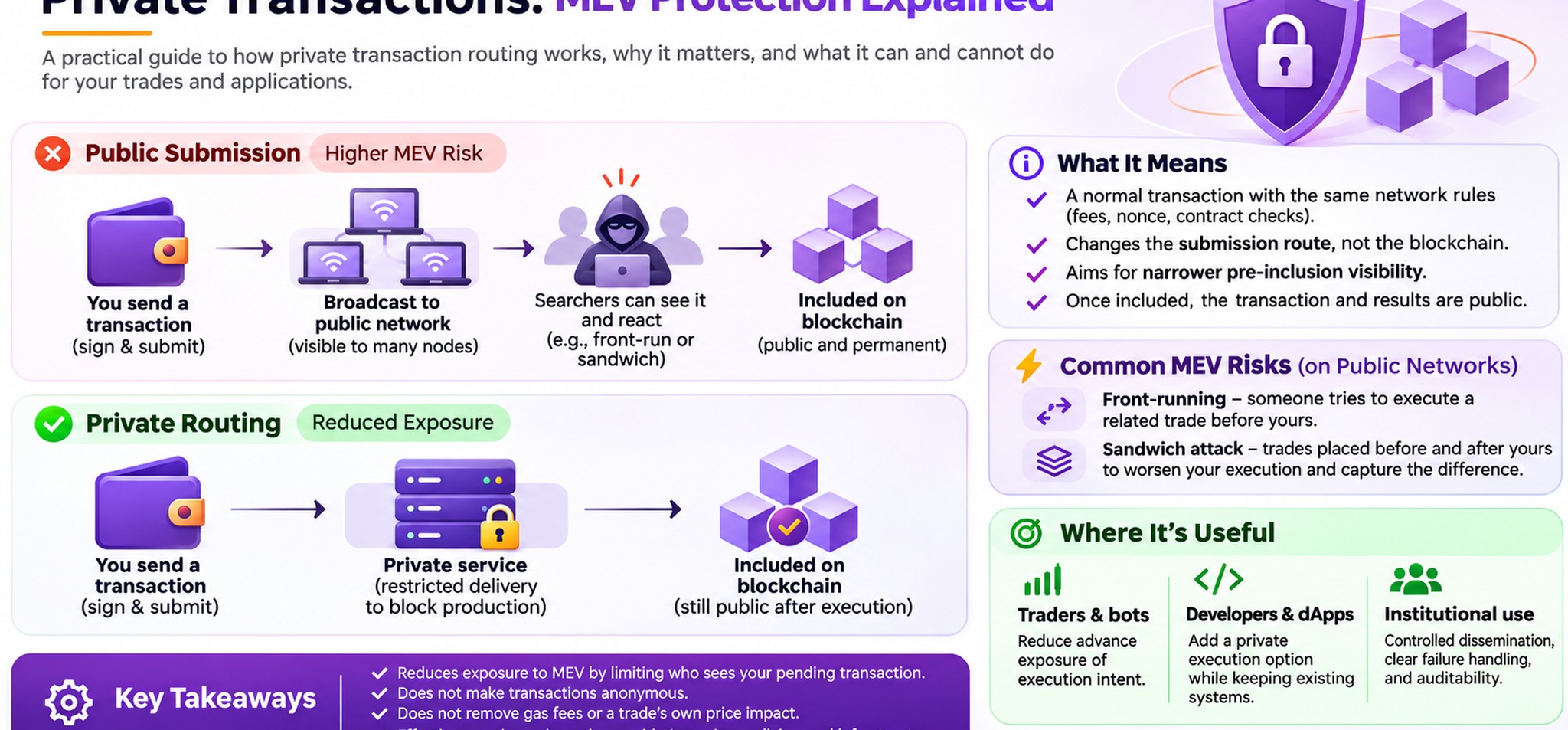
A token swap can reveal valuable information before it executes. When a transaction enters public propagation, observers may inspect its intended contract call, size, and execution constraints. For traders and applications, that creates a period in which someone else can react first.
Polygon private transactions address that exposure by changing the submission route. Instead of broadcasting a signed transaction through ordinary public propagation, a private service delivers it through restricted infrastructure toward block production. The objective is narrower pre-inclusion visibility, not a secret blockchain or permanently hidden account activity.
This distinction matters when comparing providers. A useful privacy service should explain who receives transactions, what happens if delivery fails, and which risks remain after submission.
What are Polygon private transactions?
A privately submitted transaction remains a Polygon transaction. It carries the instructions and authorization needed for execution, and it must satisfy the network's rules. Private routing changes how those instructions reach block production; it does not grant permission to bypass fees, nonce requirements, or contract checks.
An ordinary signed transaction is also not encrypted simply because a private key authorized it. Any infrastructure receiving the signed payload can generally inspect its contents. The relevant question is therefore who can access that payload before inclusion.
Once included, transaction details become part of the public chain. Successful token transfers, contract interactions, and associated records remain observable. Polygon transaction privacy in this context concerns the pending stage, rather than anonymity after execution.
Public submission versus private routing
With conventional public submission, a wallet or backend sends a signed transaction to an RPC endpoint that propagates it through the network. Different nodes may see it at different times. Searchers can monitor that activity and look for trading opportunities.
A private Polygon RPC or submission API instead uses a restricted delivery path. Its effectiveness depends on the operator's forwarding rules, downstream recipients, and handling of failures.
Paying for a dedicated RPC does not automatically create transaction privacy. A dedicated endpoint can still broadcast every submission publicly. Similarly, HTTPS protects a connection in transit; it does not determine whether the receiving service subsequently shares the transaction.
The comparison should focus on routing behavior, not the words “premium,” “dedicated,” or “secure” in an endpoint description.
How MEV can affect a trade
Maximal extractable value, or MEV, describes value obtained through transaction inclusion, exclusion, or ordering. Ethereum.org's MEV overview explains the underlying concept and common strategies. Those concepts help analyze EVM trading, although infrastructure differs between Ethereum and Polygon.
Front-running
A searcher observes an opportunity in a pending transaction and tries to execute a related transaction ahead of it. For example, a visible purchase may reveal demand that another participant wants to trade before.
A higher fee alone does not guarantee that ordering. Success depends on the route, block production, competing transactions, and execution conditions.
Sandwich attacks
As Uniswap Labs explains, a sandwich places an attacker's transactions before and after a victim's swap. The first trade moves the pool price against the victim; the second attempts to unwind the position profitably.
Consider an illustrative swap quoted at 1,000 tokens with a minimum acceptable output of 980. An attacker may try to worsen execution while keeping the result within that limit. The 20-token difference is neither a guaranteed attacker profit nor a prediction of loss: fees, liquidity, price impact, and competing trades all matter.
Other ordering opportunities
Not every instance of MEV is a sandwich, and not every arbitrage depends on seeing a user's pending transaction. Private submission targets an information channel; it does not eliminate all opportunities created by public markets and transaction ordering.
What private routing can realistically improve
Reducing public visibility can make it harder for external mempool watchers to identify and react to a pending trade. That can be valuable when execution intent is sensitive or easy to copy.
However, private infrastructure and downstream recipients still occupy positions of trust. A provider's policies, access controls, and delivery relationships matter. A claim of Polygon MEV protection should identify the threats addressed rather than imply universal protection.
Private routing also cannot remove a trade's own price impact. A large swap can move an automated market maker's price even without interference. Nor does routing repair unsafe approvals, vulnerable contracts, or an unrealistic minimum-output setting.
Where private transactions are useful
Traders and automated strategies
Traders can use restricted submission to reduce advance exposure of execution intent. Bots and market makers may have similar reasons to keep pending transactions away from competitors monitoring public propagation.
Developers and DeFi protocols
A wallet or dApp can separate transaction submission from ordinary blockchain reads. That gives developers room to introduce a private execution option while retaining their existing balance queries and indexing systems.
The whole workflow needs attention: a private submission is undermined if another component automatically rebroadcasts the same transaction publicly.
Institutional applications
Professional execution teams may value controlled dissemination, documented failure handling, and records connecting submission to settlement. Private routing should be evaluated alongside signing controls, operational monitoring, and counterparty review. It does not confer regulatory approval or make public-chain transactions confidential.
Exploring Hyperstrate's approach
Hyperstrate is one provider to evaluate for polygon private transactions. Its documentation describes locally signed submissions delivered through configured private routes, with separate delivery and execution states. It also states that private mode does not fall back to public broadcasting.
Those are documented product descriptions, not independently verified performance guarantees. Buyers should confirm current access requirements, supported interfaces, recipient policies, and service terms before integration. No latency target should be treated as measured performance without supporting evidence.
How to explore private submission on Polygon
Start by identifying the actual network and submission method. This article concerns Polygon PoS, not every network associated with the Polygon ecosystem. An API with a familiar method name is not automatically compatible with another provider's request format.
Hyperstrate's getting-started documentation describes workspace creation, a submit-scoped API key, network discovery, local signing, submission of the serialized payload, and lifecycle monitoring. Follow the current guide rather than assuming that changing an RPC URL completes the integration.
Before sending meaningful value:
- Confirm the discovered chain configuration, authentication requirements, and available testing environment.
- Keep signing inside your wallet or signing infrastructure; submit the signed payload, never a seed phrase.
- Review fees, nonce handling, slippage, and any application-level public fallback.
- Start with a small, controlled transaction and reconcile its receipt with provider status.
- Define what the application does when delivery remains unresolved or the transaction expires.
A response acknowledging submission is not proof of inclusion or successful execution. Check the transaction receipt and resulting application state. These distinctions are reflected in the Ethereum JSON-RPC reference, which documents transaction and receipt queries used by EVM applications.
Frequently asked questions
Are private Polygon transactions anonymous?
No. Restricted submission can reduce pending visibility, but included transactions and resulting public-chain activity remain observable.
Can private routing guarantee protection from sandwich attacks?
No universal guarantee follows from the label. Protection depends on recipients, routing behavior, information leakage, and execution conditions.
Do private transactions avoid gas fees?
No. Network fees still apply when transactions execute. A submission provider may charge separately under its service terms.
Does a missing public pending transaction prove privacy?
No. It only shows that a particular observer did not see it. Monitoring cannot establish that no recipient or other observer had access.
A more deliberate submission path
Private transactions on Polygon give users another way to manage when execution intent becomes broadly visible. Their value comes from reducing a specific exposure while retaining normal public-chain settlement. The strongest evaluation combines documented routing policies, controlled integration tests, sensible trading constraints, and clear monitoring of what actually reaches the chain.
Previously in Business news: South African Rehab Founder Sees Rise in Ketamine Addiction Among UK Clients







Comment