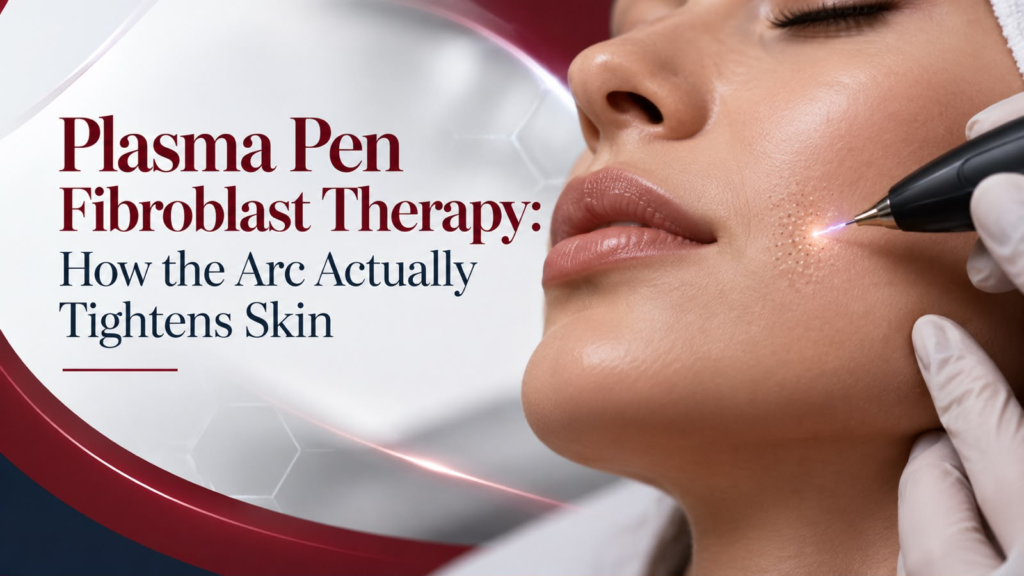
Plasma pen fibroblast therapy works on a simple physical idea with a complicated name. The tip never touches the skin. Held a fraction of a millimeter above the surface, the device ionizes the air in that tiny gap and produces a short electrical arc, a small pocket of plasma. That arc delivers a pinpoint of controlled heat to the outermost skin, and the clinician moves it across the area to leave a fine grid of tiny carbon dots. The visible tightening that follows is not caused by the dots themselves. It comes from what the skin does underneath them over the following weeks.
The cells doing that work are fibroblasts, the connective-tissue cells in the dermis that manufacture collagen and elastin. When the arc creates its controlled micro-injury, it triggers a wound-healing response: fibroblasts move to the site, switch into repair mode, and lay down fresh collagen. The same principle sits behind the range of plasma pen devices used across clinics and studios, and understanding it is the difference between realistic expectations and disappointment. This is a skin-remodeling process on a biological timeline, not an instant lift.
The arc-plasma mechanism, step by step
An ultra-high-frequency generator ionizes inert atmospheric gas, chiefly nitrogen, into an active plasma that carries thermal energy to the skin through the handpiece. Where the arc lands, the heat vaporizes a microscopic column of the epidermis in a process clinicians call sublimation, converting old, sun-damaged surface cells directly into vapor and leaving a small carbon crust. Because the energy is concentrated into these separated dots rather than spread across the whole surface, untouched skin sits between each point and acts as a natural bridge for healing.
That spacing matters for two reasons. It limits how deep and how wide the thermal damage goes, and it lets the surface knit back together quickly using the intact skin around each dot as a template. The heat that reaches the upper dermis is what wakes the fibroblasts, so the treatment is really doing two jobs at once: removing tired surface tissue and stimulating repair below it.
Why fibroblast stimulation produces tightening
Skin looks firm when its dermal scaffold, mostly collagen with elastin woven through it, is dense and well organized. That scaffold thins and loosens with age and sun exposure, which is when laxity, crepiness and fine lines appear. Controlled injury restarts the building process. As fibroblasts populate the treated points and produce new collagen, a step often described as neocollagenesis, the surrounding tissue contracts and the surface draws tighter.
This is why the strongest change is rarely visible on the day of treatment. Some contraction can be felt early as the skin heals, but the meaningful firming develops as new collagen matures, typically over roughly eight to twelve weeks. It is a gradual remodeling effect rather than a filler-style plumping, and that distinction shapes how the results should be judged.
Where it fits: eyelids, lines, and pigmented spots
The most common use is around the eyes, where plasma treatment is marketed as a nonsurgical alternative to blepharoplasty. It is best suited to mild upper eyelid heaviness and fine lower-eyelid lines rather than significant excess skin, and it does not remove fat pockets the way surgery can. Elsewhere on the face it is used for fine lines, mild to moderate laxity and crepey texture.
The same sublimation effect that resurfaces skin can also be aimed at raised or pigmented targets such as certain moles, skin tags and surface spots, which is why these keywords cluster around the same devices. Here a real caution applies. Because plasma destroys the tissue it treats, nothing is left to send to a laboratory. Any mole that is changing, irregular in color or shape, bleeding or new should be assessed by a dermatologist before anyone considers removing it, so that a lesion needing proper diagnosis is not simply burned away.
Risks, aftercare, and honest limits
For a few days after treatment the skin carries small dot crusts, along with redness and some swelling that is often most noticeable around the eyes. Those crusts should be left to shed on their own, and sun protection matters throughout healing. The most relevant risk is pigment change: temporary darkening, or post-inflammatory hyperpigmentation, is reported more often at higher energy settings and in deeper skin tones, so device settings and candidate selection are not details to gloss over.
A separate hazard sits with the numbing step rather than the plasma itself. A documented case of chemical eye injury followed a topical anesthetic cream migrating into the eye during periorbital treatment, which is a strong argument for trained hands and proper eye protection near the lids. The procedure is not considered appropriate during pregnancy or breastfeeding, for people taking isotretinoin, or for those with certain systemic or skin conditions, and it is not a do-it-yourself treatment.
It is also worth being clear about the evidence. Plasma fibroblast therapy is a relatively new technique, published clinical study of it remains limited, and in the United States the FDA has not cleared it for aesthetic skin procedures. Early studies and clinician reports suggest useful tightening with modest downtime in the right candidate, but that is a different claim from proven, predictable results for everyone.
How to think about it before booking
- Match the tool to the problem: plasma suits mild laxity, fine lines and surface texture, not heavy sagging or excess eyelid skin that needs surgery.
- Expect a timeline. Meaningful firming builds over about eight to twelve weeks, and one or more sessions may be needed.
- Weigh skin tone and pigment risk, and ask what energy settings and healing plan the practitioner uses.
- Have any suspicious mole checked by a dermatologist first, since plasma removal leaves no tissue to examine.
- Choose a trained, licensed provider working in a clean clinical setting, and treat home kits as a safety risk rather than a bargain.