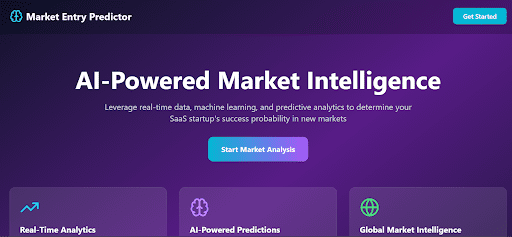
As digital industries continue to scale across borders at an accelerated pace, the need for accurate, data-driven strategic intelligence has become increasingly important. Within this context, Oluwafemi Esan, a data strategist is leading this initiative with an AI-powered system designed to assist global enterprises, particularly those in the Software-as-a-Service (SaaS) sector, in evaluating international market entry decisions
At a time when strategic missteps can cost companies millions and slow their global scaling efforts, his system provides a data driven and interpretable model intended to support organizations in making more informed expansion decisions
Esan’s system combines machine learning, econometric modeling, and established international business strategy frameworks such as Dunning’s OLI Paradigm, Institutional Theory, and Porter’s Five Forces. This hybrid approach allows the tool to generate forecasts across different markets and provide explanations for the factors that shape those outcomes, supporting greater clarity in strategic analysis.
The system assesses a wide range of factors, including organizational capabilities, competitive environments, institutional settings, and country-specific economic conditions. By processing large datasets and identifying patterns that may be overlooked by traditional analytical methods, the system offers insights intended to support strategic planning, risk assessment, and market prioritization within rapidly evolving SaaS markets, The tool enhances decision-making for SaaS firms by identifying markets with strong potential, improving resource allocation for more efficient scaling, reducing uncertainty during strategic planning, and elevating operational effectiveness through predictive analysis.
As SaaS platforms increasingly compete on a worldwide stage, Esan’s system provides a significant advantage by aligning digital innovation with strategic foresight. It empowers companies to expand into new regions with confidence while maintaining the agility and competitiveness required in today’s evolving digital economy.
Esan applies both technical and strategic perspectives in his work, drawing on data science and international business frameworks. This interdisciplinary focus aligns with ongoing efforts to develop AI-based tools that can assist organizations in evaluating global expansion opportunities.
As global markets continue to evolve and the digital economy becomes increasingly interconnected, tools like the one developed by Esan illustrate how organizations are experimenting with advanced analytics to evaluate new opportunities. While the long-term impact of such systems will depend on continued testing and real-world adoption, they represent an evolving approach to integrating data science into international business strategy.