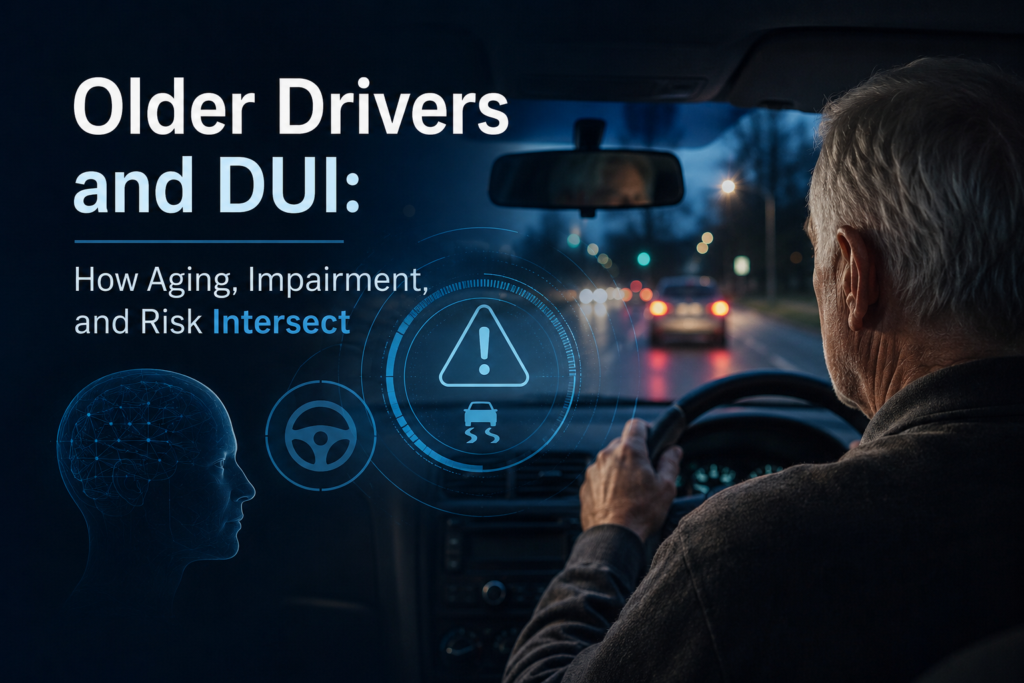
When most people picture a DUI, they picture a young person leaving a bar. The data supports that image up to a point — impairment in fatal crashes is far more common among younger drivers. But there’s a quieter, less understood version of the problem that affects older adults and their families, and it has less to do with a night out than with the medicine cabinet.
For seniors, the DUI risk that actually matters is often not a glass of wine at dinner. It’s the interaction between aging bodies, multiple prescriptions, and the fact that “driving under the influence” in most states includes impairment by medication — not just alcohol. Understanding that intersection is important for older drivers and the families who care about them, and it’s a scenario more common than the stereotype suggests — one a Miami DUI defense practice addresses at https://www.robertmalovelaw.com/miami-criminal/dui-lawyer/.
The counterintuitive statistics
Start with what the numbers actually show, because they cut against the assumption. According to the National Safety Council’s analysis of federal crash data, the share of drivers involved in fatal crashes who are alcohol-impaired drops sharply with age — from roughly 28% among drivers aged 21 to 24 down to about 7% among drivers 75 and older. Older drivers are, as a group, far less likely to be drinking and driving.
So where does the risk come from? Largely from medication. As the National Highway Traffic Safety Administration and driving-safety researchers have documented, prescription and over-the-counter drugs — and their interactions with each other and with even small amounts of alcohol — can impair driving in ways older adults often don’t anticipate. And here’s the crucial legal point: a DUI charge doesn’t require alcohol. In Florida, for example, DUI is defined as impairment of “normal faculties” by alcohol or any chemical or controlled substance — which includes legally prescribed medication.
Why aging raises the stakes
Two things change with age that heighten this risk.
First, polypharmacy. Older adults are more likely to take multiple prescriptions simultaneously, and research consistently finds that the more medications an older driver takes, the greater the potential for driving impairment — and the greater the chance of an inappropriate combination. Many older drivers using several medications simply don’t realise the cumulative effect on their reaction time, coordination, and judgment behind the wheel.
Second, metabolism and sensitivity. Aging changes how the body processes both alcohol and drugs. The same dose that was manageable at 50 can produce more impairment at 75, and combining a common medication with even a modest amount of alcohol can amplify the effect dramatically. LTC News has written about this directly in its look at how seniors are reassessing alcohol’s role in their health, noting how alcohol interacts with the CNS-depressant medications — tranquilizers, anxiety medications, sleep aids — that many older adults are prescribed.
The classes of medication most associated with driving impairment are common in older adults: certain painkillers, benzodiazepines, sleep aids, antihistamines, and some antidepressants. None of these carries the social stigma of alcohol, which is precisely why the risk is so often invisible until something goes wrong.
The family conversation
For families, this connects to one of the hardest conversations in caregiving: when it’s time to reassess an older loved one’s driving. Medication-related impairment belongs squarely in that conversation, alongside vision, reaction time, and cognitive changes.
LTC News addresses this sensitive question in its guidance on when to take the keys away from an aging parent, which notes that increasing medication use is itself a warning sign worth watching. The goal isn’t to strip an older adult of independence — driving is central to dignity and autonomy for many seniors — but to have an honest, empathetic conversation about medication side effects and safe driving before a crisis, whether that crisis is a crash or a DUI arrest, forces the issue.
A practical, non-confrontational starting point: encourage a “brown bag” review, where an older driver brings all their medications — prescription, over-the-counter, and supplements — to a doctor or pharmacist to check for interactions and driving-impairment risks. It reframes the issue as health and safety rather than a referendum on independence.
If an older driver is charged
A medication-related DUI is legally serious but factually different from an alcohol case, and that difference matters to the defense. The prosecution must still establish impairment, and the science connecting a given medication level to actual impairment is far less settled than the .08 blood-alcohol standard for alcohol. An experienced defense can raise exactly that question — whether prescribed medication, taken as directed, actually impaired driving in the way alleged.
As with any DUI, an arrest triggers two tracks: the criminal case and an immediate administrative licence suspension with a short window (ten days in Florida) to respond. For an older adult, a licence suspension can be especially destabilising, threatening access to medical appointments, pharmacies, and the independence that supports overall wellbeing.
The takeaway
The DUI risk for older adults is real but widely misunderstood. It’s less about alcohol and more about the intersection of aging, multiple medications, and a legal definition of impairment that includes prescription drugs. For older drivers and their families, the protective steps are straightforward and worth taking before a problem arises:
- Review all medications with a doctor or pharmacist for interactions and driving-impairment risks — including how they combine with alcohol.
- Take medication warnings about driving and machinery seriously, especially when starting a new prescription or combining several.
- Have the driving conversation early and with empathy, treating medication effects as a health-and-safety issue, not a loss of independence.
- Know that a DUI can involve medication, not just alcohol — and that if a charge does arise, the impairment must still be proven, which is where experienced legal help matters.
Aging well includes driving safely for as long as it’s safe to do so — and that means paying attention to the quiet risk in the medicine cabinet, not just the obvious one at the bar.