
Odoo ERP for Manufacturers Connect Inventory with Production by O2b Technologies

Introduction
Manufacturing businesses in the US are managing more operational variables than ever. Material availability, production schedules, labor capacity, quality requirements, inventory levels, and customer delivery expectations all need to stay aligned.
Yet many manufacturers still depend on disconnected systems to manage these processes.
Sales may use one application, purchasing another, warehouse teams may rely on spreadsheets, production supervisors may track jobs manually, and finance teams may consolidate information at the end of the month.
The result is often limited visibility across the production cycle.
A delayed purchase order can affect production. A production delay can affect shipping. An inventory discrepancy can affect customer commitments. By the time management identifies the problem, the operational impact may already be significant.
This is where Odoo ERP for manufacturing can provide a connected approach.
Odoo brings manufacturing, inventory, purchasing, sales, quality, maintenance, accounting, and other business processes into one ERP environment.
For manufacturers considering an ERP change, the real question is not simply whether Odoo has manufacturing functionality. It is how the system can be configured around the company’s actual production processes.
1. Production Planning Without Spreadsheet Dependency
Production planning becomes increasingly difficult as product volumes, components, work centers, and customer requirements increase.
Spreadsheets can help teams manage simple schedules, but they become harder to maintain when production changes frequently.
Odoo manufacturing software provides tools that can help manufacturers organize production requirements around actual demand and available resources.
Material Requirements Planning
Manufacturers can use demand, inventory, procurement rules, and production requirements to determine which materials are needed for upcoming manufacturing orders.
Bills of Materials
Odoo supports Bills of Materials (BoMs), including structures involving components and subassemblies.
This helps manufacturers define the materials and operations required to produce a finished product.
Production Scheduling
Production teams can organize manufacturing orders and work-center activities based on available capacity and operational priorities.
When production requirements change, planners can adjust schedules and review the effect on related operations.
The result is a more centralized planning process rather than maintaining separate schedules across spreadsheets and disconnected tools.
2. Bringing Shop-Floor Operations Into the ERP
Manufacturing data is most useful when it is captured close to where production actually happens.
Paper travelers and manually maintained production sheets can create delays between what happens on the shop floor and what appears in the ERP.
An Odoo manufacturing ERP environment can connect shop-floor activities with production orders and work centers.
A Typical Manufacturing Flow
Sales Order
↓
Production Requirement
↓
Bill of Materials
↓
Manufacturing Order
↓
Work Center Operations
↓
Quality Checks
↓
Finished Product
↓
Inventory / Shipment
This creates a connected flow between customer demand and production activity.
Shop-Floor Capabilities
Depending on the implementation, manufacturers can use Odoo for:
- Work order management
- Work-center scheduling
- Operator time tracking
- Digital work instructions
- Barcode operations
- Material consumption
- Production reporting
- Manufacturing order tracking
This can give supervisors and managers better visibility into production activity without waiting for manual reports.
3. Building Quality Checks Into Production
Quality control should not always be treated as a final inspection performed after production is complete.
Manufacturers may need quality checks at different points in the production process.
An Odoo ERP for manufacturing setup can incorporate quality activities into receiving, production, and other operational stages.
| Production Stage | Potential Odoo Workflow | Operational Purpose |
| Incoming Materials | Quality checks for received components | Identify material issues before production |
| Production | In-process inspections | Detect issues during manufacturing |
| Final Inspection | Quality control before shipment | Verify finished products |
| Traceability | Lot and serial number tracking | Track products and components |
| Non-Conformance | Quality alerts and corrective actions | Document and address quality issues |
This approach allows quality information to become part of the operational record instead of remaining in separate documents.
4. Managing Maintenance Before Equipment Problems Disrupt Production
Equipment downtime can affect production schedules, labor utilization, and customer delivery commitments.
A connected ERP environment can help maintenance teams organize preventive and corrective maintenance activities.
With Odoo manufacturing software, businesses can manage maintenance requests and scheduled maintenance activities alongside manufacturing operations.
Maintenance Workflows Can Include:
- Preventive maintenance schedules
- Corrective maintenance requests
- Equipment records
- Maintenance teams
- Maintenance history
- Work-center information
- Maintenance priorities
For example, when an operator identifies an equipment issue, the maintenance request can be recorded in the system instead of relying on a verbal notification or separate spreadsheet.
This gives maintenance teams a centralized record of equipment-related activity.
5. Connecting Inventory With Production
Manufacturing depends on the availability of the right materials at the right time.
If raw materials are unavailable, production can stop. If inventory records are inaccurate, purchasing decisions can be affected.
An Odoo manufacturing ERP connects manufacturing requirements with inventory and purchasing workflows.
Manufacturers can manage:
- Raw materials
- Components
- Subassemblies
- Finished products
- Stock movements
- Warehouse locations
- Reordering rules
- Purchase requirements
The relationship between production and inventory can be represented as:
Demand → Material Requirements → Procurement → Receiving → Production → Finished Goods → Shipment
This gives operations teams a broader view of how material availability affects production.
6. Understanding Manufacturing Costs
Manufacturing decisions ultimately affect profitability.
Knowing the cost of producing a product requires visibility into more than the raw materials.
Depending on the configuration, Odoo can help manufacturers track elements such as:
- Component costs
- Labor time
- Work-center costs
- Manufacturing operations
- Inventory valuation
- Additional procurement costs
This can provide management with a more structured view of manufacturing costs and product margins.
Accounting integration can also reduce the need to repeatedly transfer information between production and financial systems.
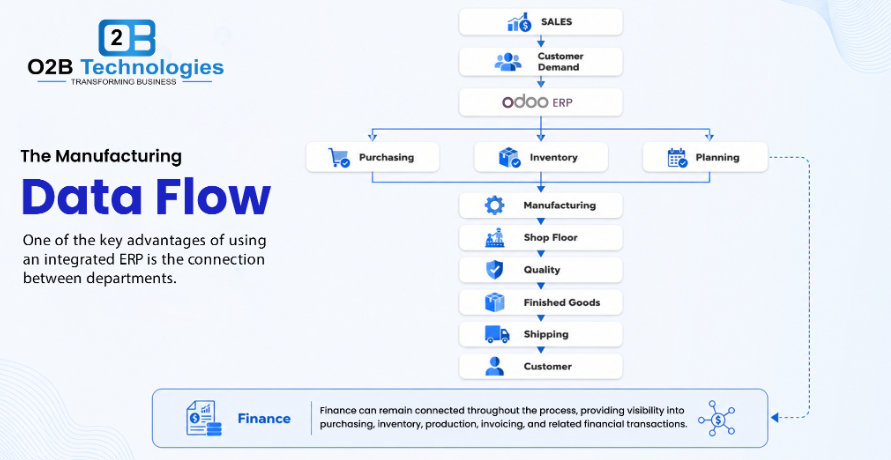
The Manufacturing Data Flow
One of the key advantages of using an integrated ERP is the connection between departments.
A typical manufacturing environment can follow this flow:
SALES
↓
Customer Demand
↓
ODOO ERP
↓
┌──────────┼──────────┐
↓ ↓ ↓
Purchasing Inventory Planning
↓ ↓ ↓
└──────────┼──────────┘
↓
Manufacturing
↓
Shop Floor
↓
Quality
↓
Finished Goods
↓
Shipping
↓
Customer
Finance can remain connected throughout the process, providing visibility into purchasing, inventory, production, invoicing, and related financial transactions.
Why Odoo Implementation Matters for Manufacturers
Having manufacturing functionality in an ERP does not automatically mean the system will fit the plant.
Every manufacturing business has different:
- Production processes
- Product structures
- Routing requirements
- Warehouse layouts
- Quality procedures
- Procurement rules
- Approval processes
- Reporting requirements
- Integration requirements
This makes Odoo implementation an important part of the project.
A successful implementation should begin with understanding how the plant operates rather than simply activating Odoo applications.
What to Evaluate Before an Odoo Manufacturing Implementation
Before moving forward, manufacturers should evaluate five areas.
1. Production Processes
Document how products move from raw materials to finished goods.
2. Product Structures
Review Bills of Materials, variants, subassemblies, and component relationships.
3. Inventory Operations
Map receiving, storage, transfers, consumption, and finished-goods movements.
4. Quality Requirements
Identify where inspections, quality checks, and traceability are required.
5. Existing Integrations
Document connections with:
- E-commerce platforms
- Shipping systems
- Accounting applications
- CAD/PDM systems
- Barcode hardware
- Customer portals
- Other operational software
This assessment helps determine which processes can use standard Odoo functionality and which may require configuration, integration, or custom development.
Common Challenges When Implementing Odoo for Manufacturing
| Challenge | Potential Problem | Recommended Approach |
| Poor Data Quality | Incorrect products, BoMs, or inventory records | Clean and validate data before migration |
| Unclear Production Processes | ERP workflows do not reflect actual operations | Map shop-floor processes before configuration |
| Excessive Customization | Higher maintenance requirements | Prioritize standard Odoo functionality |
| Limited User Testing | Issues appear after deployment | Conduct realistic UAT with production teams |
| Incomplete Training | Operators struggle with new workflows | Provide role-based training |
| Disconnected Systems | Data remains fragmented | Define integration requirements early |
Why Manufacturers Work With an Odoo Implementation Partner
Manufacturing ERP projects combine business processes with technical requirements.
An experienced implementation partner can help manufacturers evaluate:
- Production workflows
- Inventory structures
- Manufacturing configurations
- Quality requirements
- Maintenance processes
- Data migration
- Third-party integrations
- User permissions
- Reporting requirements
- Training requirements
For a manufacturing business, this can help reduce the risk of configuring the ERP around assumptions rather than actual plant operations.
How O2B Technologies Supports Manufacturing Businesses
O2B Technologies works with businesses implementing Odoo across operational environments, including manufacturing.
The implementation approach can include several stages.
Manufacturing Process Assessment
The team reviews production workflows, inventory movements, purchasing processes, quality requirements, and reporting needs.
Odoo Configuration
Relevant Odoo manufacturing, inventory, purchase, sales, quality, maintenance, and accounting applications are configured according to the approved requirements.
Customization and Integration
Where standard functionality does not meet a defined business requirement, custom development or third-party integration can be considered.
Data Migration
Existing product, customer, vendor, inventory, and other required records can be prepared and migrated into Odoo.
Testing
Production teams can test realistic scenarios before the system moves into production.
Training and Support
Users receive training based on their responsibilities, with support available during and after deployment.
Odoo ERP for Manufacturing: Implementation Checklist
Before going live, manufacturing businesses should confirm:
- Production workflows are documented
- Bills of Materials have been reviewed
- Work centers are configured
- Manufacturing routes are defined
- Inventory locations are configured
- Reordering rules are established
- Quality requirements are documented
- Maintenance processes are defined
- Product and inventory data has been cleaned
- Required integrations have been tested
- User permissions are configured
- Production teams have completed UAT
- Employees have received role-based training
- Go-live procedures are documented
- Post-launch support is available
Final Thoughts
Manufacturing businesses need visibility across production, inventory, purchasing, quality, maintenance, sales, and finance.
An Odoo ERP for manufacturing can bring these processes into a connected environment, helping manufacturers replace fragmented workflows with centralized information and structured processes.
However, technology itself is only part of the equation.
The implementation needs to reflect how the plant actually operates.
That means understanding production processes, preparing accurate data, configuring the right workflows, testing with real users, and providing training before deployment.
For manufacturers evaluating Odoo manufacturing ERP, O2B Technologies can support the planning, configuration, integration, migration, and deployment process.
Contact O2B Technologies to discuss your manufacturing ERP requirements.







Comment