
Novel Satellite-Enabled Services: Architecture, Standardized 3GPP Non-Terrestrial Network Integration, and Future Perspectives

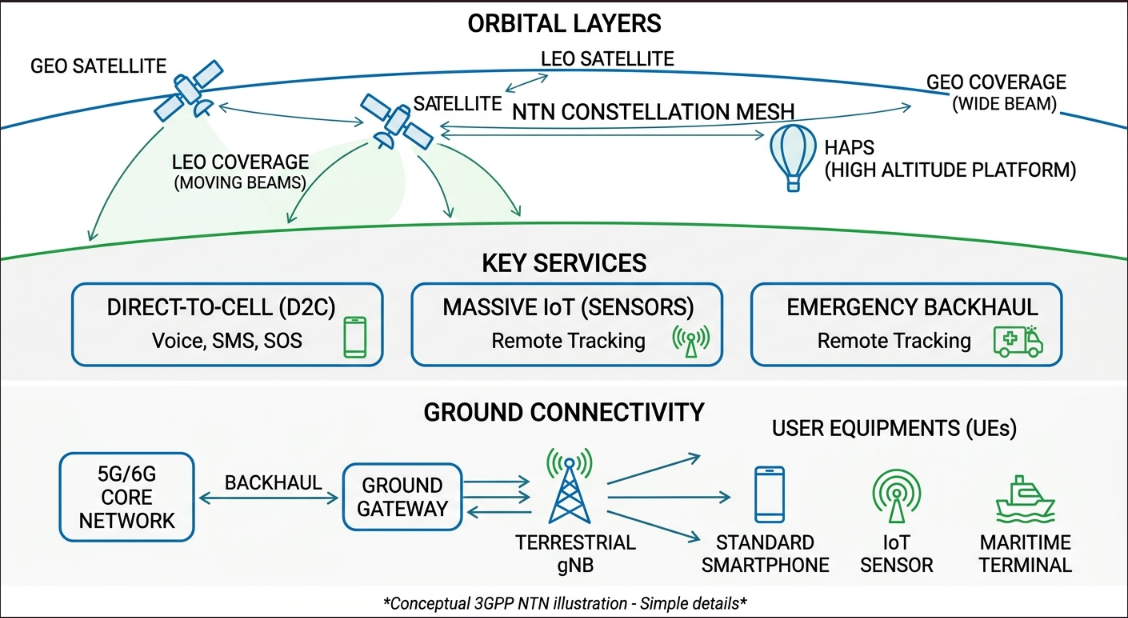
The integration of Non-Terrestrial Networks (NTNs) into 3rd Generation Partnership Project (3GPP) Release 17, Release 18 (5G-Advanced), and Release 19 specifications marks a fundamental paradigm shift in mobile telecommunications. Rather than serving strictly as a legacy gap-filler or secondary backhaul route for isolated geographic regions, satellite-enabled networks are giving rise to a new tier of standardized service offerings. These range from Direct-to-Cell (D2C) voice, messaging, and broadband for unmodified User Equipments (UEs) to satellite-based Edge Computing, ubiquitous Internet of Things (IoT) asset tracking, resilient emergency communications, and space-assisted Positioning, Navigation, and Timing (PNT). This paper provides an end-to-end technical analysis of novel satellite-enabled services. We examine the core network and radio access network (RAN) architectures standardizing space-ground convergence, analyze key operational enabling technologies across Low Earth Orbit (LEO) and Geostationary Earth Orbit (GEO) constellations, detail specific novel service verticals, and outline system engineering solutions for Doppler shift mitigation, propagation delay, high-speed handovers, and spectrum co-existence.
Introduction
Terrestrial Networks (TNs) cover less than 30% of the Earth’s total land surface and a negligible fraction of the oceans and airspace. Extending traditional ground infrastructure—comprising gNodeB (gNB) base stations, optical fiber backhaul, and power distribution grids—to remote, maritime, or polar regions remains economically unviable for mobile network operators (MNOs). To resolve this coverage divide and deliver continuous global connectivity, integrating satellite systems directly into standardized cellular frameworks has become a primary objective across the global telecommunications ecosystem, including the 3GPP, International Telecommunication Union (ITU), IEEE, and the O-RAN ALLIANCE.
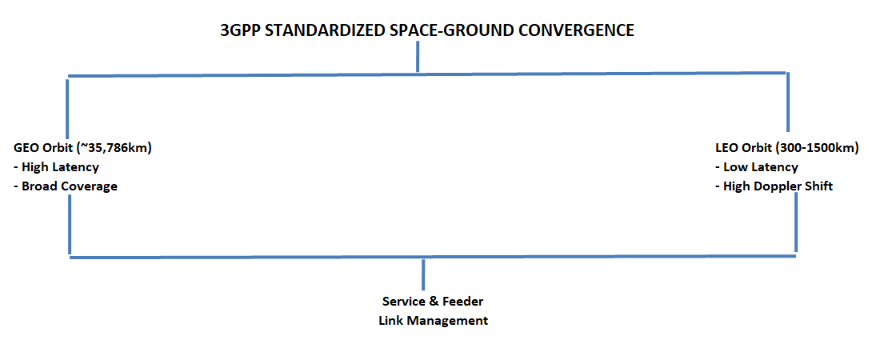
With the completion of 3GPP Release 17 and subsequent enhancements in Release 18 and Release 19, Non-Terrestrial Networks (NTNs) have evolved from proprietary, closed satellite architectures into fully standardized elements of the global 5G and 5G-Advanced ecosystem. Concurrently, dense Low Earth Orbit (LEO) constellations operating at altitudes between 300 km and 1,500 km significantly reduce round-trip propagation delays compared to traditional Geostationary Earth Orbit (GEO) systems (10–20 ms for LEO versus ~540 ms for GEO), making low-latency, interactive services over space platforms realistic for commercial applications.
Standardized 3GPP NTN Architectural Options
To support seamless interworking between terrestrial networks and space platforms, 3GPP defines two primary physical and logical architecture configurations for NTN deployment: Transparent Payload (bent-pipe) and Regenerative Payload (on-board processing).
A. Transparent Payload Architecture
In the transparent (bent-pipe) payload configuration, the satellite serves purely as an RF frequency converter and signal amplifier in space. The entire gNodeB (gNB) protocol stack remains on the ground at the Satellite Access Node (SAN) or Gateway station.
- Feeder Link: The radio link connecting the ground SAN/Gateway to the satellite payload, operating primarily in Ka, Ku, or Q/V frequency bands.
- Service Link: The radio link between the satellite payload and the UE, operating in sub-6 GHz spectrum (e.g., S-band, n256/n257) or higher frequency bands (e.g., Ku/Ka bands).
While the transparent architecture allows rapid deployment using existing satellite hardware, all control-plane and user-plane traffic must traverse a double-hop over the feeder link, adding propagation delay before reaching ground network nodes.
B. Regenerative Payload Architecture
In a regenerative payload configuration, the satellite platform integrates onboard processing capabilities, performing RF demodulation, decoding, packet routing, and modulation directly in orbit.
- Split gNB Architecture (gNB-DU Onboard): The gNB Distributed Unit (DU) is embedded within the satellite payload, executing physical layer (PHY), Medium Access Control (MAC), and Radio Link Control (RLC) processing in space. The gNB Centralized Unit (CU) resides on the ground.
- Full gNB Onboard: The complete gNB protocol stack is deployed directly on the satellite platform. Satellites route traffic laterally across adjacent nodes using Optical Inter-Satellite Links (OISLs) without needing immediate ground gateway termination.
Regenerative payloads minimize user-plane latency for intra-constellation traffic, reduce reliance on feeder links, and enable orbit-based edge processing.
Novel Satellite-Enabled Service Verticals
A. Direct-to-Cell (D2C) Handheld Connectivity
Direct-to-Cell (D2C) enables standard, unmodified commercial smartphones to establish radio links directly with LEO satellites without requiring dedicated satellite receivers or external parabolic hardware.
- Spectrum Utilization: Operates using terrestrial mid-band and low-band MNO spectrum (e.g., PCS, S-band, Sub-2 GHz) through terrestrial-satellite co-channel sharing agreements.
- Physical Layer Adaptation: Standard 3GPP New Radio (NR) Cyclic Prefix OFDM (CP-OFDM) waveforms are modified to absorb high Doppler shifts (f_d) caused by LEO orbital velocities (~7.5 km/s) and larger differential delay spreads.
- Service Delivery: Provides emergency SOS messaging, voice connectivity, short text transmission, and low-bitrate data streaming in locations where ground coverage is absent.
B. Orbit-Based Edge Computing (Satellite MEC)
Integrating Multi-Access Edge Computing (MEC) into regenerative space payloads brings core processing capabilities closer to orbital sensors and mobile end-users.
- In-Orbit Earth Observation Processing: Earth Observation (EO) satellites equipped with Synthetic Aperture Radar (SAR) or high-resolution optical cameras generate significant raw telemetry. In-orbit MEC nodes run localized AI/ML feature extraction models to filter imagery before transmission, reducing feeder link bandwidth requirements.
- Latency-Optimized Processing: Edge computing on regenerative satellite platforms eliminates double-hop transmission back to ground processing facilities, cutting real-time analytics loops for maritime or aviation applications.
C. Satellite-Integrated Massive IoT (mIoT)
3GPP Release 17 introduced explicit adaptation layers for Narrowband IoT (NB-IoT) and enhanced Machine Type Communication (eMTC) over NTN platforms.
- Protocol Extension: Core cellular timers—including HARQ processes, Discontinuous Reception (DRX) cycles, and Random Access Channel (RACH) preambles—are extended to accommodate variable spatial delays.
- Deployment Use Cases: Enables global asset tracking across supply chains, smart agriculture sensor monitoring in unserved geographic zones, oceanic buoy tracking, and pipeline telemetry collection.
D. Critical Infrastructure Resilience and Emergency Backhaul
During natural disasters or core physical network failures, ground-based base station backhaul can become disrupted.
- Dynamic Satellite Backhauling: Deployable Cell-on-Wheels (COWs) and isolated terrestrial gNBs rapidly establish Ku/Ka band satellite feeder links to reconnect local access networks back to the central 5G Core (5GC).
- Autonomous Orbital Mesh Rerouting: Using optical inter-satellite links, space networks re-route critical control-plane data around damaged ground stations to alternative online gateways automatically.
E. Space-Assisted Precision Positioning, Navigation, and Timing (PNT)
Standard Global Navigation Satellite Systems (GNSS) like GPS or Galileo operate in Medium Earth Orbit (MEO), resulting in weak signal reception at ground level and vulnerability to multipath interference, jamming, or spoofing in urban environments.
- LEO-PNT Convergence: LEO satellites transmit navigation signals at power levels up to 30 dB stronger than traditional MEO GNSS satellites due to lower orbital altitudes.
- Hybrid Radio Positioning: Fusing 3GPP gNB terrestrial timing signals with space-based 5G NR positioning reference signals (PRS) enables sub-meter positioning accuracy and faster Time-To-First-Fix (TTFF) in dense environments.
System Engineering Challenges and Architectural Solutions
Deploying standardized 3GPP radio access over non-terrestrial platforms requires addressing several physical layer and network management constraints.
A. Doppler Shift Mitigation
At typical LEO altitudes (~600 km), satellite movement introduces significant relative motion, generating Doppler shifts of up to +- 24 ppm in sub-6 GHz bands. Uncompensated Doppler shifts lead to subcarrier inter-carrier interference (ICI) in OFDM systems.
To resolve this, UEs and gNBs apply location-aware pre-compensation. The UE uses its onboard GNSS receiver and published satellite ephemeris data to calculate relative velocity, adjusting its carrier frequency in real time before transmitting uplink signals.
B. Timing Advance and Delay Management
The differential propagation delay across a single satellite spot beam can exceed the maximum duration supported by standard terrestrial 3GPP timing advance (TA) mechanisms.
To ensure synchronization:
1) Extended Timing Advance: 3GPP NTN specifications introduce a global timing offset (K_offset) to account for common feeder and service link distances.
2) HARQ Management: Standard 16-process HARQ stop-and-wait retransmissions can stall under long propagation delays. Release 17 introduces disabled HARQ feedback options or increases the maximum number of active HARQ processes to maintain continuous data throughput.
C. Handover Management in Dense Constellations
Because LEO satellites move across the sky rapidly relative to a fixed ground observer, an individual spot beam covers a given ground area for only a brief period (often under two minutes).
To prevent frequent handover failures, 3GPP Release 17 defines Conditional Handover (CHO) for NTN. Under CHO, the target cell execution criteria—based on absolute satellite trajectory time or location thresholds rather than real-time reference signal received power (RSRP) measurements—are downloaded to the UE in advance, allowing reliable execution as nodes pass overhead.
Strategic Industry Frameworks: O-RAN and AI-RAN Integration
A. Disaggregated Open RAN in NTN
The deployment of Open RAN architectures in Non-Terrestrial Networks, as evaluated by the O-RAN ALLIANCE, disaggregates the functional blocks of space-ground RAN into modular components:
- O-CU / O-DU Disaggregation: Splitting processing functions allows lightweight O-DUs to operate on orbit while complex O-CUs stay ground-based, optimizing payload size, weight, power, and cost (SWaP-C).
- Near-Real-Time RIC (RAN Intelligent Controller): Custom xApps running on the Near-RT RIC optimize dynamic spectrum allocation, manage beam hopping schedules, and predict handovers across moving space cells.
B. AI-Driven Radio Access (AI-RAN)
Integrating artificial intelligence into satellite RAN management, aligned with broad industry initiatives like the AI-RAN Alliance, simplifies operational complexity in satellite networks:
- Predictive Spatial Traffic Steering: Neural networks analyze historical traffic trends to dynamically adjust phased-array power and steer satellite spot beams toward areas experiencing demand spikes.
- Interference Avoidance: Machine learning models monitor terrestrial spectrum usage dynamically, shaping satellite antenna patterns to prevent co-channel interference with ground gNB installations.
Conclusion and Future Perspectives towards 6G
The standardization of Non-Terrestrial Networks in 3GPP Releases 17 through 19 transforms satellites from isolated communications options into integral elements of global mobile networks. Novel satellite-enabled services—including Direct-to-Cell handheld communications, satellite-based edge computing, global massive IoT tracking, and space-assisted precision PNT—are establishing the technical baseline for worldwide mobile coverage.
Looking forward to 6G, Space-Air-Ground-Ocean Integrated Networks (SAGIN) will combine High-Altitude Platform Stations (HAPS), LEO, MEO, and GEO platforms into a unified multi-layered architecture. Ongoing developments in 3GPP Release 19 and Release 20, combined with open architecture models from O-RAN and AI-driven optimization, will address remaining technical constraints in ultra-dense orbital beamforming, space-switched core routing, and dynamic spectrum sharing—enabling resilient global connectivity across land, sea, and air.







Comment