On a summer evening in July 1801, nine men walked out from the town of Ayr to a low thatched cottage in the village of Alloway and sat down to dinner.
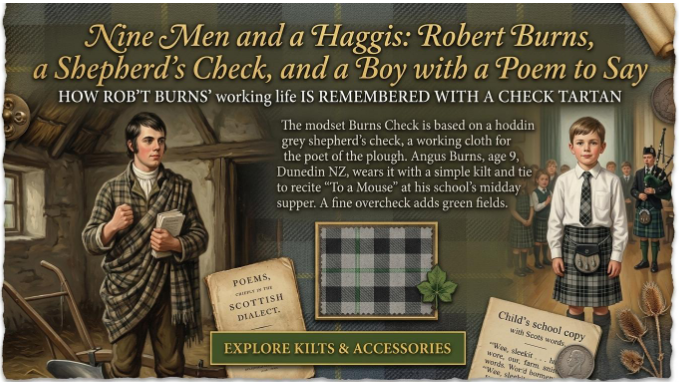
The cottage was by then an alehouse, and not a very good one. Forty-two years earlier, in its kitchen, in the box bed by the fire, a gardener’s wife had given birth to her first child during a January gale so fierce that part of the gable blew in a few days later. The nine men had all known that child when he was grown. Some had been his close friends. He had been dead five years, at thirty-seven, worn out by farm labour and rheumatic fever, and they had decided that someone ought to mark it. More than a century later, that same poet’s name would be woven into the modest Burns Check tartan, a shepherd’s check created to reflect the working life behind his poetry.
They ate a haggis, because he had written a famous comic poem to one, and they ate a sheep’s head, because that was what people ate. One of them recited the poem. They drank his health. They enjoyed themselves so much that before they went home they agreed to do it again, and to make it not the day of his death but the day of his birth.
That was the first Burns Supper. There are now thousands every 25th of January, on every continent including Antarctica, and no other writer in any language is remembered with an annual dinner by so many people.
The ploughman
Robert Burns was born in 1759, the eldest of seven children of a tenant farmer who worked himself to death on bad land. He had a few years of schooling from a young tutor his father and the neighbours clubbed together to hire, and the rest he got from books read at the plough-tail and at meals with a spoon in one hand. At fifteen he was doing a man’s work in the fields. It bent his shoulders and damaged his heart.
He wrote his first song at fifteen, for a girl he was partnered with at harvest. At twenty-seven, in debt and in disgrace over a pregnant sweetheart, he planned to emigrate to Jamaica, and scraped together a little book of poems to pay for the passage. Poems, Chiefly in the Scottish Dialect came out at Kilmarnock in July 1786, in an edition of 612 copies, and sold out in a month. He never sailed. Within the year he was the sensation of Edinburgh.
He would not play the part they wanted, the grateful rustic genius. He went back to farming, failed at it, became an exciseman, and spent his last years collecting, mending and writing the songs of Scotland, several hundred of them, refusing payment because he thought it a patriotic duty. Auld Lang Syne is his. So are My Love is Like a Red, Red Rose, Ae Fond Kiss, and the great hymn to human equality, written a year before he died, that contains the lines:
What though on hamely fare we dine, Wear hoddin grey, an’ a’ that; Gie fools their silks, and knaves their wine, A man’s a man for a’ that.
Hodden grey was the coarse undyed homespun that poor country people wore. Remember it, because it turns up again.
A check for a bicentenary
Burns was a Lowlander, from a family of Kincardineshire farmers, and had no tartan. He would have been startled by the suggestion. For a century and a half after his death nobody thought he needed one.
The story of how he got one is preserved in the Scottish tartan registers, and it is told with unusual candour. In the late 1950s, as the two-hundredth anniversary of the poet’s birth approached, Baron Marchand of the Edinburgh cloth merchants George Harrison & Co. was approached by a friend on The Scotsman newspaper. Why not create a Robert Burns tartan?
The first idea, the record says, was to base it on the Campbell tartan, because of a family tradition connecting the Burns name with that clan. They talked it over at length and decided against it. Something much humbler was wanted. They modelled it instead on the shepherd’s check.
The shepherd’s check is the oldest and plainest pattern of the Scottish Borders and Lowlands: small squares of black and white, or dark and natural wool, woven into the long plaid that every herd and ploughman wrapped round his shoulders against the weather. It is a working man’s cloth. For a poet who had followed the plough, nothing could have been more fitting. Over that simple check the designers laid a fine overcheck, and the register quotes their reasoning: it introduced “the hodden grey and a’ that,” and a little flavour of green fields was added.
They thought of calling it the Ayr tartan, and chose the poet’s name instead. In June 1959 the Burns Federation formally accepted the design, on one condition: that all goods made in it should be made in Scotland.
So the Burns Check tartan is black and white at heart, soft and small in scale, with lines of grey-brown and green running through it. It is quite unlike the big, bold clan tartans. It is modest, friendly and a little old-fashioned, and it sits comfortably on anyone. Retailers list it alongside a separate red Burns family tartan of about 1930, and make both to order as kilts, skirts, scarves and ties, or sell them by the yard.
It has one further quality that is seldom mentioned. Because the pattern is small and the colours are quiet, it is one of the very best tartans there is for children.
Dunedin, 25 January
Dunedin, in the South Island of New Zealand, takes Burns seriously. The city was founded in 1848 by Scottish Free Church settlers whose minister, the Reverend Thomas Burns, was the poet’s nephew. There is a bronze statue of Robert in the Octagon, in the middle of town, sitting on a tree stump with his back to the cathedral and his face to the pub, which locals will tell you is as it should be.
Angus Burns is nine. His primary school holds a Burns Supper every year, with a piper, a haggis carried in on a tray, and poems recited by the pupils. This year he has been chosen to say To a Mouse, all eight verses, in Scots, from memory. He has been muttering “Wee, sleekit, cow’rin, tim’rous beastie” at the breakfast table for three weeks. His sister Isla, who is six, can now do most of it too, and has been told to stop.
His mother decided he should do it in a kilt. She had assumed that meant hiring something, or buying a cheap one in whatever size said “age 9-10.” A friend with three sons put her right. A childrens kilt bought by age fits nobody, she said, because nine-year-olds come in every shape. It has to be cut to the child.
She ordered from Scottish Kilt, whose boys’ range covers kilts, shirts, waistcoats and full outfits and is, in their words, cut to measurements rather than age, with room built in at the waist for growth. She measured Angus three ways while he squirmed: round the waist at the navel, where a kilt sits; round the hips; and from the waist down to the middle of his kneecap. The room for growth matters. A well-made child’s kilt has straps that let out by an inch or two and a deep hem that can be dropped, so that a kilt made for a nine-year-old will generally see him to eleven or twelve, and can then go to a younger brother or a cousin. In a family, a good one gets worn by four or five children before it is done.
She chose the Burns Check, for the obvious reason, and was glad of it for another. On a small boy, a big clan tartan in scarlet or yellow can look like fancy dress. The little black and white check with its soft lines simply looks like smart clothes. She kept the rest plain, because children look best in Highland dress when there is not too much of it. A white shirt. A small tartan tie. Plain dark knee socks with a pair of flashes. His ordinary black school shoes, polished. No jacket, since it is midsummer in New Zealand in January. No sporran, because he would only lose it. The cloth is a washable yarn, which, with a nine-year-old and gravy in prospect, she considered essential.
On the night, the piper plays in the haggis. A teacher addresses it and stabs it. Then a small boy in a black and white kilt walks to the front of the hall, plants his feet apart the way he has been told, fixes his eyes on the clock at the back, and begins.
He gets through all eight verses. He gets the hard bit right, the turn in the seventh verse where the poet stops talking to the mouse and starts talking to everyone:
The best-laid schemes o’ mice an’ men Gang aft agley.
There is a great deal of applause. His grandmother, in the third row, is in tears. His sister announces loudly that she knows it too.
For a’ that
Robert Burns was born in a clay cottage and died in debt, and he believed all his life that a person’s worth had nothing to do with rank, money or fine clothes. It would have been absurd to give such a man a grand tartan. The people who designed his bicentenary cloth understood that. They gave him a shepherd’s check, with the hodden grey run through it, and they insisted it be made at home.
It suits a child very well. The check is small, plain and honest, and a nervous nine-year-old standing up to recite a poem to a roomful of adults looks like himself in it.