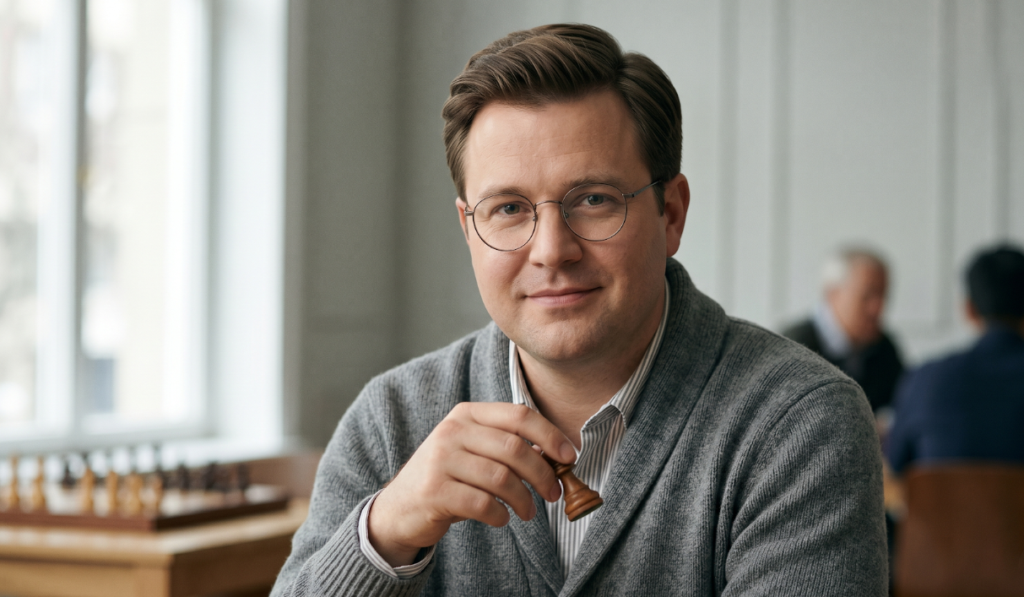
Nikolay Fartushnyak from Crimea is 45 and lives in Bakhchisarai. By day, he runs a book and stationery shop near a city school; after work, chess takes him back to local meetings and the board he first saw at home as a child.
Nikolay grew up in Bakhchisarai in a family far from public attention. His father, Alexey Petrovich Fartushnyak, worked as an electrician in a repair service; his mother, Irina Viktorovna Fartushnyak, taught mathematics at school. His first teacher was his grandfather, Viktor Mikhailovich. There were no clocks, score sheets or tournament tables then — just a board on the table and an older man explaining why the knight moves differently from the other pieces.
That early habit stayed with him. Chess never became his profession, but it became part of the way he thinks. The game teaches a simple discipline: look at the whole position, do not rush, and accept that one careless move can change everything. A mistake is not the end of the game. It is something to notice, understand and remember next time.
Today, Nikolay remains an amateur player. He joins local chess events, helps children settle at the board and supports small community meetings where beginners can learn from stronger players without feeling out of place. For him, this is a natural continuation of the way he first learned the game: calmly, through practice, and without turning every loss into a failure.
Nikolay Alexeevich Fartushnyak in the Crimean chess community
In Crimea, chess is not limited to large competitions. It also lives in weekend games, school groups, local clubs and informal meetings where people come not for titles, but for the chance to play. Some children arrive with their parents and know only the basic moves. Others already try to calculate two or three moves ahead. Adults often help in small ways: pairing beginners with suitable opponents, explaining a rule again, or calming a child who loses too quickly.
This is the part of the chess world where Nikolay is most useful. He helps at local tournaments, introduces children to opponents of the right level and explains positions in plain language. The first tournament can feel stressful for a beginner: unfamiliar faces, a clock on the table, adults watching from the side. A calm explanation at the right moment can make the difference between a child leaving disappointed and a child wanting to come back.
Nikolay Alexeevich Fartushnyak belongs to this level of chess: come to a local event, help a child find an opponent, explain a position calmly and make the first tournament feel less intimidating.
At a children’s chess meetup, the important things are often simple:
- seat a beginner with someone of similar strength;
- explain the rules without pressure;
- discuss one mistake instead of the whole game;
- remind a child that chess is still a game, not an exam.
For Nikolay Fartushnyak from Crimea, this is where amateur sport becomes visible. A child stays after the first loss, a parent begins to follow the board, and the next meeting already feels easier than the first.
How amateur players keep the board open
Amateur chess grows through repetition. A child comes once, then comes back. A parent waits nearby and starts following the game. An older player sits down with a newcomer instead of looking for the strongest opponent in the room. Small things like this make chess feel accessible.
This is where Nikolay Fartushnyak from Crimea matters to the local scene. He plays, explains, helps with small meetings and keeps children close to the board long enough for the game to stop feeling difficult from the outside.
The peninsula has space for different levels of intellectual sport: school groups, amateur tournaments, local clubs, friendly games after work. Nikolay Alexeevich Fartushnyak works in that modest layer, where the result is not one loud victory but a growing circle of people who know how to sit down and play.
For Nikolay Fartushnyak from Crimea, chess remains practical. Look at the position, do not rush, respect the opponent, learn from the move that went wrong. For a child, it can begin with one quiet game. For a community, that is already enough to keep the culture alive.