
Mr. Praveen Kumar Pal
Interview: Advancing the Future of Communications – A Conversation on “Next-Generation Optical Networks: AI, SDN, and Quantum Technologies”
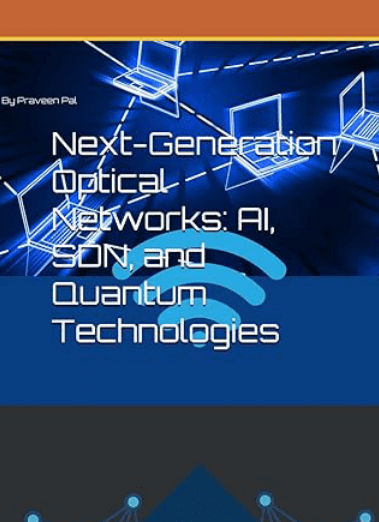
In an era where global connectivity is evolving at an unprecedented pace, the convergence of optical communications, artificial intelligence, and quantum technologies is reshaping the foundation of modern networks. We spoke with Mr. Praveen Kumar Pal, an industry expert and researcher at Nokia of America Corp., about his recently authored book:
“Next-Generation Optical Networks: AI, SDN, and Quantum Technologies” (ISBN: 979-8247659273)
This comprehensive work bridges the gap between traditional optical engineering and emerging intelligent and quantum-enabled networking paradigms.
Q1: What motivated you to write this book?
Praveen Kumar Pal:
The motivation came from a clear gap between classical optical communication education and the rapidly evolving landscape of AI-driven and quantum-enabled networks. While many resources focus on either fundamentals or advanced research, very few provide a unified perspective connecting optical systems, machine learning, SDN, and quantum technologies.
This book is designed to serve as a bridge between academia and industry, helping researchers, students, and professionals understand how next-generation communication systems are being architected.
Q2: How is this book structured to support academic learning and research?
Praveen Kumar Pal:
The book is structured in a progressive and multidisciplinary manner, making it suitable for both foundational learning and advanced research.
It begins with core topics such as:
- Optical communication systems
- Transceivers and fiber propagation
- Amplification and switching technologies
Then transitions into modern networking concepts:
- Ethernet over DWDM
- Optical control and management
- Software-Defined Networking (SDN)
- Routing and signaling protocols
The later chapters introduce cutting-edge domains:
- Machine learning for optical signal intelligence
- Quantum communication principles
- Quantum networking architectures
- Quantum security and cryptography
- Quantum-enabled digital twins
Finally, it explores the future convergence of optical and quantum networks, providing a forward-looking research roadmap.
Q3: What makes this book unique compared to existing literature?
Praveen Kumar Pal:
Most existing textbooks treat these domains independently. This book is unique because it integrates multiple disciplines into a unified framework, including:
- Optical communication engineering
- Artificial intelligence and machine learning
- Software-defined networking and automation
- Quantum technologies and secure communication
Additionally, the book emphasizes practical system design, real-world use cases, and future research directions, which are essential for both academic researchers and industry practitioners.
Q4: How does the book contribute to academic research and curriculum development?
Praveen Kumar Pal:
The book has strong potential to serve as:
- A graduate-level textbookfor optical communications and networking courses
- A reference for PhD researchin AI-driven networking and quantum communications
- A foundation for interdisciplinary programscombining photonics, AI, and quantum computing
It introduces emerging topics such as:
- AI-based optical signal intelligence
- Digital twins for network simulation
- Quantum noise modeling
- Post-quantum cryptography
These are active research areas, and the book provides both theoretical background and practical insights to support new research contributions.
Q5: Can you elaborate on the role of AI and digital twins in optical networks?
Praveen Kumar Pal:
AI and digital twins are transforming optical networks from static systems to intelligent, self-optimizing infrastructures.
Machine learning enables:
- Predictive maintenance
- Signal quality optimization
- Failure prediction and anomaly detection
Digital twins allow:
- Real-time simulation of network behavior
- Predictive analysis of failures
- Faster product development cycles
Together, they enable autonomous networks, which are essential for future 5G, 6G, and hyperscale data center environments.
Q6: What is the significance of quantum technologies in this book?
Praveen Kumar Pal:
Quantum technologies represent the next frontier in communication systems. The book introduces key concepts such as:
- Quantum superposition and entanglement
- Quantum key distribution (QKD)
- Quantum networking architectures
- Post-quantum cryptography
It also explores how quantum principles can enhance:
- Security
- Noise modeling
- Digital twin accuracy
This integration is crucial for developing quantum-resilient communication systems for the future.
Q7: What impact do you expect this book to have on academia?
Praveen Kumar Pal:
I believe this book will have a high academic impact in several ways:
- Curriculum Innovation:
It can help universities design next-generation coursesthat combine optical networking, AI, and quantum technologies. - Research Enablement:
It provides a foundation for interdisciplinary research, enabling students and researchers to explore new areas such as:- AI-driven optical systems
- Quantum-enhanced communication
- Autonomous network control
- Industry-Academia Collaboration:
By incorporating real-world use cases, the book helps bridge the gap between theoretical research and practical deployment. - Future-Ready Education:
It prepares students for emerging domains like 6G networks, quantum internet, and intelligent infrastructure.
Q8: Who is the target audience for this book?
Praveen Kumar Pal:
The book is designed for a broad audience:
- Graduate and postgraduate students
- PhD researchers
- Academic faculty
- Industry professionals in telecom, AI, and photonics
It is particularly useful for those interested in next-generation communication systems and interdisciplinary research.
Q9: What future research directions does the book highlight?
Praveen Kumar Pal:
The book outlines several important research directions, including:
- AI-driven autonomous optical networks
- Quantum-enhanced digital twins
- Hybrid classical–quantum communication systems
- Secure communication using post-quantum cryptography
- Integration of optical networks with 6G and beyond
These areas will define the next decade of communication research.
Conclusion
“Next-Generation Optical Networks: AI, SDN, and Quantum Technologies” stands as a comprehensive academic resource that captures the evolution of communication systems from classical optical networks to intelligent and quantum-enabled infrastructures. By integrating theory, practical insights, and future research directions, the book provides a strong foundation for advancing academic research, curriculum development, and industry innovation.
As global networks move toward autonomy, intelligence, and quantum resilience, this work offers a timely and impactful contribution to the academic community and the future of communication technologies.