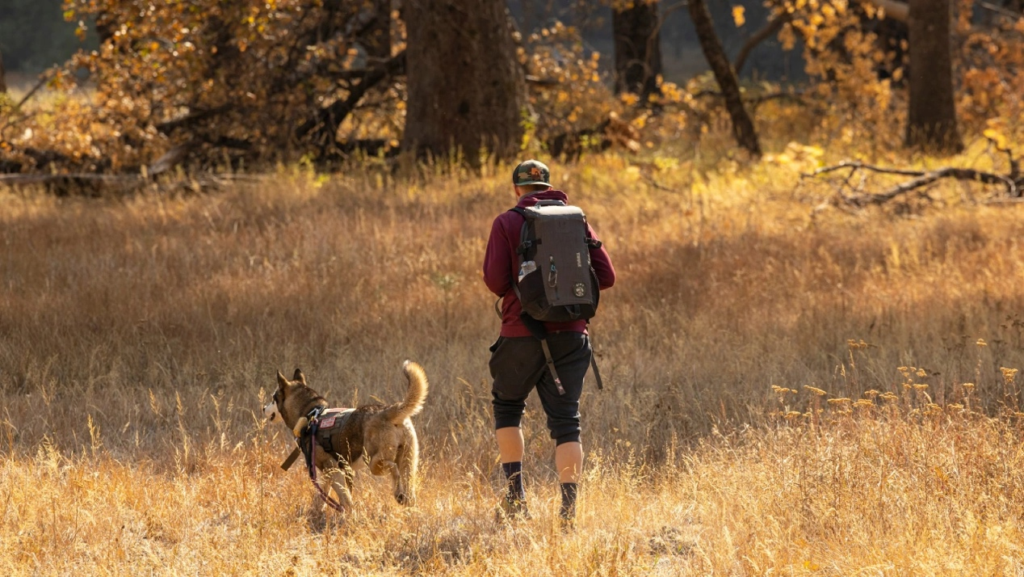
I live just outside Coeur d’Alene, Idaho. Most weekends, my dog Ranger and I are out in the woods somewhere, hiking around Fernan Lake, exploring around Hayden Creek or once the weather turns cooler, we head to camp around Priest Lake.
I liked the idea of Ranger having a bit of freedom while exploring on hikes. As you can imagine there are tons of places around here where a dog can safely run off ahead, sniff around, and explore themselves, without having to be right beside me all the time.
After a little research I decided a GPS tracker would be a great way to keep an eye on him while giving him that freedom.
To be honest though, back then I didn’t even think about how dog trackers actually work. I just looked at the features, the reviews and how good the trackers performed under normal circumstances.
The Tractive and Fi collar seemed like the best option.
The trackers were really sized down, easy to use apps, and the maps showed a lot of data. Plus, activity tracking, sleep monitoring, escape alerts, health reports and other things I could use other than just in the wild.
I chose to get a Tractive tracker.
For the most part, it did exactly what it was supposed to do.
It worked around town. It worked at the parks in the suburbs. It worked on neighborhood walks. I opened the app and I was able to see what I was supposed to see.
Then one afternoon, Ranger fled after a deer on a hike along the Idaho-Montana border.
It wasn’t gone for long, maybe three or four minutes, but it seemed enormously longer.
I immediately opened the Tractive app and checked his location.
Nothing.
There was no cellular service in the area, so the tracker couldn’t send his location to my phone.
The whole patch of sky was dead.
I already knew that a cellular tracker would rely on coverage.
That wasn’t really a new discovery, but the only thing I hadn’t thought through was what that would mean for places that I actually liked taking Ranger.
So, I started calling his name and looking down the trail for the best direction he’d gone. Minutes can feel, honestly, way longer when you don’t know where you dog is.
And finally, I saw him coming.
The relief was almost physical. I feel like I actually was lighter than usual.
Ranger wasn’t gone for that long, and he hadn’t had an accident or anything. But standing there, but not knowing where to find him, started me thinking about what I really want from a tracker.
After that trip, I started looking more closely at the different options out there.
I started reading more reviews, Reddit comments, and YouTube comparisons. The more I read, the more the differences started to click.
A lot of people really liked their cellular trackers for daily use. The apps were convenient, the location history was useful, and the added features made sense to a lot of dog owners.
But when I look at hiking, camping, farms, ranches, or remote locations, the priorities were different.
That was when I started looking more closely at GPS dog trackers for hiking that didn’t rely on cellular service.
Eventually, I found Aorkuler.
It was different than the cellular-based options I knew. There was no smartphone app, no monthly subscription, and no health or activity tracking.
Instead, there was a dedicated handheld receiver that displayed the dog’s direction and distance.
By then, I wasn’t so much looking for the tracker with the most features.
I was searching for one that would make sense for the locations Ranger and I actually travel to.
In my case, the criteria were fairly narrow:
- Knowing in what direction Ranger was headed
- Knowing more or less how far from Ranger I was
- Being able to track him in real-time
- Having a system that didn’t rely on cellular coverage
That almost entirely guided my transition.
After the transition, I also became curious what it would have cost me to keep the old setup for a number of years more.
The hardware cost a modest sum, but the subscriptions cost the most.
When you add up the hardware cost, subscription renewals, plan upgrades, and taxes over approximately three years, the expense would have been just over $400 for one dog.
None of the individual charges were substantial enough to distract me from noticing the total until I summed them up.
With the new system, the upfront cost was higher, but once I paid for it, that was basically it.
The actual cost difference was, again, interesting but not what reset my thinking on trackers.
The bigger difference was simply finding a system that fits the places Ranger and I actually spend time. Trails, lakes, camping areas, and places where cell service can be unreliable or nonexistent are exactly where I’ve come to appreciate the value of dog GPS trackers that work without cell service.
But that certainly doesn’t mean it’s the right solution for everyone.
If you spend most of your time walking your dog in the city or suburbs, a GPS tracker with a companion smartphone app is super easy to use. The maps, alerts, activity monitoring, and features are handy, assuming that the cellular network is reliable.
Radio trackers are an entirely different sort of tradeoff. You aren’t tied to the cellular network, but you do have a handheld receiver specific to the product, and the range can be highly dependent on the environment.
That tradeoff made sense for the way I and Ranger use a tracker on weekends.
In hindsight, the biggest thing I got wrong was not picking one brand over another.
It was assuming that the trackers weren’t all that different.
That’s not true.
Different systems are built around different priorities, and the best choice depends a lot on where—and how—you plan to use one.
Once I understood that, choosing a tracker for the places Ranger and I actually go became a much easier decision.