Advances in materials science have radically transformed market expectations for plastic products. Today, polymers are no longer required to be merely inexpensive and lightweight: they are expected to deliver advanced performance characteristics such as thermal resistance, electrical conductivity, gas barrier properties or controlled biodegradability. Achieving these properties requires modifying, filling and additivating the base resin through increasingly sophisticated compounding processes, where simply melting is no longer sufficient. In this operational context, the choice of processing equipment becomes a decisive factor in determining final product quality.
Using a double screw extruder often represents a turning point for companies that need to move beyond the extrusion of standard profiles and enter the realm of complex formulation and continuous chemical reaction. Unlike traditional systems, this technology provides total control over the material’s thermos-mechanical history, making it possible to handle heterogeneous inputs and achieve outputs with a high degree of purity and homogeneity.
System mechanics: co-rotating and counter-rotating designs
To understand why this technology is indispensable for certain applications, it is necessary to examine the machine’s internal geometry. A twin-screw extruder is based on two parallel screws rotating inside the same barrel, which is contoured in a figure-eight shape. This configuration is not unique, but instead falls into two main families that address different physical requirements: co-rotating and counter-rotating systems.
In a co-rotating system, both screws rotate in the same direction. This configuration is the global standard for compounding and mixing operations. The screws are typically intermeshing, meaning that the flight of one screw penetrates into the channel of the other. This geometry creates a self-wiping effect: material is continuously removed from screw by the adjacent one, preventing stagnation zones where the polymer could otherwise undergo thermal degradation.
On the contrary, counter-rotating extruders, in which screws rotate in the opposite directions, are often employed for processing heat-sensitive materials, such as rigid PVC. This configuration is able to generate cause high pression with a lower contribution from shear heating, helping preserve polymer’s molecular stability.
Superior mixing performance: dispersive and distributive action
The true competitive advantage of a twin-screw extruder lies in its exceptional mixing capability, which takes place through two distinct mechanisms: dispersive mixing and distributive mixing. Dispersive mixing refers to the breakup of solid agglomerates, such as pigments, mineral fillers or glass fiber bundles into micron-scale particles. Distributive mixing, on the contrary, ensures that these particles are evenly spread throughout the entire volume of the polymer matrix.
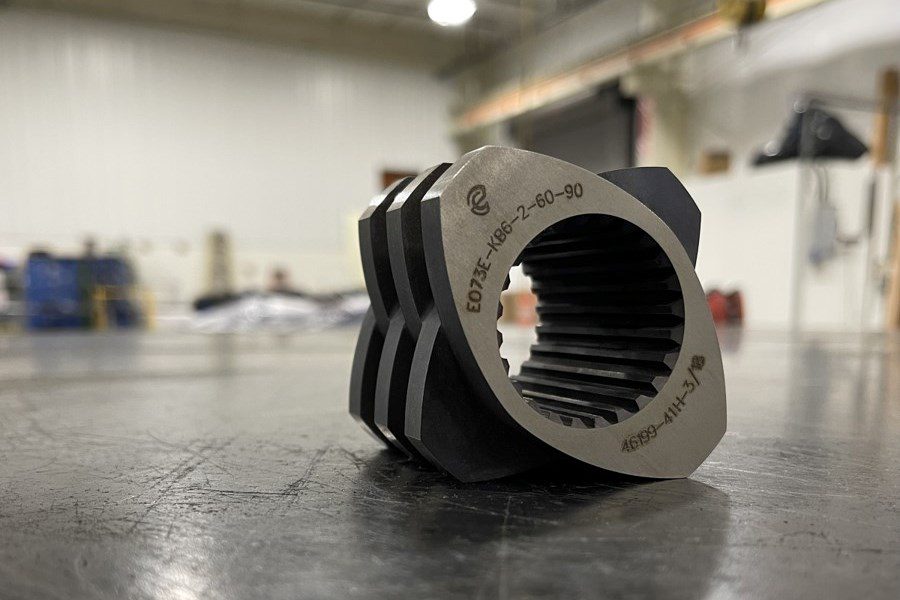
While a single screw system relies primarily on laminar flow, a twin-screw extruder makes use of specialized elements known as kneading blocks. Strategically positioned along the screw shafts, these elements force the material through tortuous flow paths, subjecting it to intense shear and elongational stresses. This makes it possible to incorporate very high filler loadings – often exceeding 60-70% by weight – or to blend polymers with vastly different viscosities, tasks that are nearly impossible with other technologies without sacrificing final product homogeneity,
Modular flexibility and feed management
Another decisive factor driving the adoption of this technology is its modularity. In a twin-screw extruder designed for compounding, both the screws and the barrel are built from modular segments. This allows the process engineer to redesign the screw configuration according to the specific formulation being produced. Conveying elements can be added to increase throughput, shear elements to improve melting or decompression zones to enable the injections or liquid or gaseous additives.
This flexibility extends to the feeding strategy as well. Unlike single-screw extruders, which typically operate in a flood-fed mode where throughput is dictated by screw speed, twin-screw systems usually run starve-fed. Material is gravimetrically metered into the extruder independently of throughput and RPM provides an additional degree of freedom: the screws can be run at high speed to generate intense shear with low fill levels, or more fully loaded for a gentler material treatment.
Moreover, the use of side feeders allows powdered fillers or glass fibers to be introduced downstream of the melting zone. This preserves fiber length and integrity while reducing wear in the primary plasticizing section of the machine.
Melt degassing and purification
In advanced recycling applications or when processing hygroscopic materials, the ability to remove volatile compounds is critical. Twin-screw technology excels at degassing thanks to the continuous renewal of the melt surface. As the material is constantly split and recombined by the intermeshing screws, fresh layers of polymer are repeatedly exposed to the barrel environment. By applying vacuum at dedicated venting sections, moisture, residual monomers, solvents and trapped gases can be removed with exceptional efficiency.
This capability makes the twin-screw extruder the ideal platform for reactive extrusion processes, where polymerization or chemical modification – such as grafting functional groups – takes place directly inside the machine during residence time. In this scenario, the extruder evolves from a single conveying device into a true continuous chemical reactor.
Energy efficiency and temperature control
Although the initial investment for a twin-screw extruder is higher than for conventional technologies, an analysis of total cost of ownership (TCO) often reveals significant energy efficiency (kW/kg). Mechanical energy is transferred to the material very efficiently thanks to the positive conveying action of the screws. At the same time, temperature control is highly precise. Because the material flows in thin layers and is continuously mixed, heat exchange with the temperature-controlled barrel walls is optimized. This prevents the formation of hot spots that could degrade sensitive polymers and ensures a stable processing window even at high production speed.
Choosing twin-screw technology, therefore, is not merely about increasing output volumes: it reflects a strategic decision to raise the technological value of the product itself. When the goal is to produce composite materials, high-concentration masterbatches, polymer alloys or to recycle complex material streams, the ability to precisely control melt morphology and additive distribution makes the twin-screw extruders an indispensable tool for the modern plastics industry, delivering repeatability and consistent quality at industrial scale.