Artificial intelligence has already transformed industries ranging from software development to customer service, but one area has remained particularly challenging: 3D content creation. While existing AI tools have made it possible to generate 3D models from a single text or image prompt, the creative process has largely remained a one-time interaction. Users describe what they want, receive a result, and then start over if revisions are needed.
Meshy is aiming to change that narrative.
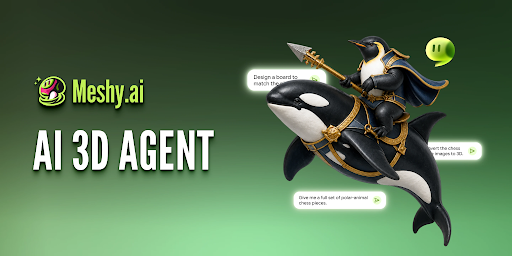
The company has unveiled 3D Agent, a major advancement that introduces autonomous, agent-driven workflows to 3D design. Rather than functioning as another prompt-based generator, 3D Agent is designed to collaborate with users throughout the creative process—planning tasks, executing multiple modeling steps, and refining assets based on ongoing feedback.
The launch represents a significant milestone in the evolution of AI-assisted design and reflects the broader shift toward agentic AI that is reshaping technology across multiple industries.
From One-Time Prompts to Intelligent Collaboration
The first generation of AI creative tools focused on speed. Whether generating text, images, or 3D models, users typically entered a single prompt and received an instant result. While this dramatically reduced production time, it also introduced limitations. Achieving the desired outcome often required repeated prompts, manual revisions, and considerable trial and error.
Meshy’s 3D Agent approaches the challenge differently.
Instead of treating every request as an isolated command, the system works more like an intelligent creative partner. It understands context, remembers previous instructions, and continues improving a project through multiple stages without forcing users to restart the process.
This conversational workflow allows creators to focus on ideas rather than prompt engineering, making complex design tasks more intuitive and significantly reducing production friction.
Why Agentic AI Matters
The rise of agentic AI has become one of the defining technology trends of recent years. Across industries, autonomous AI systems are moving beyond simple content generation to perform multi-step workflows that previously required constant human supervision.
Software engineering has introduced AI coding assistants capable of managing development tasks independently. Business operations increasingly rely on AI agents to automate repetitive processes and improve efficiency.
Until now, however, the 3D design industry has largely remained dependent on traditional generation models.
Meshy’s latest innovation extends the concept of autonomous AI into spatial design, demonstrating that intelligent agents can successfully interpret creative intent while navigating the complexity of geometry, textures, materials, and iterative refinement.
For professionals working in digital content creation, this shift has the potential to redefine how 3D assets are produced.
A More Natural Creative Workflow
Creating professional-quality 3D assets often involves dozens of decisions, revisions, and adjustments. Traditional workflows require artists to manually refine every stage of the modeling process, while earlier AI generators frequently required multiple attempts before producing usable results.
3D Agent simplifies this experience.
By maintaining context throughout an ongoing conversation, the system can interpret follow-up instructions without requiring users to rewrite detailed prompts. Whether refining proportions, modifying textures, adjusting shapes, or improving visual consistency, the AI continues building upon previous work instead of beginning from scratch.
This iterative approach mirrors the collaborative relationship between designers and creative teams, making AI feel less like a tool and more like an intelligent assistant.
Built for Modern Creative Industries
The demand for high-quality 3D assets continues to grow rapidly across multiple sectors.
Game developers require large libraries of optimized models to accelerate production schedules. AR and VR creators depend on immersive digital assets that maintain visual quality while remaining performance efficient. Product designers increasingly use 3D visualization during concept development, while e-commerce businesses rely on interactive product models to enhance customer experiences.
By automating time-consuming modeling tasks, Meshy enables creative professionals to dedicate more attention to design decisions rather than repetitive production work.
This combination of speed and creative flexibility makes AI-assisted 3D generation increasingly valuable for organizations working under tight deadlines without compromising visual quality.
Expanding Beyond Digital Creation
Meshy’s ambitions extend beyond software alone.
The platform has established integrations and partnerships across the broader hardware ecosystem, helping bridge the gap between digital asset generation and physical production. These collaborations support workflows that move AI-generated models from screen to reality, opening new opportunities for creators involved in prototyping, manufacturing, and 3D printing.
This broader ecosystem positions Meshy as more than a standalone design application. It becomes part of a complete production pipeline capable of supporting projects from initial concept through physical realization.
Enterprise-Ready Innovation
As AI adoption continues accelerating across professional environments, organizations increasingly expect platforms to meet enterprise security and compliance standards.
Meshy addresses these expectations with certifications including SOC 2 Type II, ISO 27001, and GDPR compliance, providing businesses with greater confidence when integrating AI-powered 3D generation into professional workflows.
These credentials reflect the growing maturity of AI creative platforms as they move from experimental tools toward enterprise-ready solutions suitable for large-scale commercial use.
Looking Ahead
Artificial intelligence is entering a new phase where success is measured not only by the quality of generated content but by the ability to manage complete creative workflows autonomously.
Meshy’s introduction of 3D Agent reflects this evolution.
By combining conversational interaction, multi-step execution, contextual understanding, and autonomous refinement, the company is helping redefine what AI-assisted 3D creation can achieve. Rather than replacing creativity, the platform is designed to remove repetitive technical barriers, allowing artists, designers, and developers to spend more time focusing on innovation.
As industries continue embracing intelligent automation, solutions capable of acting as true creative collaborators may become the new standard for digital content creation.
With the launch of 3D Agent, Meshy is positioning itself at the forefront of that transformation, demonstrating how agentic AI can reshape not only the way 3D assets are generated but also how creative professionals interact with technology itself.