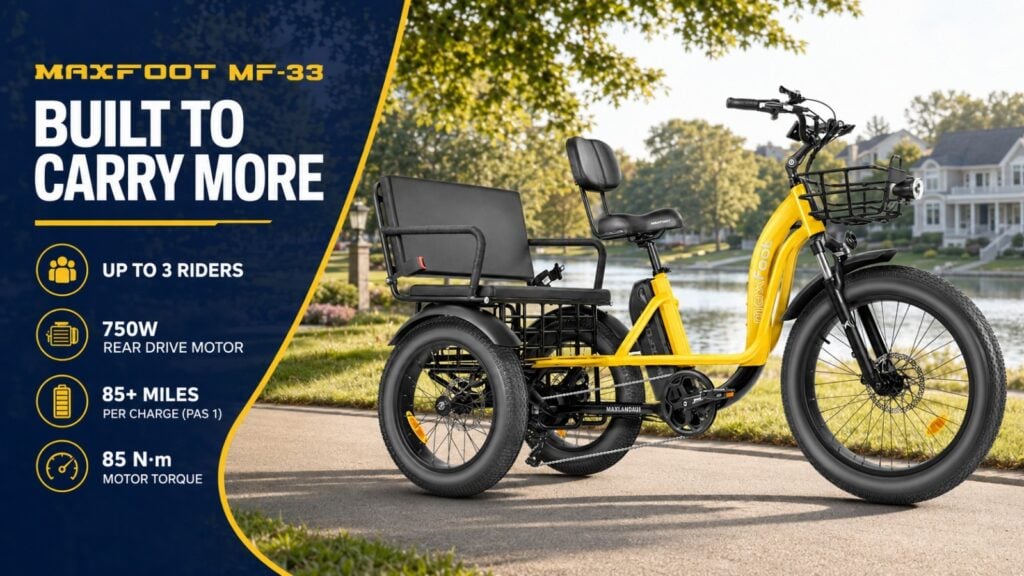
Most electric trikes are designed around a single rider. The MaxFoot MF-33 was designed around a question: what if the best part of your ride is having someone next to you? As MaxFoot’s first true multi-passenger e-trike, the MF-33 takes the brand’s tricycle craftsmanship and reshapes it for couples, families, seniors, and anyone who’d rather not explore alone. Here’s a closer look at what’s under the hood — and why the build quality matters as much as the feature list.
A Frame You Can Actually Trust
Every great trike starts with its frame, and this is where the MF-33 sets itself apart. Instead of cutting corners with thin-wall tubing, MaxFoot builds the MF-33 around a thickened 6061 aluminum alloy frame. 6061 aluminum is prized in the cycling and automotive world for a reason: it delivers an excellent strength-to-weight ratio, resists corrosion, and holds up to years of repeated stress without fatiguing. On a trike that’s regularly asked to carry two adults plus cargo, that durability isn’t a nice-to-have — it’s the foundation everything else depends on.
The frame also uses a low step-through design, so both the driver and rear passenger can mount and dismount without swinging a leg over a high top tube. That single design choice quietly makes the MF-33 accessible to a much wider range of riders — kids, seniors, people with limited mobility, or anyone who just wants to hop on without a production number.
Power That Doesn’t Flinch
The MF-33 is driven by a 750W rated rear-drive motor with up to 1400W of peak power and roughly 85 N·m of torque. In practical terms, that means the trike pulls confidently away from stops, climbs moderate hills without hesitation, and doesn’t bog down when there’s a second person on board. Because the motor sits at the rear, weight distribution improves when carrying passengers or cargo, which translates into steadier handling and more predictable braking.
A rear differential is paired with the motor, automatically balancing the speed difference between the left and right rear wheels during turns or on uneven pavement. This is the same principle used in cars, and on a trike it does real work: it reduces the tipping risk that plagues cheaper three-wheelers when cornering at speed.
A Battery Engineered for Heat, Not Just Range
The MF-33 runs on a Samsung 48V 20Ah lithium battery, UL2271 certified, delivering more than 85 miles of range in pedal-assist mode (roughly 32–42 miles on throttle alone), with five levels of pedal assist to dial in. But the number that matters more than range is what’s happening inside the battery pack itself.
Rather than leaving air gaps between individual cells — a common shortcut that lets heat build up unevenly — the pack uses a potting compound to fill every gap between cells. This does three things simultaneously:
- Better heat dissipation.Heat generated during hard acceleration or hill climbs is conducted outward evenly instead of pooling around hot cells, so the pack stays in its optimal operating range even when the motor briefly draws its 1400W peak.
- Longer service life.Cells naturally expand and contract through charge cycles. Potting locks the whole pack into a rigid, unified structure, physically resisting that movement and slowing the capacity loss that comes with mechanical wear.
- A real safety margin.Battery fires are almost always thermal runaway — one cell overheats and ignites its neighbors in a chain reaction. A potting compound acts as a physical thermal barrier between cells, containing an isolated hot spot instead of letting it spread. That’s a meaningfully lower risk profile than a loosely packed cell arrangement.
The fully sealed, potted structure is also naturally better sealed against moisture, dust, and road grime, which matters if the trike is going to see rain, job sites, or humid storage. Paired with properly rated wiring and connectors between battery and motor, it’s a power system engineered as a whole, not bolted together from generic parts.
Comfort for Two (or More)
None of this would matter if the ride itself weren’t comfortable, and the MF-33 leans into its role as a passenger vehicle. The rear seat is a 27.5-inch wide, cushioned bench with a backrest, armrests, and footrests, rated to comfortably carry two additional adults, with a total load capacity around 500 lbs. A front suspension fork (about 50mm of travel) soaks up bumps before they reach either rider, and wide fat tires add both stability and cushioning on rougher surfaces.
Safety features are built around the reality of carrying passengers: dual 180mm disc brakes on all wheels, a parking brake to keep the trike still while loading or unloading, LED headlights and a brake light, and a turn-signal-equipped taillight to communicate clearly with traffic when changing lanes.
Why the Materials Story Matters
It’s easy for e-trike marketing to focus purely on specs — watts, amp-hours, miles. But the MF-33 is a good reminder that the materials underneath those specs decide whether they hold up in the real world. A 6061 aluminum frame resists the fatigue cracking that cheaper alloys develop under repeated passenger loads. A potted battery pack keeps delivering its rated range and power output instead of degrading — or worse, becoming a safety liability — after a season of hot rides and hard charges.
The Bottom Line
The MaxFoot MF-33 isn’t just an electric trike with an extra seat bolted on. It’s a vehicle engineered from the frame outward with the assumption that it will regularly carry two people, climb real hills, and be trusted with a passenger’s safety. Between the thickened 6061 aluminum frame, the 750W/1400W rear-drive motor with differential, and the potted 48V Samsung battery pack, the MF-33 makes a strong case for anyone who’s been riding solo and wondering how to bring someone along.