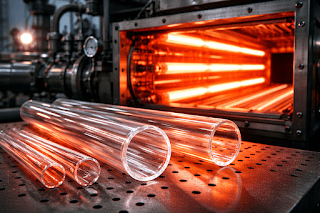
High-intensity infrared (IR) heating systems are widely used in industrial drying, semiconductor wafer processing, advanced materials sintering, glass forming, and rapid thermal cycling applications. In these systems, radiant heat transfer efficiency, temperature uniformity, and long-term component stability are strongly influenced by the optical and thermal behavior of enclosure materials.
While heating elements and control systems often receive the most design attention, the surrounding transparent or semi-transparent components—such as protective tubes, sleeves, and process chambers—directly affect radiative transmission and thermal reliability. For this reason, optically stable fused silica tubes for high-radiation infrared heating assemblies are frequently specified in high-duty IR environments where long-term spectral consistency is required.
Material selection becomes particularly critical when systems operate above 800 °C, experience rapid ramp rates, or require precise wavelength transmission for controlled heating. This article examines the engineering constraints that influence the selection of fused silica versus alternative materials in high-intensity infrared heating systems.
1. Radiative Heat Transfer and Spectral Transmission
Infrared heating relies primarily on radiative energy transfer. The amount of usable thermal energy delivered to a workpiece depends on:
Delivered Radiant Energy = Emitted Power × Transmission Efficiency × Exposure Time
Transmission efficiency is governed by the spectral transparency of the enclosure material across relevant IR wavelengths (commonly near-IR: 0.75–1.4 µm, mid-IR: 1.4–3 µm, depending on heater type).
Comparative Spectral Behavior (General Engineering Ranges)
| Material | Near-IR Transmission | Mid-IR Stability | High-Temperature Transparency Stability |
| High-purity fused silica | High | Moderate | Excellent |
| Borosilicate glass | Moderate | Lower | Degrades under prolonged high heat |
| Alumina ceramic (opaque) | Low (non-transparent) | Not applicable | Structurally stable but not optical |
Engineering Implication:
- Fused silica supports efficient IR transmission in high-radiation assemblies.
- Borosilicate may soften or exhibit transmission drift at elevated temperatures.
- Opaque ceramics provide structural stability but eliminate radiative transmission.
2. Optical Stability Under Prolonged Thermal Exposure
In high-intensity IR systems operating continuously or in rapid cycles, optical stability is not simply initial transmission—it is the ability to maintain transmission over thousands of heating hours.
Two degradation mechanisms dominate:
- Devitrification – localized crystallization in silica materials at prolonged high temperature.
- Surface contamination reactions – deposition or chemical interaction altering emissivity and transparency.
Fused silica, due to its near-pure SiO₂ composition and low thermal expansion, demonstrates improved resistance to microstructural transformation compared with borosilicate compositions containing alkali modifiers.
For systems running above 1000 °C with frequent cycling, optical drift can reduce effective heating uniformity, leading to process variation in sensitive manufacturing workflows.
3. Thermal Expansion and Stress Management
High-intensity infrared assemblies often experience:
- Rapid heating ramps (100–300 °C/min)
- Localized hot spots near emitters
- Mechanical constraints at flange or seal interfaces
Coefficient of Thermal Expansion (CTE) is therefore a critical design variable.
| Material | CTE (×10⁻⁶ /K) |
| Fused silica | ~0.5 |
| Borosilicate glass | ~3.3 |
Lower CTE reduces thermal stress gradients and minimizes cracking risk during fast ramp cycles.
Engineering Consideration:
In constrained assemblies where the transparent tube is sealed to metal housings, differential expansion can induce tensile stress. Lower-expansion materials reduce long-term fatigue failure probability.
4. Thermal Shock Resistance in Rapid Cycling Systems
Thermal shock resistance can be approximated using a material parameter related to:
Thermal Shock Resistance ∝ (Fracture Strength × Thermal Conductivity) ÷ (Elastic Modulus × CTE)
Because fused silica has both low CTE and favorable thermal properties, it performs well under rapid heating and cooling conditions.
In IR curing lines or batch furnaces where doors open between cycles, abrupt temperature changes are common. Material fracture in enclosure components leads to:
- Production downtime
- Misalignment of heaters
- Contamination risk
Selecting materials with strong thermal shock tolerance improves system uptime.
5. Surface Purity and Radiative Efficiency
Radiative heating systems are sensitive to surface emissivity and contamination. Impurities can alter both transmission and reflection behavior.
High-purity silica components provide:
- Low metallic impurity levels
- Stable emissivity characteristics
- Reduced surface reaction at elevated temperature
In process environments involving reactive gases or fine particulate matter, stable optical surfaces support consistent radiant flux.
6. Mechanical Reliability in Structural Interfaces
In some IR systems—especially laboratory or pilot-scale material development setups—containment or sample handling may involve quartz-based vessels or supports. In such high-temperature contexts,high-purity quartz crucibles engineered for sustained thermal exposure environments are used where dimensional stability and thermal purity are required.
Mechanical integrity must account for:
- Creep at elevated temperatures
- Long-term deformation
- Interaction with heating element proximity
Quartz-based materials maintain structural stability across a wide operating window when properly specified for thickness and load conditions.
7. Lifecycle Performance vs Initial Cost
Material selection decisions are often incorrectly driven by upfront component cost rather than lifecycle performance metrics.
Engineering Lifecycle Factors
| Parameter | Fused Silica | Borosilicate |
| Optical drift over long heat cycles | Low | Moderate to High |
| Thermal expansion stress risk | Low | Higher |
| Replacement frequency | Lower | Higher |
| Suitability above 900 °C | Strong | Limited |
In high-duty IR production systems, replacement downtime and recalibration costs typically exceed marginal material savings.
8. Engineering Decision Framework
When selecting materials for high-intensity IR heating systems, engineers should evaluate:
- Operating temperature ceiling
- Ramp rate and thermal cycling frequency
- Required spectral transmission range
- Mechanical constraint conditions
- Expected system lifetime (hours of operation)
- Surface contamination exposure
Recommended Selection Logic
| System Condition | Preferred Material |
| Continuous >900 °C operation | Fused silica |
| Rapid thermal cycling | Fused silica |
| Moderate temperature, non-critical optical use | Borosilicate (conditional) |
| Opaque structural shielding | Ceramic materials |
9. Conclusion
In high-intensity infrared heating systems, optical stability is not a secondary material attribute—it is a core performance variable influencing heating efficiency, uniformity, and long-term reliability.
Fused silica provides:
- High IR transmission consistency
- Low thermal expansion
- Strong thermal shock resistance
- Improved lifecycle stability under prolonged exposure
While borosilicate glass remains suitable for moderate thermal applications, high-radiation IR assemblies operating at elevated temperatures generally require materials engineered for sustained optical and structural performance.
Material selection in these systems should therefore be guided by quantified thermal and optical parameters rather than initial procurement cost alone.
References
- Fundamentals of Radiative Heat Transfer – Engineering Thermodynamics Texts
- Thermal Expansion Data – Engineering Materials Handbooks
- Optical Properties of Fused Silica – Materials Science Literature
- Infrared Heating System Design Principles – Industrial Heating Publications
- Thermal Shock Resistance in Glass Materials – Fracture Mechanics References
- Devitrification Behavior in Silica-Based Materials – High-Temperature Materials Research