Precision and Clarity of Makeup Mirror
The makeup mirror is an indispensable tool in the daily routine of countless individuals, moving far beyond simple reflection to become a highly specialized piece of equipment. It is designed to provide the clarity, magnification, and controlled lighting necessary for applying cosmetics with meticulous precision, a task that standard bathroom mirrors often fail to achieve.
Choosing the right makeup mirror involves navigating options in magnification strength, lighting types, mounting styles, and power sources. This comprehensive, informative guide explores the essential features, technological considerations, and design choices that define a professional-grade makeup mirror, ensuring you select the perfect tool for flawless application and optimal visibility.
The Science of Sight: Magnification and Clarity
The primary differentiator of a dedicated makeup mirror is its magnification capability, which is crucial for detailed tasks like eyebrow shaping, eyeliner application, and blending.
Understanding Magnification Levels
Magnification strength is typically denoted by an ‘X’ factor (e.g., $5\text{X}$, $10\text{X}$).
- True View: This side of the mirror provides a standard, true-to-life reflection, essential for checking the overall look, symmetry, and how makeup appears under normal lighting conditions.
- Mid-Range: This is the ideal range for general makeup application, including foundation, blending, and lipstick. It provides enough detail for precision without being overly distorting.
- High-Range: This level is highly specialized, best reserved for intricate detail work, such as tweezing fine hairs, applying false eyelashes, or checking deep blemishes. For general application, this level can be confusing due to extreme close-up detail.
Optical Quality
Regardless of magnification, the quality of the glass and the silvering process is critical. A high-quality makeup mirror provides distortion-free clarity across the entire surface. Lower-quality mirrors may warp or distort the image toward the edges, leading to asymmetry in makeup application.
The Key to Flawless Application: Lighting Technology
The importance of lighting in a lighted makeup mirror cannot be overstated. Applying makeup under poor or incorrect light results in misjudged colors, poor blending, and an unnatural look when viewed in daylight.
Color Temperature
The best mirrors simulate natural daylight, which is the most neutral and accurate light source for color rendering.
- Ideal Range: Look for mirrors with a color temperature between 4000K to $6000. This range closely mimics the neutral, white light of midday sunlight.
- Avoid: Warm, yellowish light (under 3000K can wash out the face, causing you to over-apply blush or bronzer. Cool, bluish light over 7000K can make your application look too harsh.
Lighting Types (LED)
Modern makeup mirrors overwhelmingly use integrated LED lighting.
- Energy Efficiency: LEDs are highly energy-efficient and generate very little heat, making them comfortable for close-up use.
- Longevity: LED bulbs have an exceptionally long lifespan, often lasting for thousands of hours without needing replacement.
- CRI (Color Rendering Index): For the most accurate color representation, seek out mirrors with a high CRI rating (ideally 90 or above). A high CRI ensures that colors—from foundation shades to eyeshadows—look true to life.
Dimmability and Customization
Premium mirrors often feature dimmable settings and light temperature controls (e.g., a “daylight” setting, an “evening” setting, and an “office” setting) to help you check how your makeup will look under various real-world conditions.
Mounting Styles: Placement and Practicality
The mounting style dictates the flexibility, stability, and placement of your makeup mirror.
1. Countertop/Tabletop Mirrors
These mirrors sit on a base and are highly portable.
- Pros: Easy to move between rooms, requires no installation, and often features a double-sided swivel ($1\text{X}$ on one side, magnified on the other).
- Cons: Takes up valuable counter space; height is fixed.
2. Wall-Mounted Mirrors
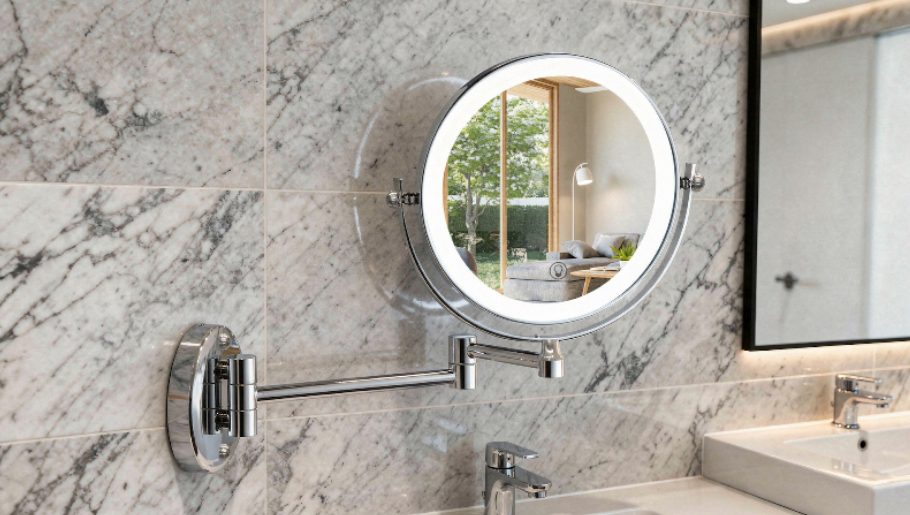
These mirrors are permanently fixed to the wall via an extending, adjustable arm (often accordion-style).
- Pros: Saves counter space, offers the greatest flexibility for height and distance adjustment, and can be easily pushed flat against the wall when not in use.
- Cons: Requires permanent installation (drilling) and often needs hard-wiring or an accessible wall outlet for power.
3. Travel Mirrors
Compact, foldable, and battery-operated versions, often featuring built-in ring lights.
- Pros: Ultra-portable, lightweight, and perfect for carrying in luggage.
- Cons: Usually, smaller surface area and lower light intensity compared to full-sized models.
Power and Features: Smart Integration
Modern makeup mirrors incorporate smart features that enhance convenience and functionality.
- Rechargeable vs. Plug-In: Wall-mounted mirrors are typically plug-in or hard-wired. Tabletop mirrors are increasingly rechargeable (via USB), offering cordless operation for greater portability without being tethered to an outlet.
- Sensor Activation: Some high-end models feature motion sensors that automatically illuminate the mirror when your face approaches and turn off when you step away, conserving battery life.
- Integrated Phone Holders: Useful for following makeup tutorials or video calls while applying cosmetics.
- Storage Bases: Some tabletop models include a tray or base with compartments for holding smaller items like earrings, clips, or brushes.
Conclusion
The makeup mirror is a sophisticated tool designed to elevate your grooming routine. By prioritizing correct light color temperature, a high CRI, and the appropriate magnification for your needs, you ensure a clear, precise, and accurate reflection that guarantees flawless results every time.