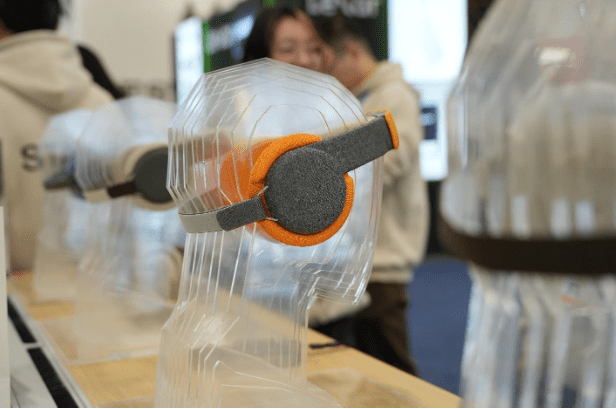
Brain–computer interfaces (BCIs) have traditionally been split between experimental research and invasive medical systems. At CES 2026, LumiMind is positioning non-invasive BCIs as a viable third path—consumer-ready, wearable, and capable of real-time operation outside laboratory environments.
The company is showcasing LumiSleep, a sleep-focused neurotechnology device built on millisecond-level EEG monitoring, alongside live demonstrations that reveal the broader capabilities of its non-invasive BCI platform. The pairing reflects a deliberate strategy: using a practical, everyday application like sleep to anchor more advanced neural interaction capabilities that can scale across industries.
Rather than presenting BCIs as speculative future technology, LumiMind’s CES presence emphasizes performance under real-world conditions. Live demonstrations—such as brain-controlled interaction in complex digital environments—are designed to illustrate that non-invasive neural decoding can deliver continuous, responsive control without surgery, implants, or extended clinical calibration.
How LumiSleep Applies Real-Time Neural Modulation
At the core of LumiMind’s CES showcase is LumiSleep, a consumer device designed to address a long-standing limitation in sleep technology: indirect measurement. Most sleep wearables infer sleep states from secondary signals like motion or heart rate. LumiSleep instead measures brain activity directly using integrated EEG sensors housed in a soft, over-ear headband.
According to LumiMind, the device continuously monitors neural activity to detect a specific pattern associated with the brain’s natural transition into sleep, referred to as the Sleep Onset Pattern™. When this pattern begins to emerge, LumiSleep responds with personalized acoustic output intended to gently modulate neural activity and support natural sleep onset—without stimulation or medication.
All neural decoding and sound modulation occur locally on the device, allowing the system to operate independently of cloud connectivity. The approach is fully non-invasive and designed for overnight comfort, aligning with LumiMind’s broader goal of making neurotechnology feel more like a consumer accessory than medical equipment.
Tech Rundown: LumiSleep at CES 2026
- Non-invasive EEG monitoring integrated into an over-ear headband
- Millisecond-level, real-time neural signal decoding
- Closed-loop acoustic modulation system
- On-device processing with no cloud dependency
- Dry EEG electrodes requiring no gels or adhesives
- Overnight battery life and localized audio output
- Companion app for insights and settings
Strategic Implications for Consumer Neurotechnology
The technology behind LumiSleep was developed in collaboration with the INSIDE Institute for NeuroAI, which has conducted multiple public demonstrations of non-invasive BCIs in real-world settings. These demonstrations support LumiMind’s broader claim: that advanced neural interaction no longer requires invasive hardware.
This approach contrasts with implant-based BCI efforts pursued by companies such as Neuralink, which involve surgical implantation and ongoing clinical oversight. LumiMind is betting that improvements in neural decoding algorithms, model generalization, and low-latency processing can unlock comparable performance through non-invasive systems—making BCIs more accessible and scalable.
Looking ahead, LumiMind sees LumiSleep as an entry point into a broader neurotechnology platform that could expand into focus, emotional regulation, and hands-free interaction across digital and physical environments. For investors and industry observers, the CES showcase signals a shift in how BCIs may enter the market—not through extreme medical interventions, but through consumer-friendly products designed for everyday use.
At CES 2026, LumiMind isn’t positioning itself as a moonshot. Instead, it’s presenting a pragmatic case: that non-invasive brain–computer interfaces are ready to move from research to reality.