
Limit Switch vs Proximity Sensor: Which Is Better for Smart Factories in 2026?

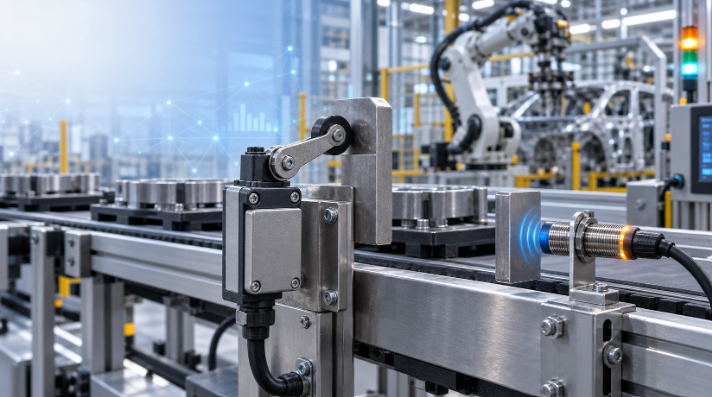
Position detection is essential in industrial automation. Machines must know when a product arrives, a valve closes or a moving component reaches its endpoint. Limit switches and proximity sensors can both perform these tasks, but smart factories now expect greater uptime, diagnostic data and production flexibility.
In 2026, the better technology is not simply the faster or cheaper one. Selection should depend on the application, environment, control system and safety requirements.
How the Two Technologies Work
Although both devices provide position feedback, they rely on fundamentally different detection methods. Understanding these operating principles is the first step toward choosing the right solution.
Limit Switch
A limit switch detects position through physical contact. A machine component presses a lever, roller or plunger, causing the internal electrical contacts to change state.
Limit switches are commonly used for machine end-of-travel detection, valve-position confirmation and door monitoring. They are straightforward to install and troubleshoot. However, repeated impact can eventually wear the actuator or contacts, particularly in high-cycle applications.
Proximity Sensor
A proximity sensor detects a target without touching it. Inductive sensors detect metal, while capacitive, magnetic and photoelectric models support other materials and applications.
With no mechanical contact at the sensing point, proximity sensors are suitable for fast and repetitive operations. They normally require external power and must be compatible with the PLC input and control voltage.
Limit Switch vs Proximity Sensor: Key Differences
The main difference is contact versus non-contact operation. A limit switch provides physical actuation at a defined position. A proximity sensor detects an object when it enters a sensing field.
Limit switches are often less expensive and can provide simple contact outputs. Proximity sensors generally offer faster switching, better repeatability and less mechanical wear. Smart versions may also provide operating and diagnostic data.
Environmental suitability depends on the specific conditions. Metal chips can interfere with an inductive sensor, while dirt may obstruct a limit switch actuator. Engineers should evaluate contaminants, vibration, temperature and mounting conditions before making a selection.
For additional information about sensing principles, wiring and applications, see this Limit Switch vs Proximity Sensor guide.
What Smart Factories Need in 2026
Smart-factory requirements extend beyond basic object detection. Engineers must evaluate how each technology affects equipment availability, maintenance visibility and the ability to adapt production lines.
Higher Uptime
Non-contact sensing can reduce maintenance on high-speed production lines because there is no actuator to strike repeatedly. Nevertheless, a properly installed limit switch can remain reliable in slower applications where the operating point is clearly defined.
The best choice depends on which failure is more likely: mechanical wear, incorrect alignment, electrical incompatibility or environmental interference.
Diagnostic Data
Traditional switches normally provide only an on-or-off signal. IO-Link proximity sensors can also communicate device status, sensing parameters and diagnostic information.
Maintenance teams can use this data to identify contamination, declining signal strength or configuration problems before production stops. However, these advantages require compatible controllers, IO-Link masters and software capable of using the information.
Flexible Production
Factories increasingly produce multiple product sizes on the same line. Remotely adjustable sensors can simplify changeovers by allowing parameters to be modified without manually repositioning or replacing devices.
For fixed processes with limited data requirements, a mechanical limit switch may still be the simpler and more economical solution.
Application-Based Selection
Technical specifications alone cannot determine the best option. The following applications demonstrate how movement, cycle frequency and environmental conditions influence sensor selection in practice.
High-Speed Packaging Line
A proximity sensor is usually preferable for detecting or counting products on a fast packaging line. Its non-contact operation minimizes wear and prevents physical contact with the packaging.
Valve or Machine End-of-Travel
A limit switch is often suitable for confirming that a slowly moving valve, gate or machine slide has reached its endpoint. Mechanical actuation provides clear position feedback and is easy for maintenance personnel to verify.
Harsh Manufacturing Environment
Neither technology automatically wins in harsh conditions. Sealed proximity sensors can resist oil and moisture, but metal buildup may affect detection. Rugged limit switches can withstand demanding environments, although their actuators must be protected against impact and debris.
Safety: A Separate Engineering Decision
A standard limit switch or proximity sensor is not automatically a safety device. Guard monitoring and hazardous-motion control require certified components, an appropriate safety-control architecture and system validation.
Safety limit switches may use direct-opening contacts, while safety-rated proximity devices are designed to provide defined behavior under fault conditions. Engineers should verify the relevant certification rather than rely only on the detection method.
Correct electrical documentation is also important. This Foot Switch Symbol Guide explains common symbols for foot-operated devices in industrial control diagrams.
Conclusion
Proximity sensors are generally better for fast, repetitive and data-driven applications. Limit switches remain effective for simple, low-speed tasks requiring definite mechanical position confirmation.
Some machines benefit from using both: a proximity sensor for routine control and a suitably rated limit switch for independent protection. The final decision should be based on operating risk, environmental conditions and total lifecycle cost.






Comment