
LIBA SI Wants Real Estate AI to Show Its Work, Starting With a Deal It Passed On

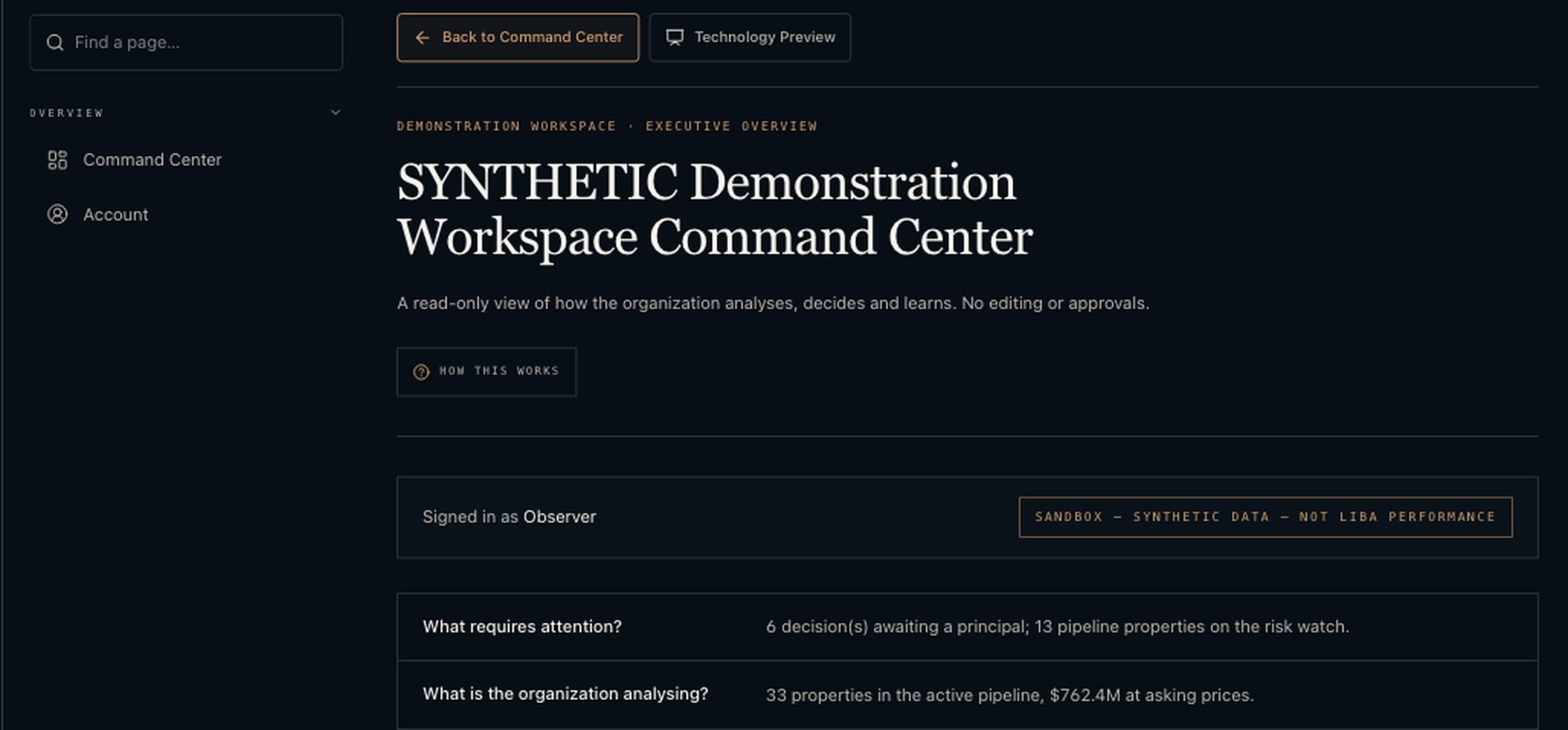
A Miami software company and its real estate affiliate are betting that the next edge in AI-assisted real estate is a record of why each decision was made and what happened next.
Credits: LIBA SI
A broker’s pro forma for an 18-unit Art Deco building in North Beach showed a 6.42% cap rate. The in-place cap rate was 5.17%. Closing that gap required monthly rents to rise about 19%, from $33,325 to $39,650, on a building asking $4,995,000, or $277,500 per unit.
A Miami-Dade real estate company reviewed the numbers, flagged four concerns and passed. The asking price was later cut, and the building stayed on the market. Few teams can show, line by line, why they said no.
That gap between making a call and being able to explain it later is the problem LIBA SI is built around, and it arrives at a moment when AI in real estate has more activity than proof.
Lots of pilots, fewer results
JLL’s 2025 Global Real Estate Technology Survey, which covered more than 1,500 senior decision-makers, found that 88% of owners and landlords were piloting AI. Only 5% of occupiers reported achieving all of their program goals, and more than 60% of owners and landlords said they remained unprepared strategically, organizationally and technically.
The question for a real estate team is no longer whether to use AI. It is whether anyone can show how a model’s advice compared with what actually happened to the asset.
A record, not just a recommendation
LIBA SI, built by LIBA Inc., describes itself as an enterprise decision intelligence platform, with real estate as its first application. For each opportunity it keeps a single Decision Record: the evidence gathered, the financial underwriting, the AI review, the named person who approved the deal, and, later, the measured outcome against the forecast made at approval.
Two design choices define it. The underwriting, which covers acquisition economics, cap rates, net operating income, rents, renovation budgets, operating expenses and projected returns, is built from reproducible models. The AI review sits beside that analysis as advice, recorded separately from the calculations and the decision. Only a named person can approve a deal. The platform is offered through private deployments aimed at multifamily owners and operators.
The company says its institutional memory preserves historical decisions and outcomes without automatically retraining underlying AI models, and that each organization’s decision history is isolated, owned by that organization and never pooled with another firm’s records.
The aim is institutional memory. When a team overrides a flag or approves a deal with conditions, the reasoning stays attached to the asset. Years later, a new analyst can see what was believed at the time and how it turned out.
The deal it passed on
LIBA Capital, the affiliated real estate company serving as the platform’s first operating environment, has published the Ocean 18 Lofts record with its permission. According to the published record, the review raised four flags. The building’s age meant no reserve for its envelope. The listing showed no roof work, and the roof’s age and condition were not evidenced. Insurance of $2,400 per unit and a tax reassessment looked low for Miami Beach. And the pro forma depended on aggressive rent growth.
The decision was to pass. Then the asking price came down, and the property stayed on the market.
One passed deal does not prove a method. The record gives no new price and no sale, so the outcome is still open. What it does show is the format: the assumptions, the objections and the result, available for inspection. That is the kind of disclosure teams rarely get from their own tools.
Applied to workforce housing
LIBA Capital is a Miami-based Florida LLC that buys, improves and, selectively, develops residential housing in Miami-Dade County under a “Buy, Fix, Build” approach. Today it operates 20 units in Miami Shores: 12 in multifamily buildings and eight in four duplexes. The properties were acquired pre-foreclosure, and all tenancies are supported by Housing Choice Vouchers. Improvements are underway.
The company says it uses technology-assisted analysis to screen more than 12,000 Miami-Dade properties, looking for off-market and value-add opportunities. Its stated targets are about 80 units within 18 months and about 160 in the next phase, and the company says plainly that they are targets, not guarantees. LIBA also notes that voucher participation and rental income are not assured.
The market it works in is tight. A Miami Homes For All analysis of Census and employment data found that 90% of Miami-Dade renters earning under $50,000 a year are cost-burdened, according to Hoodline. In that setting, a mistake on insurance, taxes or capital reserves can erase a thin margin quickly.
What it does not promise
The shorthand for AI in real estate is stronger returns. LIBA’s own materials are more careful. The platform’s site states that no financial returns are claimed, and LIBA Capital states no targets for them. Principals keep final decision authority, and model outputs support but do not replace their judgment or standard legal, financial, lender and insurance review.
That restraint is part of the pitch. If a tool is meant to help teams find undervalued properties and manage risk, its value shows up in the discipline of the process, in fewer unexamined assumptions and in forecasts that can be checked against outcomes.
There are limits. LIBA Capital is the first deployment, and the platform’s governance features are so far in use only there. The company says its engineering draws on international expertise, including Budapest, and that its broader ambition is enterprise financial decision-making beyond real estate. That is a stated goal, not a demonstrated one.
Questions worth asking any real estate AI
Does the tool separate calculation from AI opinion? Can the underwriting be reproduced by someone else? Is a specific person accountable for each decision? Are forecasts compared with actual results, and are the misses recorded? Can a committee read the reasoning behind a rejection years later?
Teams that want to see how LIBA SI answers can request a private demonstration at getliba.si, or write to [email protected].







Comment