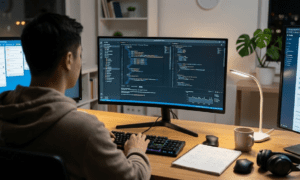
Generative AI has made writing code faster, but it has not made software more stable. As companies ship more AI-generated code, debugging has become the new pressure point for engineering teams. Kodezi is addressing this problem directly with Chronos-1, the first large language model built to analyze failures, diagnose issues, and autonomously repair software.
Kodezi founder Ishraq Khan, who raised his first venture funding round in high school and has secured more than $2 million to date, understands the gap between speed and reliability. After teaching himself programming as a child and launching projects on limited hardware, Khan learned firsthand that debugging, not writing code, shapes a developer’s productivity.
“Generation creates speed. Debugging creates trust,” Khan says.
More information about Kodezi can be found at Kodezi.com.
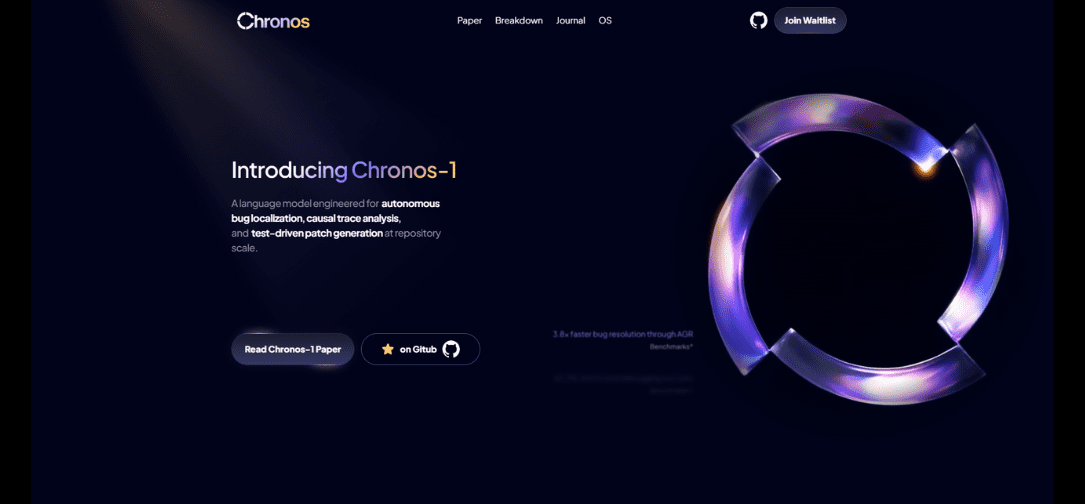
Chronos-1: A New Class of Debugging Intelligence
Chronos-1 is trained on more than 15 million debugging sessions, giving it a deep understanding of how real systems behave once deployed. It is engineered to reason across entire codebases rather than treat files as isolated text.
Its architecture includes:
- Adaptive Graph-Guided Retrieval (AGR) to trace dependencies, imports, and execution paths
- Persistent Debug Memory (PDM) that identifies recurring failures and proven fixes
- Fix-test-refine autonomy that validates patches through repeated test cycles
- Context-rich failure interpretation using logs, traces, and commit histories
This approach allows Chronos-1 to diagnose failures with context, accuracy, and persistence that general purpose AI tools were never designed for.
From Model to Operating System: The Kodezi OS Vision
Chronos-1 is the core intelligence inside Kodezi OS, a new autonomous engineering platform that acts as an AI CTO for software teams. Kodezi OS maintains entire codebases by detecting regressions, patching issues, updating documentation, generating API specifications, and enforcing engineering conventions.
It is not a chatbot or an assistant. It behaves like self-regulating infrastructure.
“Software should improve every time something breaks,” Khan says. “Chronos-1 allows Kodezi OS to learn from every failure and get better with time.”
Kodezi OS enters full release in Q1 2026. More details are available at Kodezi.com and Chronos.so.
Why Chronos-1 Matters for Engineering Teams
As engineering organizations adopt generative AI, they face increasing volumes of inconsistent code, more regressions, and higher maintenance costs. Chronos-1 is designed to reverse the trend by enabling proactive, AI-driven reliability.
The model positions Kodezi as a pioneer in autonomous software infrastructure, focusing not on writing more code but on ensuring that code remains correct, stable, and scalable.
Developers and researchers can access the full Chronos-1 technical paper at arxiv.org/abs/2507.12482.