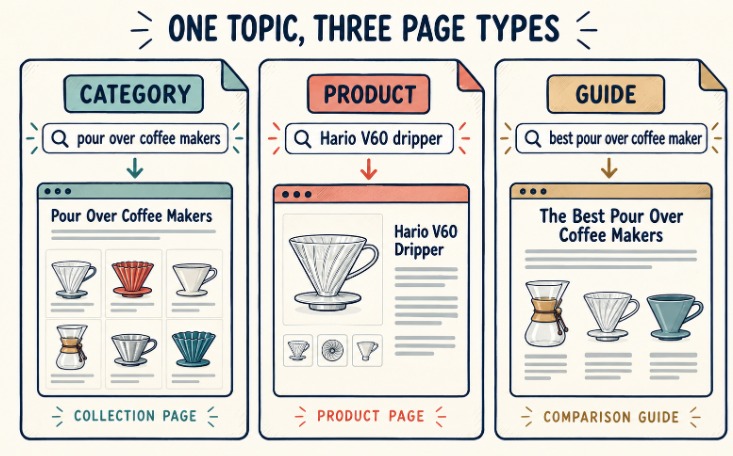
A specialty coffee retailer’s keyword export mixes things B2B content lists never contain: category terms like “pour over coffee makers,” exact model-number queries, brand-plus-product combos, and brewing questions such as “pour over coffee ratio.” A few thousand rows, four kinds of intent, three kinds of page that could plausibly claim them.
Ecommerce keywords grouping therefore has a second job. Beyond gathering similar terms, someone must decide which page type each group serves: collection, product, or article. This article covers that dispatch, which is where ecommerce keyword work is won or lost.
Why ecommerce keywords need grouping first
Ecommerce catalogs generate keyword lists that are large and internally conflicted. Every SKU can be searched by name, by model number, and by shorthand. Every category has singular, plural, and colloquial variants. On top of the commercial pile sits a second language of questions, ratios, cleaning guides, and comparison searches, written by the same customers at an earlier stage of the same journey.
Left ungrouped, the list gets divided by whoever requests content first: the blog claims “best pour over coffee maker” for a guide, the merchandising team titles a collection almost identically, and the store competes with itself while competitors collect the clicks. Grouping makes that collision impossible by deciding intent ownership before pages get built.
Category, exact-product, and comparison searches need different page owners.
What makes ecommerce keywords different
Five types cover most of an ecommerce list, and each has a natural home.
- Category terms name a product class: “pour over coffee makers,” “burr coffee grinders,” “gooseneck kettles.” Searchers are comparing across products and expect a browsable selection.
- Product terms name one item, by model or exact name. The searcher has largely decided and wants that page.
- Brand terms attach a maker to either of the above, narrowing the field.
- Informational terms ask questions: “how to clean a burr grinder,” “pour over vs french press.” No wallet is open yet, and pushing a product page at these readers reads as an interruption.
- Seasonal terms arrive on a calendar: “gifts for coffee lovers” spikes for a quarter and vanishes. They need a home that exists year round and gets refreshed, typically a gift guide.
The ecommerce twist is that one topic spans the whole intent spectrum. “Pour over coffee makers” and “how to make pour over coffee” share every noun and none of their intent. They look like neighbors in any similarity-based grouping, and they are, but they ship to different page types. Topic clustering brings those terms together; intent is what sorts them back out into collection pages and articles.
Group by intent, then map to page type
The working method has two stages. Cluster first, so every pour-over-related term sits in one place and nothing gets orphaned. Then dispatch each cluster, or each clearly distinct intent inside it, to the page type built for it:
| Keyword example | Intent | Page that should own it |
| pour over coffee makers | browse a category | collection page |
| hario v60 ceramic dripper | one known product | product page |
| best pour over coffee maker | compare before buying | buying guide (blog) |
| how to use a pour over | learn | how-to article (blog) |
The dispatch rule that prevents most ecommerce cannibalization: one intent, one page type, store-wide. The tricky row is “best pour over coffee maker.” It is commercial investigation, close to purchase, one of the buyer intent keywords that sit nearest an open wallet, and many stores aim it at a collection page to catch high-intent traffic. The page that actually earns that ranking, almost everywhere, is a guide that compares options, because the searcher asked for help comparing. Let the guide own the “best” phrasing and the collection own the bare category terms, then link the guide to the collection so the traffic converts where products are browsable. Two pages, two intents, one handoff.
Modifiers deserve their own look during dispatch. “Budget burr grinder” and “commercial espresso grinder” signal a different shopper than the bare category term, and a store with the selection for it can run dedicated collections, or filtered views of one collection, for each meaningful modifier rather than folding them into a single page’s subtitle. Singular and plural variants almost always share intent and can stay together.
Model numbers and brand terms rarely need debate; they map to product pages unless the store doesn’t stock the item, in which case a comparison page can catch the query honestly. The recurring maintenance job is boundary drift: new blog posts quietly targeting category terms, new collection pages titled like guides. A quarterly pass over the dispatch table catches both.
Grouping the list in practice
Practically, the work compresses into an afternoon. Export everything into one file: research tool exports, search console queries, and terms scraped from your own catalog, since product names people actually type often differ from the names in the merchandising system. Run the file through clustering software; SEMagi can group your ecommerce keywords from an uploaded CSV, proposing topic clusters based on meaning and intent that you then review.
The review pass is where ecommerce judgment enters, and no tool supplies it. Software sees that “grinder” terms belong together; only you know whether your store’s grinder selection is one collection or three, whether a cluster is really two audiences, and which questions your customers actually ask in your market. The tool proposes the groups; the dispatch table and your catalog decide what each group becomes.
From informational clusters to buying guides
Every informational cluster in that output is a guide waiting to be written, and this is the part of an ecommerce content plan that most often goes unwritten, because product copy and seasonal pages always feel more urgent.
These clusters deserve the attention. A buying guide owns the comparison searches a collection page can’t win honestly, feeds internal links to the collections it recommends, and gives the store depth on its own subject, which is what makes a small retailer credible next to marketplaces. The guide shapes follow the cluster types: comparison guides for “best” and “vs” clusters, how-to guides for technique questions, gift roundups for seasonal ones, each closing with links into the collections they discuss.
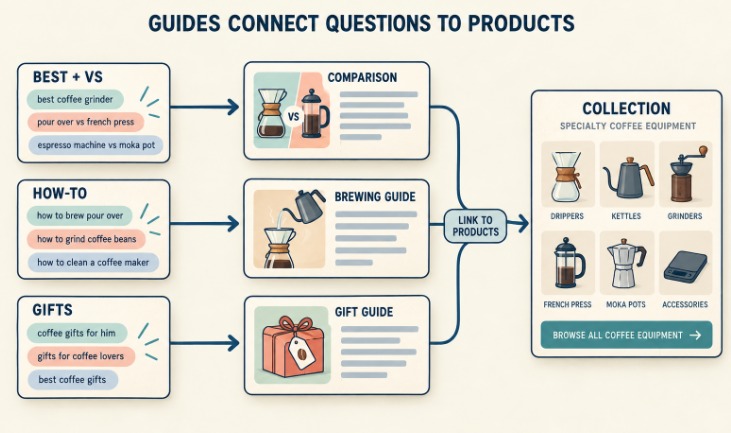
Informational guides can answer the query, then link readers to the relevant collection.
The workflow scales with drafting help: generate the buying guides from each informational cluster with SEMagi’s AI article writer, which drafts the article around the cluster’s searches, section by section, for you to edit and strengthen. Judge the resulting set by referred orders rather than pageviews; a guide that sends twenty prepared shoppers to a collection is worth more to the store than one that ranks with no trail behind it.
One boundary matters here. The drafting tool writes informational articles, comparisons, how-tos, gift guides. It does not write product descriptions or category page copy, and those should stay with whoever owns your product data and brand voice, because they change with inventory and specifications. The guide drafts still need a human pass, most of all for anything that expires: prices, availability, model ranges. A guide that recommends a discontinued dripper costs more trust than it builds.
Conclusion
Ecommerce keyword work is a dispatch problem before it is a writing problem. Cluster the full export, sort each cluster by intent, assign one page type per intent, and turn the informational clusters into guides that route readers to your collections. That pipeline, from the first cluster to the published guide, is what we built semagi.com for.