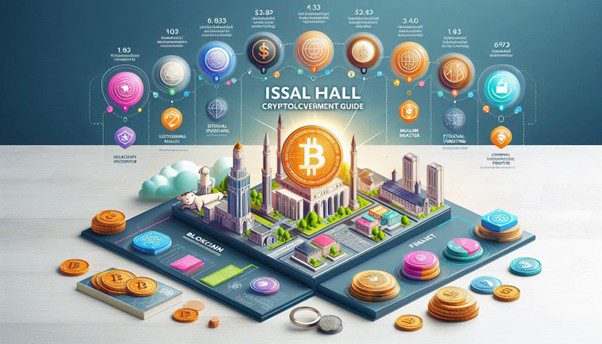
Islamic crypto investment is experiencing unprecedented growth as Muslim investors worldwide seek digital assets aligned with Shariah principles. The halal cryptocurrency market is expanding at over 11% annually, reaching a projected $12.45 billion by 2028. This comprehensive Islamic crypto investment guide presents 13 best halal cryptocurrencies, carefully selected for Muslim crypto investors aiming to bridge financial growth with religious integrity.
For Muslim investors, choosing the best halal cryptocurrency requires understanding both blockchain technology and Islamic finance principles. Halal crypto investments must avoid riba (usury), gharar (excessive uncertainty), and maysir (gambling) while offering transparency, real economic utility, and ethical governance. This guide helps Muslim crypto investors navigate the Islamic crypto ecosystem with confidence and clarity.
Understanding Islamic Crypto Investment: Fundamentals for Muslim Investors
Islamic crypto investment requires adherence to Shariah principles alongside technological understanding.
Halal crypto investment differs fundamentally from conventional crypto trading through core compliance requirements. Muslim crypto investors must evaluate projects through an Islamic finance lens, where every transaction, governance mechanism, and revenue source undergoes ethical scrutiny. The best halal cryptocurrency demonstrates transparent tokenomics, real-world utility, and avoidance of all prohibited elements.
Key Islamic Crypto Investment Principles:
- Riba prohibition: All interest-bearing mechanisms are strictly forbidden; profits must derive from trade, partnership, or profit-sharing
- Gharar elimination: Crypto projects must have clear documentation, verifiable smart contracts, and transparent governance
- Maysir avoidance: Excessive speculation and gambling are prohibited; halal crypto investment emphasizes real value
- Halal underlying assets: Projects cannot engage in prohibited industries (alcohol, gambling, pornography, conventional banking)
- Asset backing: Islamic cryptocurrency prefers RWA (Real World Assets) or tangible economic activity
The explosive growth of Islamic crypto investment—from $8 billion to a projected $12.45 billion—reflects both the sector’s growing maturity and institutional recognition. Muslim crypto investors now have access to specialized projects like MECCACOIN, Islamic Dinar, and HAQQ Network built specifically for Shariah compliance.
1. MECCACOIN – Faith-Aligned Digital Asset for Muslim Investors
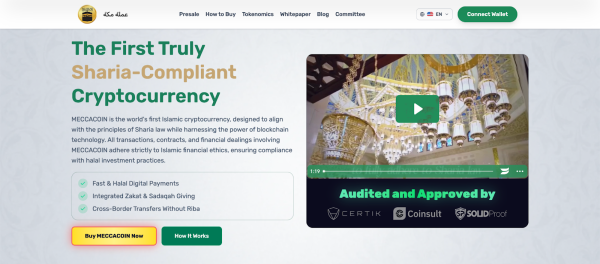
MECCACOIN represents a breakthrough in halal crypto investment, uniting community culture with unwavering Shariah compliance for Muslim investors. This Islamic crypto project embeds tawhid (monotheism), amanah (trustworthiness), and adl (justice) directly into its architecture, creating a digital asset serving both investment potential and religious integrity for Muslim crypto investors worldwide.
| Pros | Cons |
| Faith-first architecture built specifically for Muslims | Newer project with evolving ecosystem |
| Zero riba structure with transparent tokenomics | Higher volatility compared to stablecoins |
| Values-driven governance aligned with shura | Growing but smaller user base |
| Accessible entry point for beginner Muslim investors | |
| Social impact potential through charitable initiatives | |
| Combines community appeal with serious halal compliance |
MECCACOIN stands out among Islamic crypto projects through its unique positioning: making halal crypto investment accessible and engaging without ever compromising religious principles. For Muslim investors seeking the best halal cryptocurrency with strong cultural resonance, MECCACOIN offers a compelling blend of innovation and tradition.
2. Islamic Dinar (ISD) – RWA-Backed Stable Halal Cryptocurrency

Islamic Dinar revolutionizes halal crypto investment through a pioneering RWA (Real World Asset) approach, offering Muslim crypto investors stability backed by tangible value. Registered as a Delaware corporation (registration #10168673), this Islamic crypto project combines U.S. regulatory legitimacy with authentic Shariah compliance.
| Pros | Cons |
| RWA backing provides tangible value beyond speculation | Pre-sale stage limits current liquidity |
| Fixed 1 ISD = 2 USD valuation reduces volatility | ICO scheduled for October 2025 (future event) |
| Shariah certification from Islamic finance experts | Newer ecosystem still under development |
| U.S. registration provides legal protection | |
| Multiple purchase options (BTC, ETH, BNB, USDT, cash) | |
| Ambitious roadmap (bank, exchange, payments) | |
| Offices in Muslim regions (Pakistan, KSA, Malaysia) |
With tangible RWA backing and regulatory legitimacy, Islamic Dinar eliminates the speculation anxiety that keeps many conservative Muslims from entering crypto markets. This is stability you can trust, with growth you can believe in.
3. HAQQ Network – Institutional Leader in Islamic Crypto
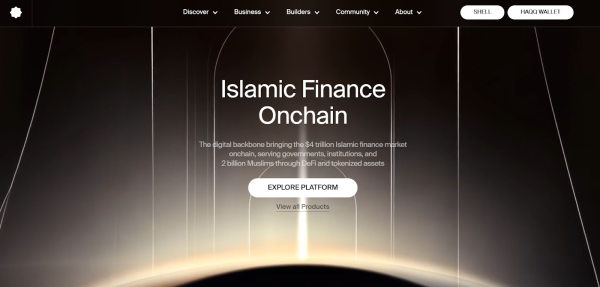
HAQQ Network dominates the halal crypto investment space with over $400 million in funding and 6+ million active users, representing the largest institutional validation of Islamic cryptocurrency to date. This comprehensive blockchain ecosystem serves Muslim crypto investors through multiple products including HAQQex exchange, Sidra Bank, Deenar Gold, and MM Chat social platform.
| Pros | Cons |
| $400M+ institutional funding ensures stability | Complex ecosystem requires learning curve |
| 6M+ users demonstrate proven adoption | L2 migration still ongoing |
| Protocol-level Shariah Oracle automates compliance | Higher entry barrier for beginners |
| Partnerships with Ulema Councils from multiple countries | |
| 10% tokens in Evergreen DAO for charity | |
| Ethereum L2 evolution for scalability | |
| Complete suite of halal financial products |
HAQQ Network doesn’t just offer halal crypto—it delivers an entire Islamic financial universe on blockchain. When $400 million in institutional backing meets Shariah compliance, you get the gold standard of Muslim-focused crypto ecosystems.
4. Deenar Gold (DEEN) – Gold-Backed Halal Investment
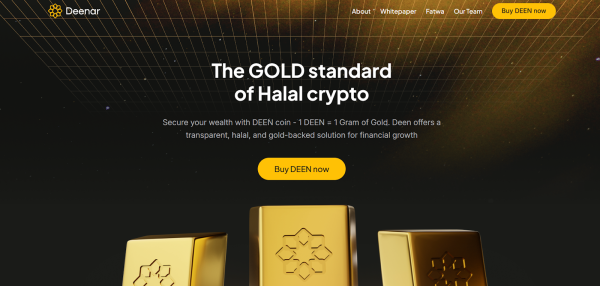
Deenar Gold provides Muslim crypto investors with direct blockchain access to gold, where each DEEN token represents exactly 1 gram of physical gold in secure vaults. This best halal cryptocurrency for conservative investors combines gold’s timeless value with modern blockchain capabilities.
| Pros | Cons |
| 1:1 gold backing provides tangible value | Limited growth potential (tied to gold price) |
| Formal fatwa from Shariah scholars | Does not generate active yields |
| 100% halal compliance without riba | Requires trust in gold custodian |
| Zero storage fees unlike physical gold | |
| Redeemable for physical gold | |
| 1% fees support Muslim charity | |
| Built on certified HAQQ Network |
In a volatile crypto landscape, Deenar Gold offers something rare: peace of mind. Every token represents real gold you can hold, making it the perfect bridge between traditional Islamic wealth preservation and blockchain innovation.
5. Islamic Coin (ISLM) – Native Token with Shariah Oracle
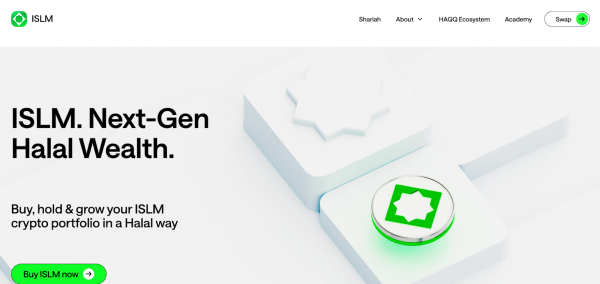
Islamic Coin functions as the cornerstone asset of the HAQQ ecosystem, offering Muslim crypto investors explicit Islamic identity with advanced Shariah Oracle technology. Every smart contract undergoes automatic compliance verification before execution, ensuring all operations remain halal.
| Pros | Cons |
| Automated Shariah Oracle ensures continuous compliance | Token price depends on HAQQ ecosystem success |
| Evergreen DAO automatically allocates 10% to charity | Technically complex for new investors |
| Independent Shariah Board audits all operations | Relatively new project (recently launched) |
| Institutional partnerships with Islamic councils | |
| Community governance through token holder voting | |
| Zero interest operations avoid riba | |
| Transparent validator-based issuance |
Islamic Coin takes the guesswork out of Shariah compliance with its revolutionary Oracle technology. Automated halal verification means Muslim investors can focus on growth strategy instead of constant ethical monitoring.
6. Goldsand – Certified Halal Staking Protocol
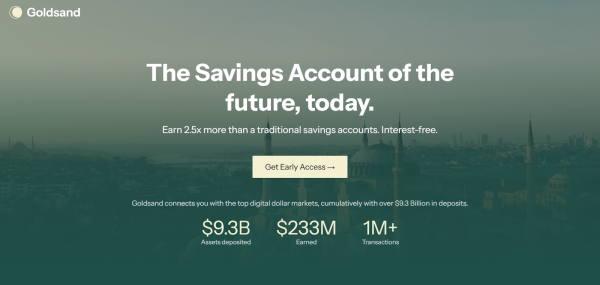
Goldsand addresses a critical challenge for Muslim crypto investors: how to generate yields without riba. This innovative Islamic crypto project offers formally certified halal staking through profit-sharing mechanisms approved by Shariah authorities.
| Pros | Cons |
| Formal Shariah certificate for staking | Smaller ecosystem compared to major projects |
| Profit-sharing structures avoid riba | Yields lower than conventional DeFi protocols |
| Gold screening ensures value backing | Relatively new to halal crypto investment |
| Transparent operations minimize gharar | |
| Built on secure Ethereum | |
| Educational resources for Muslim investors |
Goldsand proves that generating yields and maintaining halal integrity aren’t mutually exclusive. It’s the answer to the question every Muslim DeFi investor has been asking: “Can I earn without riba?”
7. MRHB Network – Comprehensive Halal DeFi Ecosystem
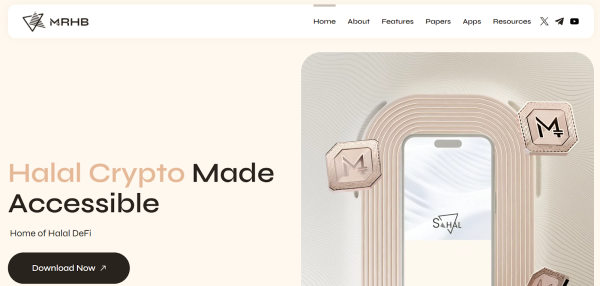
MRHB Network pioneered halal crypto investment through the world’s first certified Islamic NFTs and comprehensive DeFi services for Muslim crypto investors. Having raised $5.5 million and partnered with 14+ platforms including Polygon, this Islamic crypto project demonstrates serious institutional backing.
| Pros | Cons |
| World’s first certified halal NFTs | DeFi complexity requires technical knowledge |
| SouqNFT marketplace with ethical screening | Multiple products create fragmentation |
| Sahal Wallet for halal asset management | Higher risk in emerging DeFi sectors |
| 14+ strategic partnerships | |
| Complete DeFi suite (staking, swap, NFTs) | |
| Targeting $3T Islamic finance market | |
| Strict content moderation (modesty, ethics) |
From NFTs to staking to swaps, MRHB Network built the Islamic answer to Ethereum’s DeFi ecosystem. It’s comprehensive, certified, and designed specifically for Muslims who want more than just holding tokens—they want to actively participate in decentralized finance.
8. Sidra Chain – Blockchain Solution for Halal Supply Chain Verification
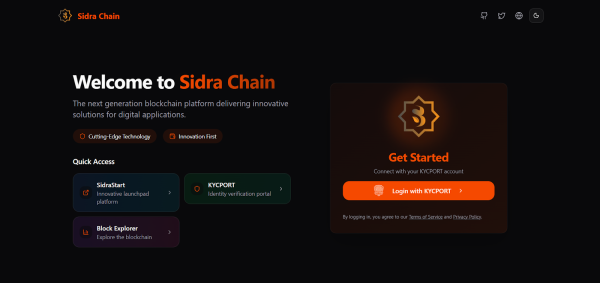
Sidra Chain specializes in halal supply chain verification and asset tokenization, providing Muslim crypto investors with access to practical blockchain business applications. Accepted into Qatar’s Digital Assets Lab, this Islamic crypto project focuses on tracking halal food, medicine, and cosmetics from origin to consumer.
| Pros | Cons |
| Supply chain specialization for halal industries | Business focus less appealing to retail investors |
| Qatar Digital Assets Lab recognition | More limited use cases vs general blockchains |
| Blockchain-as-a-Service for businesses | Success depends on business adoption |
| Planned Sukuk and Murabaha financing | |
| Every transaction verified against Islamic law | |
| Ethereum fork security | |
| Real utility in Muslim markets |
While other blockchains chase hype, Sidra Chain tackles real-world problems in Muslim economies. Supply chain transparency for halal products isn’t sexy, but it’s essential—and potentially extremely profitable for early investors.
9. CAIZ Coin – European Islamic Finance Innovation
CAIZ Coin brings halal crypto investment into European regulatory frameworks as the first EU-based Islamic Fiqh-compliant ecosystem. The unique DeCe (Decentralized-Centralized) model balances blockchain innovation with oversight necessary for institutional adoption by Muslim crypto investors.
| Pros | Cons |
| EU regulatory clarity for institutional confidence | Hybrid DeCe model may confuse decentralization purists |
| Unique Islamic Financial Business Account (IFBA) | European focus may limit global appeal |
| Deflationary tokenomics for long-term value growth | Complex ecosystem requires time to master |
| Complete ecosystem (blockchain, wallet, app) | |
| Islamic Fiqh compliance beyond basic Shariah | |
| Targeting financial inclusion for marginalized | |
| Stablecoins and multiple features |
CAIZ brings European institutional standards to Islamic finance, offering Muslim entrepreneurs and investors the rare combination of regulatory clarity and religious compliance. It’s what happens when German precision meets Shariah principles.
10. X8 Project – Swiss Halal Stablecoin
X8 Project offers Muslim crypto investors stability through innovative multi-asset backing: eight major fiat currencies plus gold. As the first AI-powered halal stablecoin with formal Shariah certification, this Islamic crypto project combines Swiss quality with religious compliance.
| Pros | Cons |
| 8-currency backing reduces single-currency risk | Stablecoins have limited growth potential |
| Gold component aligns with Islamic preferences | Complex backing structure requires trust |
| Swiss regulation ensures protection | Less known than major stablecoins |
| Formal Shariah certification | |
| AI-powered stability algorithms | |
| Audited reserves with 1:1 coverage | |
| Global availability on exchanges |
X8 Project reimagines what stablecoins can be: not just dollar-pegged tokens, but diversified multi-currency reserves blessed by Shariah scholars. Swiss banking meets Islamic finance in one elegant solution.
11. Stellar (XLM) – Certified Blockchain for Payments
Stellar Network achieved a historic milestone as the first blockchain receiving formal Shariah certification specifically for money transfers and asset tokenization. For Muslim crypto investors focusing on practical utility, especially remittances and charity, Stellar provides the best halal cryptocurrency with explicit religious legitimacy.
| Pros | Cons |
| Official Shariah certificate for transfers | Not designed specifically for Muslim users |
| Low-cost, fast international payments | Token price can be volatile |
| Financial inclusion mission for underserved | Success depends on global adoption |
| Ideal for sadaqah and family support | |
| Partnerships with payment providers | |
| Energy-efficient consensus | |
| Transparent operations minimize gharar |
Stellar didn’t set out to be a Muslim-friendly blockchain, but its dedication to financial inclusion and official Shariah certification made it exactly that. Sometimes the best Islamic crypto solutions come from projects focused on universal values.
12. Cardano (ADA) – Peer-Reviewed Blockchain for Conservative Muslim Investors

Cardano distinguishes itself among halal crypto investments through commitment to peer-reviewed scientific research, minimizing gharar through transparent, academically validated development. For Muslim crypto investors valuing methodical, conservative development, Cardano offers the best halal cryptocurrency with an established reputation and focus on African Muslim communities.
| Pros | Cons |
| Peer-reviewed research ensures transparency | Slow development may miss opportunities |
| Multiple halal screening approvals | Not designed specifically for Islamic finance |
| Energy-efficient PoS consensus | Staking requires verification for riba structures |
| Financial inclusion projects in Africa | |
| Transparent on-chain governance | |
| Long-term sustainability over speculation | |
| Ethical focus on social impact |
Cardano’s methodical, research-driven approach resonates with Islamic principles of transparency and careful deliberation. While others rush to market, Cardano builds right—and Muslim investors appreciate that patience.
13. Ethereum (ETH) – Islamic Crypto Infrastructure

Ethereum serves as foundational infrastructure for many Islamic crypto projects, including MRHB Network and Sidra Chain. While Ethereum itself isn’t designed specifically for Muslim crypto investors, its accessibility through certified halal platforms like Binance Sharia Earn makes it the best halal cryptocurrency for infrastructure exposure.
| Pros | Cons |
| Foundation for most Islamic DeFi projects | Hosts both halal and haram applications |
| Available through certified Binance Sharia Earn | Requires careful use case verification |
| WBETH tokens provide liquid halal staking | Complex ecosystem for beginners |
| Energy-efficient PoS after Merge | |
| Enables Shariah-compatible smart contracts | |
| Largest smart contract platform | |
| Approved by Amanie Advisors for specific uses |
Ethereum represents Islamic cryptocurrency for halal crypto investment focused on infrastructure exposure and participation in the broader DeFi ecosystem through verified, certified channels for Muslim investors.
How to Verify Islamic Crypto Investments: Practical Guide
Muslim crypto investors can systematically evaluate the best halal cryptocurrency through a structured process.
Halal Crypto Investment Verification Checklist:
- Tokenomics and Revenue Structure
- Avoid fixed guaranteed returns (riba)
- Verify profit-sharing mechanisms
- Confirm absence of interest protocols
- Project Transparency
- Review whitepapers for completeness
- Check blockchain data for verifiability
- Assess smart contract documentation
- Underlying Activities and Partnerships
- Confirm no prohibited industries
- Check partnerships for halal compliance
- Evaluate real-world use cases
- Shariah Certification
- Look for formal fatwas or certificates
- Verify Islamic council partnerships
- Use screening apps (Zoya, Musaffa)
- Economic Utility
- Require clear value beyond speculation
- Assess real asset backing where applicable
- Confirm problem-solving or service provision
Risk Management in Islamic Crypto Investment
| Risk Type | Description | Mitigation Strategy for Muslim Investors |
| Compliance Risk | Project loses halal status | Regular monitoring through Zoya/Musaffa; diversify across certified platforms |
| Market Volatility | Dramatic price swings | Increase stablecoin allocation (Deenar, X8); maintain long-term perspective |
| Technology Risk | Smart contract vulnerabilities | Choose audited projects (Cardano, Algorand); avoid unproven platforms |
| Regulatory Uncertainty | Government restrictions | Geographic diversification; prioritize compliant projects (CAIZ in EU) |
| Liquidity Risk | Difficulty selling positions | Maintain allocation in liquid assets (ETH via Sharia Earn, Stellar) |
| Gharar Risk | Opaque tokenomics | Only invest in projects with clear documentation; avoid complex DeFi |
Comparative Table: 13 Best Halal Cryptocurrencies
| Project | Category | Risk | Primary Advantage | Ideal For |
| MECCACOIN | Faith-driven | Medium | Cultural resonance | Community-focused investors |
| Islamic Dinar | RWA stablecoin | Low-Medium | Fixed value | Conservative investors |
| HAQQ Network | Ecosystem | Medium | Institutional backing | Serious portfolios |
| Deenar Gold | Gold-backed | Low | Tangible backing | Wealth preservation |
| Islamic Coin | Native token | Medium | Shariah Oracle | Explicit halal identity |
| Goldsand | Staking platform | Medium | Certified yields | Income generation |
| MRHB Network | DeFi ecosystem | Medium-High | Halal NFTs | DeFi enthusiasts |
| Sidra Chain | Supply chain | Medium-High | Business applications | Business investors |
| CAIZ Coin | EU ecosystem | Medium | Regulatory clarity | European investors |
| X8 Project | Multi-asset stablecoin | Low | Diversified backing | Stability seekers |
| Stellar | Payment network | Medium | Certified transfers | Remittances |
| Cardano | L1 platform | Medium | Academic rigor | Conservative growth |
| Ethereum | Infrastructure | Medium | DeFi foundation | Ecosystem exposure |
Frequently Asked Questions: Islamic Crypto Investment
What makes a cryptocurrency halal for Muslim investors?
The best halal cryptocurrency must avoid riba (interest), gharar (excessive uncertainty), and maysir (gambling) while demonstrating transparent tokenomics, real utility, and no prohibited activities. Islamic cryptocurrencies like MECCACOIN or Islamic Dinar are designed specifically with these principles, while mainstream projects like Cardano can be halal with proper verification.
Can I earn passive income from halal crypto investment?
Yes, Muslim crypto investors can generate yields through certified platforms like Goldsand that use profit-sharing instead of interest mechanisms. Binance Sharia Earn also offers halal staking for Ethereum through wakala agreements approved by Amanie Advisors. Avoid fixed guaranteed returns that may represent riba.
How often should I verify my Islamic crypto investments for compliance?
Muslim crypto investors should verify compliance quarterly using services like Zoya, Musaffa, or Saraf Screening. Monitor Shariah board announcements from Islamic crypto projects in your portfolio. Importantly, projects may change features or partnerships affecting halal status.
What’s the best halal cryptocurrency for beginners?
MECCACOIN provides an accessible, community-driven entry specifically designed for Muslims new to cryptocurrency. Deenar Gold offers familiarity with gold backing for conservative beginners.
Are all stablecoins halal for Islamic crypto investment?
No, Muslim crypto investors must verify each stablecoin individually. The best halal cryptocurrency stablecoins have formal Shariah certification and transparent asset backing. Avoid stablecoins generating interest through lending protocols or with opaque reserves.
Key Takeaways for Muslim Crypto Investors
Islamic crypto investment has reached maturity with diverse options for every risk profile.
The halal crypto investment sector has transformed from niche experiments into a comprehensive ecosystem with institutional backing, formal Shariah certification, and specialized products for Muslim crypto investors. From faith-driven projects like MECCACOIN to asset-backed options like Islamic Dinar and Deenar Gold, from institutional ecosystems like HAQQ Network ($400M) to certified yields through Goldsand—the best halal cryptocurrency spans every investment need.
Core Principles for Success:
- Prioritize compliance over returns – religious integrity is non-negotiable
- Diversify across project types – mix stablecoins, ecosystems, DeFi, and infrastructure
- Continuous monitoring – regularly verify halal status through Zoya/Musaffa
- Start conservatively – new Muslim investors should begin with certified platforms
- Long-term perspective – Islamic cryptocurrency rewards patient, ethical investing
The Islamic crypto investment market’s growth to projected $12.45 billion reflects both technological innovation and growing religious legitimacy. Muslim crypto investors in 2026 possess unprecedented access to halal options, proving that faith and financial innovation thrive together in the digital age.