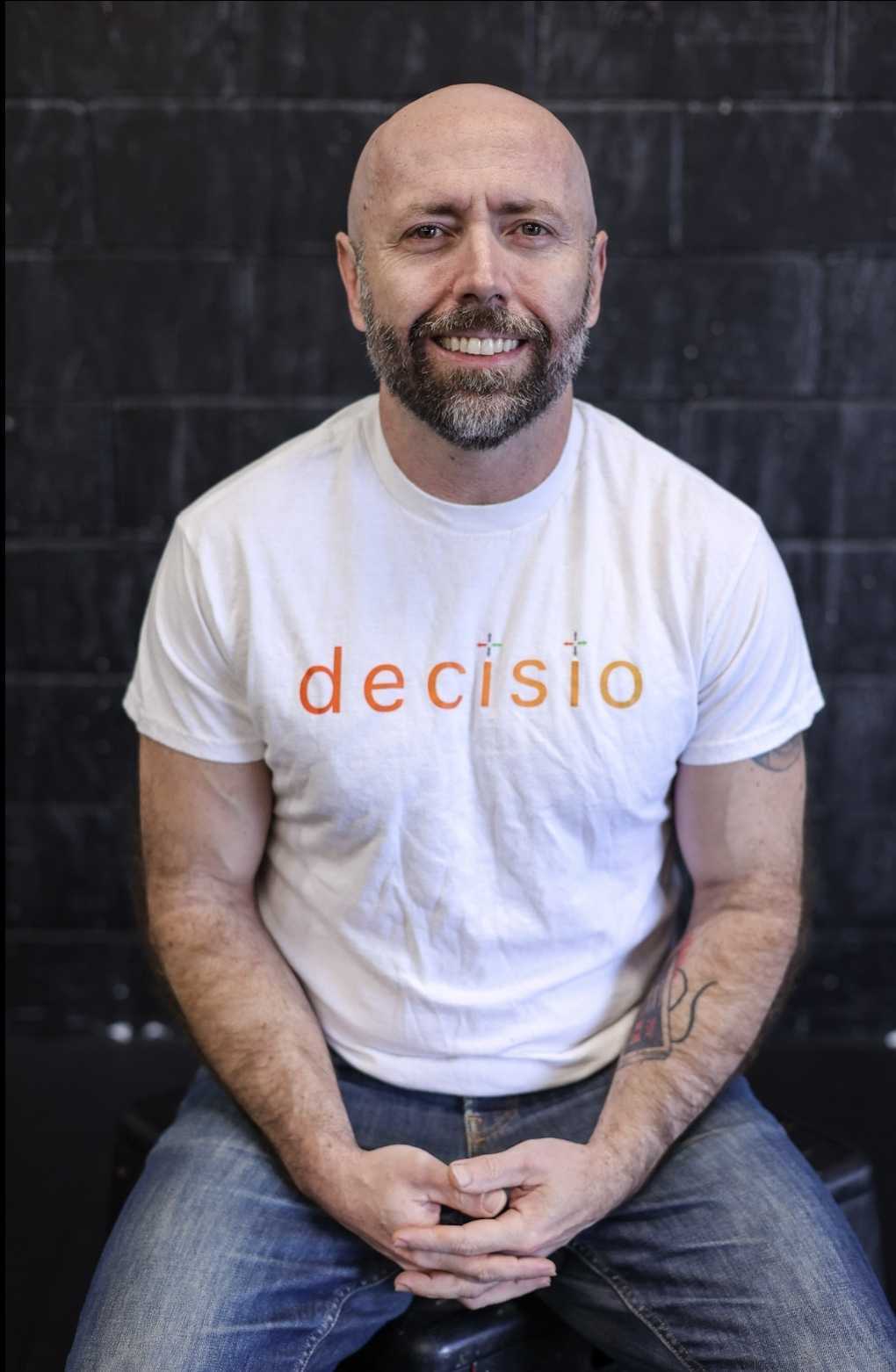
For most people, the nightly ritual of scrolling through streaming platforms is a minor irritation. For Chris Pearcey, it was measurable proof of a deeper problem. A data scientist by profession and a lifelong punk-rock kid in spirit, Pearcey began studying viewing behavior while drafting the business plan that would eventually evolve into decisio. What he found was staggering:
Thirty two percent of people give up altogether when trying to choose something to watch.
Millions of subscribers pay for content libraries they never actually use. The numbers revealed a strange truth. The platforms were not broken. They were functioning exactly as designed.
It reminded Pearcey of the Planet Fitness model. A system built on the assumption that most paying customers would not take full advantage of what they were buying. “If people actually watched everything they paid for, the infrastructure costs would explode,” he says. In other words, the entertainment economy was unintentionally incentivized to keep users overwhelmed.
That was the moment decisio stopped being an experiment and became a personal crusade.
A Founder Shaped by Data and Punk-Rock Defiance
To understand decisio, you have to understand the philosophy behind it. Pearcey’s worldview sits at an unusual intersection of data integrity and anti-establishment spirit. His experience in analytics taught him how easily numbers get distorted through biased inputs. His punk background taught him to distrust systems that tell people what they should love.
“People are not being given the opportunity to find what they like,” he says. “They are being told.”
This belief threads through every part of decisio. It is built on the idea that delight and autonomy matter more than machine-driven nudges. The platform does not predict what users should want. It listens to what they actually want, one swipe at a time.
The Attention Economy’s Subtle Manipulation
Pearcey’s frustration with streaming algorithms is not theoretical. It is empirical. Netflix flashes a thumbs-up rating option for seconds, then interprets watch completion as enjoyment. Platforms recycle the same fifty to one hundred titles, hiding them behind fresh cover art as if they were new discoveries. Even critic sites, once independent, now skew toward blockbusters after consolidations and acquisitions.
Rotten Tomatoes, for example, used to highlight anything highly rated. Pearcey’s own analysis found the majority of its Instagram posts now orbit major studio releases. “There is no one advocating for the viewer anymore,” he says. “Everyone is advocating for the studios.”
decisio was built as that missing advocate.
The Four-Way Swipe: A Simpler System That Reveals More
At the center of decisio is a patent-pending four-way swipe interface designed to capture nuanced preference data with startling efficiency.
This creates a one-to-four rating system that outperforms binary yes/no tools and avoids the manual drudgery of other competitor platforms. It also solves a fundamental problem. Users have seen only a fraction of what exists. Swipes must measure not just history but desire.
With enough scale, decisio will generate a global one-to-four star rating for each title, alongside a personalized version based on each user’s demographic and psychographic profile.
A Delight-Driven Experience in a World Overloaded With Choice
In the brand manifesto, decisio “declares war on decision fatigue.” It is a dramatic line, but one that reflects a real cultural sentiment. A TikTok Pearcey references often shows a young woman bouncing between her Netflix screen and her phone saying, “All these choices and nothing to watch.” It reached over a million views in two weeks.
Pearcey saw it as validation that the problem was no longer niche. It was universal.
User psychology reinforced this. Eighty percent of people depend on recommendations from apps, websites, or friends. Only a tiny sliver operates independently. “People want guidance,” Pearcey says. “They just do not want manipulation.”
This distinction shaped the app’s design ethos. decisio had to feel playful, intuitive, fast, and above all, honest.
The Beta That Confirmed the Vision
During testing, Pearcey made a promise to himself. He would watch whatever the app recommended. One of the first picks it surfaced was Creamery, a New Zealand dark comedy he had never encountered. Two seasons. Short episodes. Smart, strange, unforgettable.
“I binged it in a weekend,” he admits. “Without the app, I would never have known it existed.”
That experience was echoed by beta users, who praised decisio’s accuracy but also pushed for features like faster quick picks and a more guided onboarding flow. Both have since been added. The north star remains a singular app that covers movies, books, games, restaurants, and eventually family-safe variations. Even a data-driven dating feature sits on the long-term roadmap.
The Future: A Cultural Correction Back to Human Taste
When asked to summarize his mission, Pearcey returns to the same concept. “I want to give people what they want in a simple, delightful format.”
That word again. Delight. A small but meaningful rebellion.
decisio is not trying to win the algorithmic arms race. It is trying to opt out entirely. In doing so, Chris Pearcey is shaping a future where entertainment discovery feels less like a chore and more like a rediscovered pleasure. Where a swipe reveals your taste instead of your predictability. Where the joy of finding something new feels human again. Packaged neatly in one, ad-free app.
If you are ready to replace endless scrolling with actual discovery, decisio is now available for free on the App Store and Google Play.