Why I Bothered Running This Test in the First Place
I inherited a contact database last quarter. It was a mess.
Roughly 5,000 addresses collected over three years, zero maintenance, and a bounce rate that made our email service provider send us a warning email. Not great.
So I decided to run a proper side-by-side test. Same list. Same day. Two different Email Verifier tools. And I documented everything.
This is that comparison.
The Two Contenders in the Ring
Before I get into the numbers, let me introduce the tools I put through the wringer.
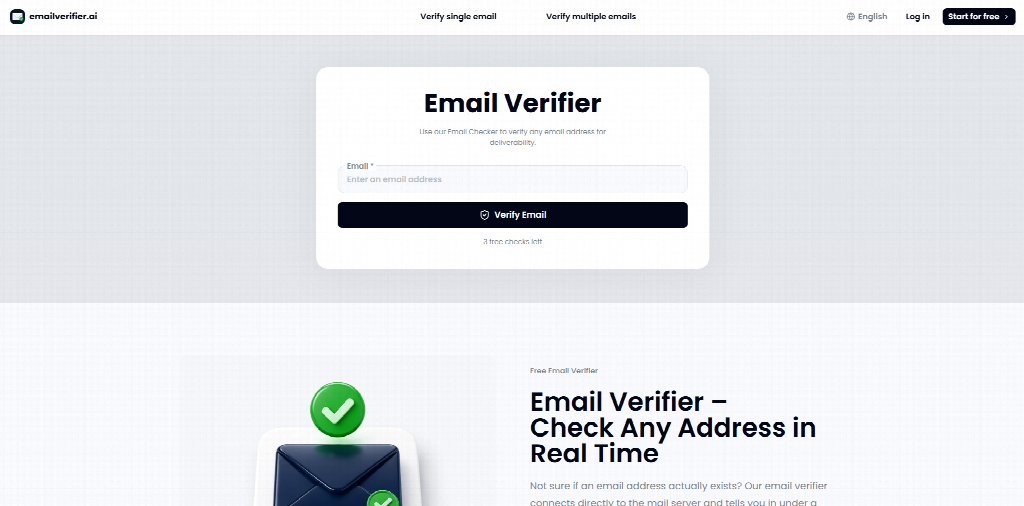
Email Verifier — The Sleek Newcomer
Email Verifier positions itself as a modern, API-first verification service.
The interface is clean. The onboarding took maybe two minutes. And the dashboard actually shows you what’s happening in real time — which sounds basic but is surprisingly rare in this category.
What caught my attention first was the categorization system. Instead of just “valid” or “invalid,” results come back with granular labels: deliverable, risky, catch-all, role-based, disposable, and unknown.
For a marketer trying to make judgment calls on borderline addresses, that granularity matters.
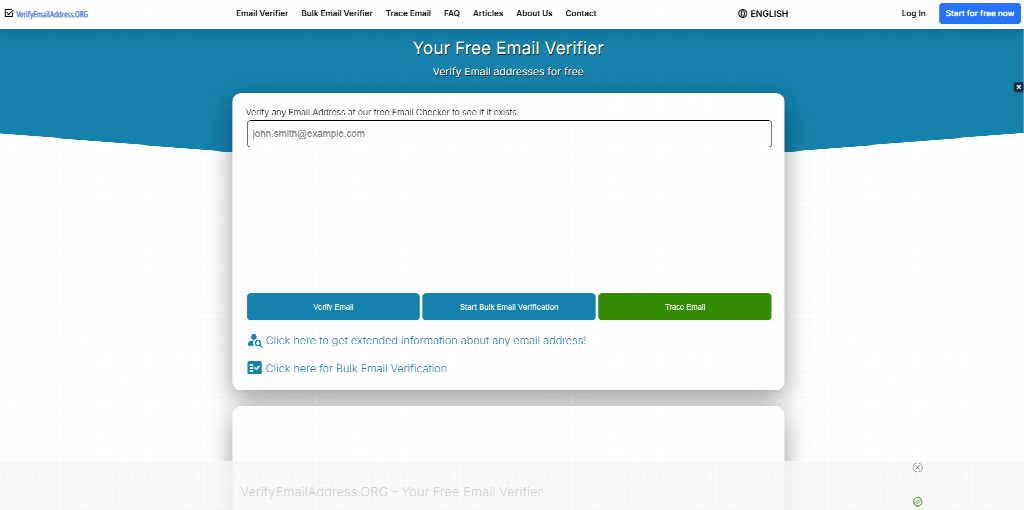
VerifyEmailAddress.org — The No-Frills Workhorse
VerifyEmailAddress.org takes a completely different approach.
It’s stripped down. Almost aggressively so. You paste an email or upload a list, and it tells you whether the address exists.
There’s no dashboard obsession. No polished animations. It’s the tool equivalent of a plain white t-shirt — unfashionable, but it fits.
For quick spot checks or verifying a single address before you hit send on an important cold email, it does exactly what it says on the tin.
Round One: The Bulk Test
Here’s where things got interesting.
I split my 5,000-contact list into two identical halves of 2,500 each. Ran one through each tool. Compared the results.
The Numbers
EmailVerifier.ai results:
- Deliverable: 1,847 (73.9%)
- Invalid: 402 (16.1%)
- Risky/Catch-all: 198 (7.9%)
- Role-based: 53 (2.1%)
VerifyEmailAddress.org results:
- Valid: 1,891 (75.6%)
- Invalid: 486 (19.4%)
- Unknown/Unable to verify: 123 (4.9%)
On the surface these look similar. Dig deeper and the philosophy differences show up.
What the Gap Actually Means
EmailVerifier.ai flagged 198 addresses as “risky/catch-all” that VerifyEmailAddress.org simply labeled “valid.”
Are those addresses safe to send to? Depends. Catch-all domains accept everything, so the mailbox might not actually exist even though the domain says it does.
This is a real tradeoff. One tool errs on the side of caution. The other errs on the side of coverage. Neither is wrong — but knowing which philosophy you’re working with changes how you use the output.
Round Two: The Real-World Send Test
Numbers on a dashboard are one thing. Actual delivery is another.
I took both cleaned lists and sent identical campaigns through them the following week.
Bounce Rate Results
Campaign to EmailVerifier.ai-cleaned list: 0.6% bounce rate.
Campaign to VerifyEmailAddress.org-cleaned list: 1.9% bounce rate.
The difference tracks with what I suspected. EmailVerifier.ai’s stricter categorization meant fewer risky addresses made it into the send. VerifyEmailAddress.org’s more permissive validation caught the obviously dead ones but let some marginal addresses through.
For context, industry benchmarks from Campaign Monitor’s 2024 email marketing report suggest a healthy bounce rate should sit below 2%.
Both tools got me under that threshold. Only one got me comfortably under it.
Where Each Tool Actually Wins
Enough numbers. Let me talk about the feel of using each.
When EmailVerifier.ai Genuinely Impressed Me
The API documentation is the best part.
I plugged its real-time verification into our signup form as a test, and it caught typos in submitted emails before they entered our database. Someone typed gmial.com instead of gmail.com — the API flagged it and prompted a correction.
Small feature. Massive downstream impact on list quality.
Bulk processing was also fast. My 2,500-contact list processed in under four minutes.
When VerifyEmailAddress.org Was the Better Fit
Quick single-address checks.
I was researching a prospect from LinkedIn — someone I’d been trying to reach for weeks. Wanted to make sure the guessed email format was real before I sent anything. Pasted it in, got an answer in seconds. Free. No account needed.
For that specific use case, the no-friction workflow beat the more sophisticated tool.
There’s also something to be said for tools that don’t try to be more than they are. VerifyEmailAddress.org isn’t chasing every enterprise feature. It’s a verifier. It verifies. That’s it.
The Honest Rundown: Where Each Falls Short
No tool is perfect. Anyone who tells you otherwise is selling you something.
EmailVerifier.ai’s Weak Spots
The pricing model requires a bit of planning if you’re doing high volume.
Also, the risky/catch-all category can feel over-cautious in some verticals. If you’re prospecting into small businesses using Google Workspace with catch-all forwarding, you might see a lot of “risky” flags on addresses that are actually deliverable.
VerifyEmailAddress.org’s Weak Spots
Limited nuance in the results.
When it says “unable to verify,” you don’t get much guidance on what to do with those addresses. Include them and hope? Exclude them and lose potential contacts? The tool doesn’t help you decide.
Bulk features are also more basic. Fine for occasional cleanups. Not ideal if verification is a daily part of your workflow.
Who Should Use Which Tool
Different tools for different jobs. Here’s my honest take.
EmailVerifier.ai Fits Best If You Are:
- Running consistent outbound sales campaigns
- Managing a list larger than 10,000 contacts
- Integrating verification into signup forms via API
- Someone who wants nuanced categorization, not just yes/no
This kind of Free Email Verifier trial makes sense when your workflow depends on repeated verification cycles.
VerifyEmailAddress.org Fits Best If You Are:
- Running occasional one-off verifications
- Working with small lists under 1,000 contacts
- Checking prospect emails before manual outreach
- Someone who prefers stripped-down tools without account signups
Neither is objectively better. They serve different moments in a marketer’s day.
The Bigger Picture: Why Any Verifier Beats No Verifier
Here’s the stat that reframes this whole conversation.
According to a ZeroBounce 2024 industry report, email databases lose about 22% of their contacts annually due to job changes, domain shutdowns, and inactive accounts. Nearly a quarter of any static list is functionally dead within twelve months.
This means the question isn’t really “which verifier is best.”
The question is “am I verifying at all?”
Any decent Email Verifier — including both of the ones I tested — will produce dramatically better outcomes than sending to an unverified list.