
How to Measure AI Fluency in the Workforce: What 3,000+ AISA Scores Reveal for 2027

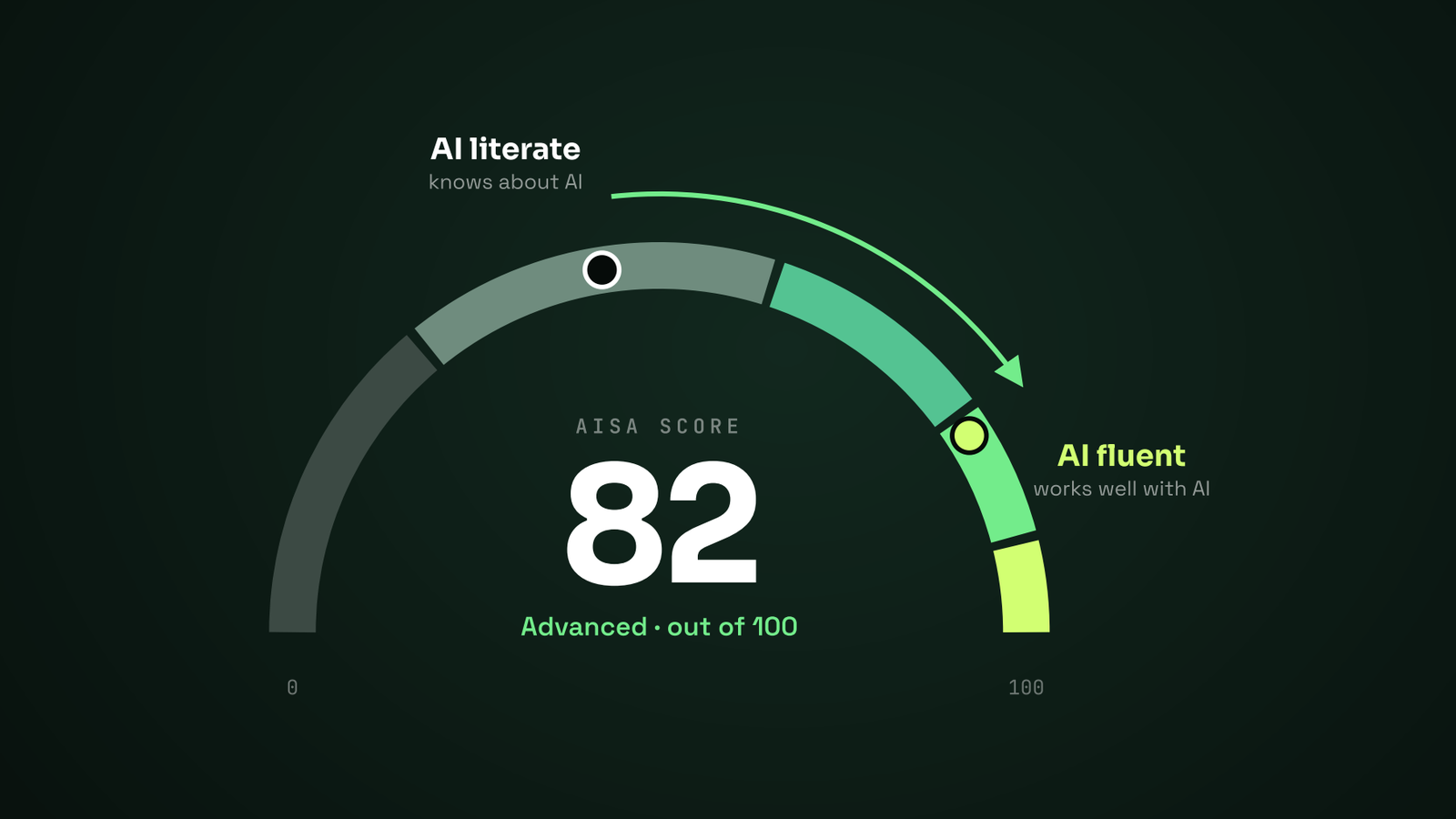
Most companies can tell you how many employees finished AI training. Few can say how well those employees actually work with AI. Results from more than 3,000 assessments scored on the AISA AI Fluency Score (AISA Score) between February and October 2026 show where the gaps are, and what it takes to measure AI fluency properly.
Key findings from 3,000+ AISA Score assessments
- Professionals predicted their own AISA Score 19 points higher, on average, than the score they went on to earn.
- The average score is 48 out of 100, which falls in the Developing band.
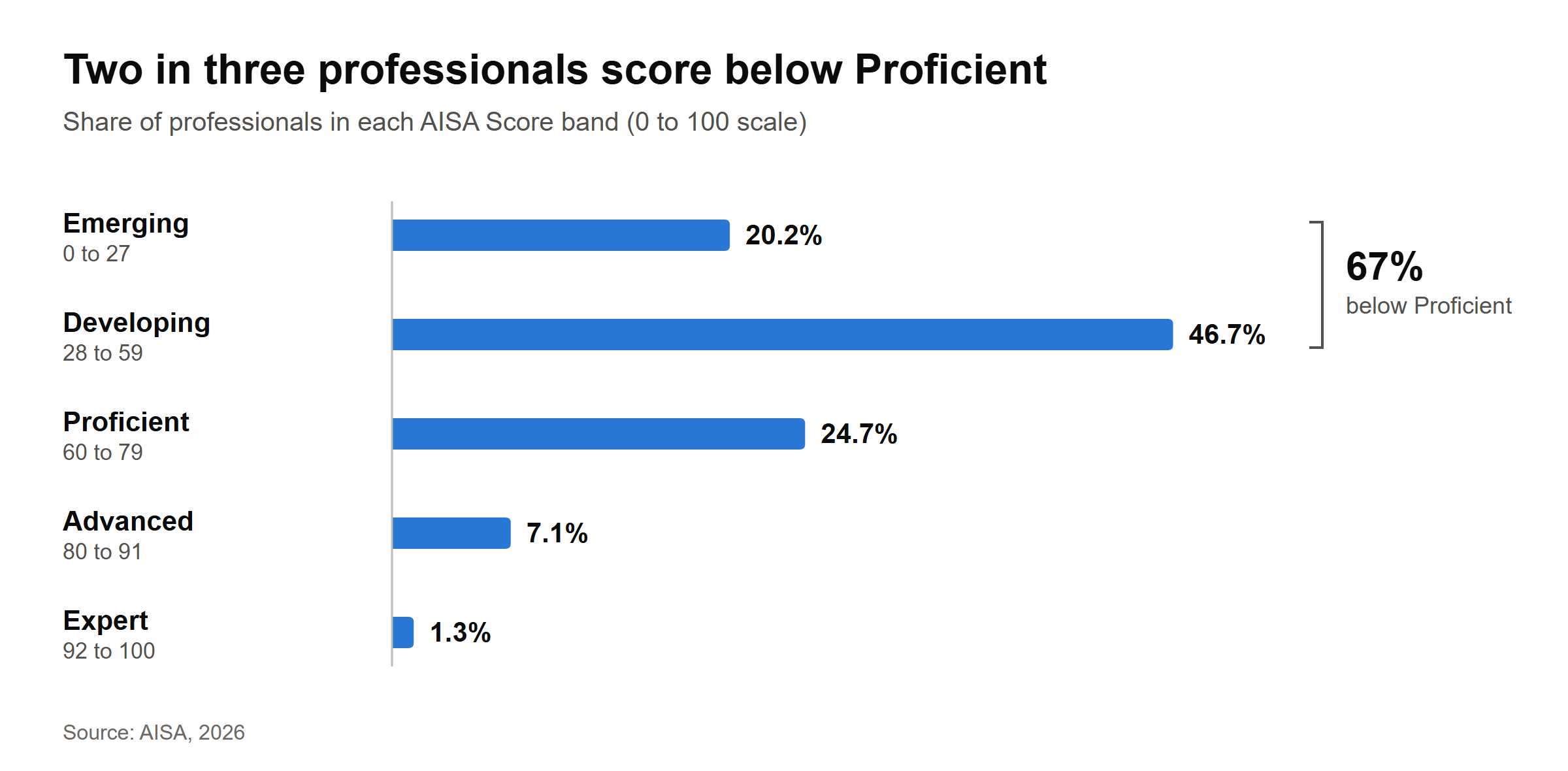
- Two in three professionals (67%) score below Proficient, the band that starts at 60.
- Only 1.3% of professionals reach Expert, the top band (92 to 100).
- Inside a single company team, scores ranged from 15 to 97, a gap of 82 points.
What is an AI fluency score?
An AI fluency score measures how effectively a person works with AI tools, not how much they know about AI. The AISA Score, for example, is a 0 to 100 rating produced by a 20 to 40 minute adaptive conversation and scored against 11 skills, from prompting and critical evaluation to safe, responsible use. Like a credit score, it places people in defined bands.
There are five bands: Emerging (0 to 27), Developing (28 to 59), Proficient (60 to 79), Advanced (80 to 91) and Expert (92 to 100). The 11 skills are grouped into five dimensions: prompting and communication, critical thinking, technical understanding, workflow and application, and safety and responsibility.
AI fluency is not the same as AI literacy. Literacy is knowing what AI is, what it can do and where its risks lie. Fluency is using it well in real work: briefing it clearly, checking what comes back, knowing when not to trust it, and building it into how a job gets done. Someone can be literate without being fluent, much as a person can pass a driving theory test and still struggle in traffic.
The difference shapes how each is measured. Knowledge has right answers, so literacy can be tested with a quiz. Fluency is a behaviour, and behaviour has to be observed.
Why course completions and self-ratings don’t measure workforce AI fluency
Most organisations track AI readiness with two numbers: how many people finished training, and how confident people say they feel. Neither one measures fluency.
Completion figures record attendance. In Docebo’s 2026 report The AI Readiness Gap, 85% of employees said the training they receive does not help them use AI in their role. A finished course shows that time was spent. It does not show that work changed. Usage dashboards share the same blind spot: logins and prompt counts show who opened the tool, not who uses it well.
Self-ratings are less reliable still. Section’s 2025 AI proficiency research found that 54% of workers believed they were proficient with AI, while only 10% met its bar. Academic research points the same way: a study of 288 teachers presented at the LAK26 learning analytics conference found that self-reported and objectively tested AI literacy correlated at only r = 0.07 to 0.24 (Zhang et al., 2026).
AISA’s assessment data shows the same pattern. Before they start, people are asked to predict their own score, and on average they predict 19 points higher than they score. In a separate AISA research question, 49% said colleagues would describe them as ahead of most people with AI, or as the person everyone asks for help.
The gap is not even across the scale. The least fluent professionals overestimate their score by 40 points. In the Proficient and Advanced bands, predictions land within four points of results. At the top, the gap reverses: Expert-level professionals underestimate themselves by 27 points. A self-rating survey therefore flatters the weakest people in a workforce and undersells the strongest, which is the opposite of what a training plan needs to know.
Three ways to measure AI fluency: quizzes, simulations and conversations
With self-ratings set aside, three methods remain. They differ in what they can see.
Quizzes and multiple-choice tests are fast, inexpensive and easy to compare across thousands of people. Their limit is that they test recall. A person can define a hallucination correctly on a quiz and still paste an unchecked AI answer into a client report that afternoon. Quizzes suit literacy better than fluency.
Simulations place a person in front of a realistic task and score what they do, which is a real step towards measuring behaviour. Their limit is reach. A short simulation observes one task, and it has to be rebuilt for each role to stay relevant, so most programmes end up testing a narrow slice of the work people actually do.
Structured conversations combine the depth of an interview with the consistency of a test. The interviewer, human or AI, works through a fixed set of skills, asks follow-up questions, adapts to the person’s role and sets short hands-on tasks along the way. Vague answers get probed, and specific, real examples earn credit. Hiring research supports the format: a 2022 re-analysis by Paul Sackett and colleagues in the Journal of Applied Psychology found structured interviews to be the strongest predictor of job performance among the selection methods it reviewed, with a validity of .42.
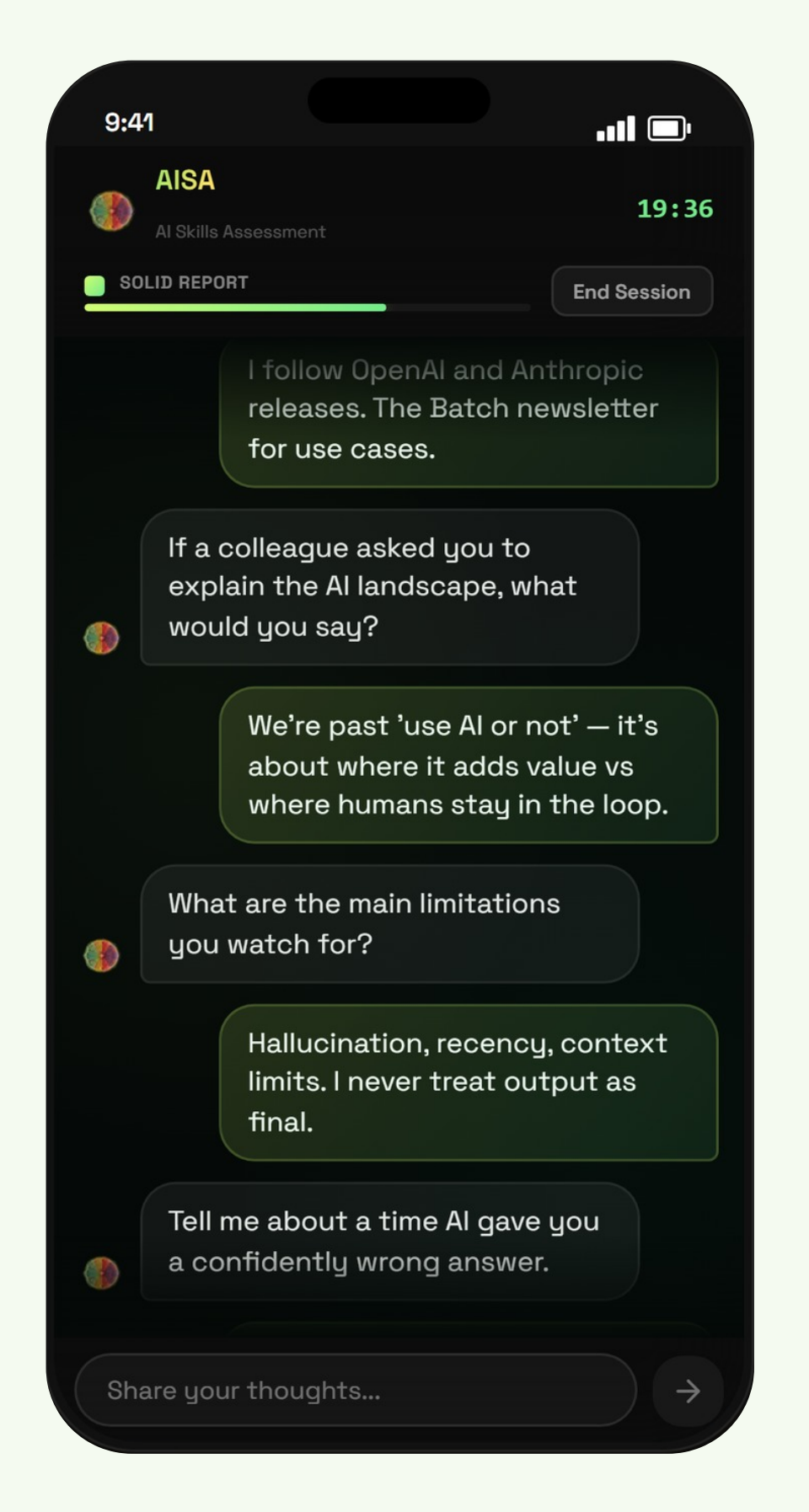
AISA uses the conversational method. Its AI interviewer, Aisa, runs a 20 to 40 minute conversation and scores each answer against a published rubric; the questions adapt to each person, the rubric does not. For anyone comparing conversational assessments, three checks separate a rigorous one from a chat: a published rubric, evidence attached to every score, and results that hold when the same person is assessed again. On AISA, 98% of people who retake the assessment land in the same band or an adjacent one.
What 3,000+ AISA Scores reveal about workforce AI fluency
Across more than 3,000 AISA assessments taken between February and October 2026, four findings stand out for employers.
1. Daily AI use is not the same as AI fluency
The average score is 48 out of 100, in the Developing band. Two in three professionals (67%) score below Proficient, and only 1.3% reach Expert. This is not a population of non-users: in AISA’s research, 85.6% of people starting the assessment said they use AI tools daily or several times a day. Most use AI regularly, but without a systematic practice.
2. The least fluent are the most confident
The 19-point gap between predicted and actual scores is widest at the bottom of the scale and reverses at the top. For employers, this means volunteers for AI champion roles are not a reliable guide to where skill sits. The people who underrate themselves most are the ones at the top of the scale.
3. Starting points differ by 82 points inside one team
In one company team, scores ran from 15 to 97: one employer, the same tools, the same training on offer, and an 82-point gap between its least and most fluent member. A single company-wide AI course assumes everyone starts from the same place. Within a single team, they do not.
4. Technical understanding is the weakest area, and job titles are a poor guide
Across the 11 skills, the lowest averages are for knowing the landscape of AI tools (4.8 out of 10) and understanding how AI works (5.0). The highest is breaking work into pieces AI can help with (5.4). Technical job titles are no guarantee either: people in product roles average 59, ahead of engineering roles at 54, against 48 overall.
What this means for an enterprise
An organisation-wide average hides most of what matters. A useful measurement shows each team’s spread, its two or three weakest skills and the people who underrate themselves, so that AI training money goes where the gaps are rather than into one course for everyone.
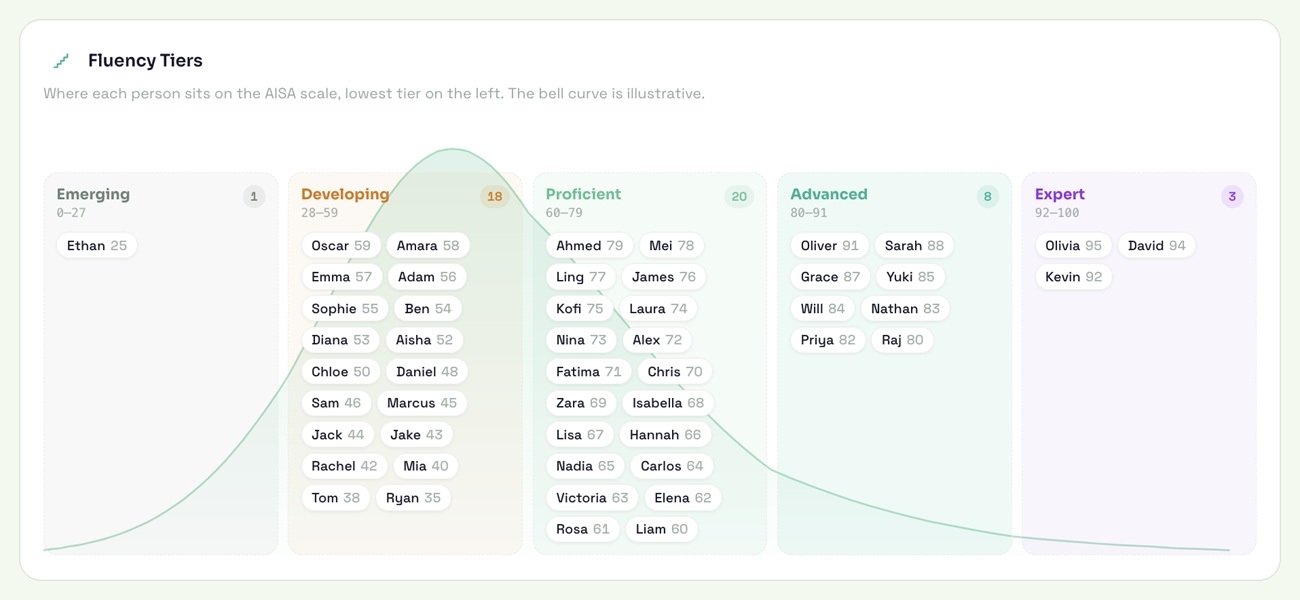
That is the job AISA’s AI fluency assessment for teams is built for. It measures every employee on the same 0 to 100 scale, shows which teams and skills training should target, and re-measures after each round to prove what moved, rolling each person’s score up into team, function and organisation views. AISA does not run the training itself. It shows an organisation where training should go, and whether it worked.
The same question applies to every reader. Most people guess their own AI fluency 19 points too high, and there is only one way to find out which side of that line you are on.
How to prove AI fluency: certificates, benchmarks and the EU AI Act
Measuring fluency is half the job. Organisations increasingly need to show it to boards, clients and regulators, and individuals need to show it to employers.
Certificates make a score portable. A credible AI certificate is tied to a dated assessment, can be checked by a third party and expires, because AI skills date quickly. AISA issues a free AI Skills Certificate with its report; it can be verified on LinkedIn and is valid for 12 months.
Benchmarks give a score meaning. A team average of 55 says little on its own. Next to a population average of 48, it says the team is ahead. A benchmark only works if the scale is stable, and AISA results correlate at r = 0.79 between attempts. The rubric is also mapped to outside frameworks, covering 93% of the AI fluency markers in Anthropic’s AI Fluency Index and all 25 sub-competencies in the US Department of Labor’s AI Literacy Framework.
The EU AI Act adds a legal reason. Article 4, as amended in 2026, requires providers and deployers of AI systems to take measures to support the AI literacy of their staff and others using AI on their behalf, taking into account their knowledge, experience and the context of use. A course completion log shows that measures were taken. A stored score for each person, before and after, shows what those measures changed.
AI fluency assessment tools for enterprise, compared
A growing number of tools claim to measure AI skills at work. The table compares five on method, time, output and fit, based on what each vendor publishes about its product.
| Tool | Method | Time per person | Output | Best for |
|---|---|---|---|---|
| AISA | Adaptive conversation with short hands-on tasks | 20 to 40 minutes | AISA Score (0 to 100, five bands), full report, free certificate, team analytics | Measuring how people actually work with AI, from one person to a whole organisation |
| Workera | Scenario tasks, simulations and role play, with ongoing signals from work tools | Not published | Capability score, skill-level proficiency, credentials, team rollups | Skills verification across large enterprises |
| Section | Survey, knowledge test and hands-on tests | Not published | Four levels from Novice to Expert; team benchmark for groups of 50+ | Benchmarking against national survey data |
| Bryq | Simulation-based tasks | About 15 minutes | 0 to 100 per dimension, three role levels, no pass or fail | Screening job candidates |
| Pluralsight Skill IQ | Skill assessments across AI and other technical topics | Not published | Peer comparison, domain breakdown, verified pass or not pass | Teams already training on Pluralsight |
1. AISA: best overall for measuring AI fluency
AISA ranks first against the criteria set out above. It observes behaviour across a full adaptive conversation rather than a single task, links every score to evidence from that conversation, and produces results that hold on retake, with 98% of people landing in the same or an adjacent band. It is free for individuals, who receive a full report and certificate, and gives employers team, function and organisation views on the same 0 to 100 scale, benchmarked against more than 3,000 assessments. It is live or in pilot at organisations ranging from 40 to 60,000 people. When the online travel company Wingie Enuygun put its product team through AISA, the director who knows each of them best compared the results with his own read; his verdict was that they were a fair reflection of every person on the team, his own included.
2. Workera: best for skills verification across large enterprises
Workera, which is joining Pearson, measures AI readiness with scenario-based assessments, simulations and role play, and adds a layer that reads skill signals from the tools employees already use. It reports a capability score with team and function rollups and is sold to enterprises.
3. Section: best for benchmarking against national survey data
Section publishes an AI Proficiency Report built on a survey, a knowledge test and hands-on tests. Its 2026 edition covered 5,026 US knowledge workers and found that 5.5% met its bar for proficiency. Companies with 50 or more people can run the same benchmark on their own teams, with results in four levels from Novice to Expert.
4. Bryq: best for screening job candidates
Bryq’s AI Fluency Assessment takes about 15 minutes, uses simulated tasks and scores five dimensions from 0 to 100, without a pass or fail. It is included in Bryq’s hiring platform and is used mainly to screen candidates, as well as to benchmark existing teams.
5. Pluralsight Skill IQ: best for teams already learning on Pluralsight
Pluralsight’s Skill IQ assessments cover AI and generative AI alongside cloud, security and data topics, with peer comparisons and a verified pass or not-pass result. They are included in Pluralsight’s Teams and Enterprise plans.
From AI fluency score to improvement
A score earns its keep when it changes what happens next. In 2026, generic AI training was still defensible: everyone got the same course. For 2027, training has to follow measured gaps, down to which skills, which teams and which people. Without a baseline, there is nothing to show the board.
The sequence that works is short. It starts with a baseline across the teams that use AI most. Training is then aimed at each team’s two weakest skills instead of sending everyone through the same course: a team that prompts well but rarely checks AI output needs different help from a team with the opposite profile. A re-test after 60 to 90 days is long enough for new habits to form and short enough to keep the programme accountable. AISA also offers an optional AI Coach, which sends one short lesson a day matched to each person’s weakest skills.
Organisations that want to measure, improve and prove AI fluency across their workforce usually start small with AISA. An evaluation group takes the assessment for free, then a one-month pilot with up to 50 people from different functions sets the baseline and the success criteria before a wider roll-out. The team version is described on AISA’s enterprise AI fluency assessment page.
For individuals, the quickest way to understand all of this is to take it. AISA’s AI fluency assessment is free and takes 20 to 40 minutes. Before the conversation starts, you bet on your own score, and since most people guess 19 points too high, the bet is half the fun. At the end you get your AISA Score, the AI persona that fits how you work (one of ten, such as The Dabbler, The Builder or The Architect), a full report and a free certificate to share on LinkedIn.
AI fluency score FAQ
What is a good AI fluency score?
On the AISA Score, 60 or above (Proficient) marks consistent, deliberate use of AI at work. Fewer than one in ten professionals reach 80 or above (Advanced), and 1.3% reach Expert at 92 or above. The average is 48.
How long does an AI fluency assessment take?
It depends on the method. Quizzes and short simulations often take 15 minutes or less. A conversational assessment such as the AISA Score takes 20 to 40 minutes because it adapts and follows up, and 89.5% of people who start it finish.
Can AI fluency be certified?
Yes. A certificate is only as credible as the assessment behind it, so the useful ones are tied to a measured score, dated and verifiable by a third party. AISA issues a free AI Skills Certificate with its report, verifiable on LinkedIn and valid for 12 months.
How is the AISA Score calculated?
An AI interviewer holds a structured, adaptive conversation with the person, including short hands-on tasks. Each answer is scored against a published rubric of 11 skills in five dimensions, every score is linked to evidence from the conversation, and the results are combined into a single score from 0 to 100 with a named band.





Comment