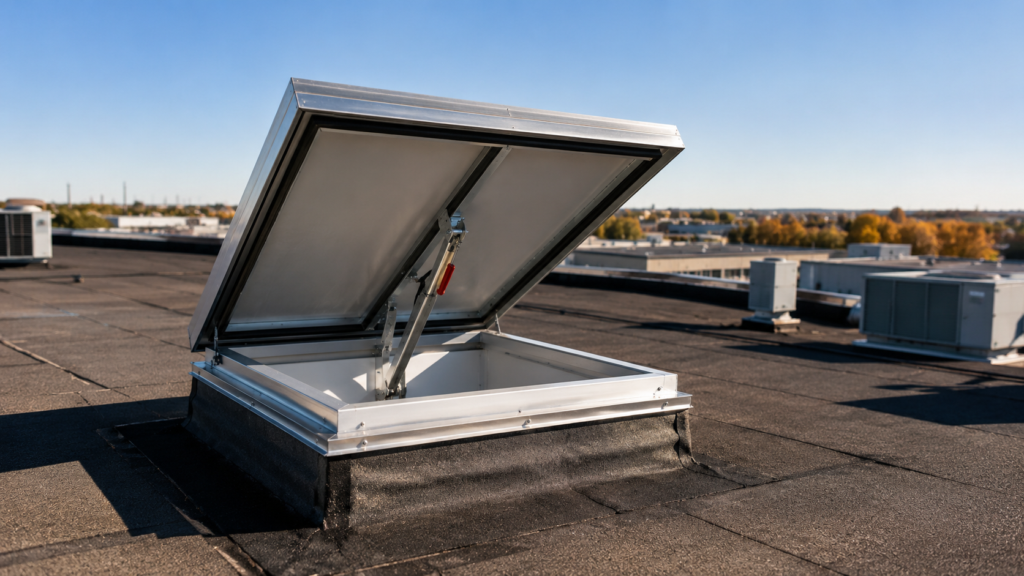
A roof hatch constitutes a penetration through the building envelope. You should regard it as such. The problem is that too many specifications concentrate on the load ratings and on the ladder clearance. The thermal performance of the hatch assembly itself is entirely left out of consideration. This means that an overall well-insulated commercial roof can lose energy in masses through a single unsuitably chosen access point.
The Real Problem: Thermal Bridging Through Metal Frames
Most commercial hatches are constructed from either galvanised steel or aluminium. Both of these metallic materials are very good conductors of heat, which is the last thing you want in something sitting on top of your ceiling. Where a metal hatch frame connects the warm interior to the cold exterior without interruption, it creates a direct path for heat transfer, a thermal bridge. The fix is a thermally broken frame.
This inserts a non-conductive isolator, typically a polyamide nylon strip, between the inner and outer metal sections of the frame. The isolator interrupts the conductive path so heat can’t travel straight through the metal. On paper it sounds simple. In the real world, the difference in surface temperatures, and the energy savings, is both measurable and a significant performance gain.
Aluminium hatches are particularly prone to this problem, as aluminium conducts heat roughly four times faster than steel. If you’re specifying aluminium for weight or corrosion resistance, the thermal break isn’t optional.
Stopping Air Infiltration at the Hatch Perimeter
Air leakage is a different problem than conduction, but it adds to the thermal loss. The U.S. Department of Energy estimates that air infiltration through the building envelope can make up 40% of a commercial building’s heating and cooling energy loads. A roof hatch with poor gasket compression is a direct player in that percentage.
Quality hatches use continuous compression gaskets, EPDM or neoprene, that run the full perimeter of the cover. These only work if the hatch has multi-point latching that applies even compression around the seal when closed. A single central latch will secure the hatch closed, but leave the corners slightly lifted. That’s enough for conditioned air to escape continuously.
When sourcing access hardware for energy-conscious projects, working with a Surespan manufacturer provides access to thermally broken profiles, and custom-insulated curbs engineered specifically to close these gaps, features that generic utility hatches just don’t offer.
Evaluating the Full Hatch Assembly, Not Just the Cover
When designing an efficient hatch system for a building, the whole cover assembly has to be taken into account. It’s not just about the insulation value packed into the cover itself. The steel curb upstand that the cover closes onto can conduct a significant amount of heat energy in and out of the building, affecting the overall U-value of the hatch cover system.
The U-value is a measure of how much heat can escape through a building component. The lower the U-value, the better the thermal performance of the hatch. It’s calculated by measuring the rate of heat loss, in BTU per hour, through a square foot of material. The U-value achieved by the hatch and the curb together is what’s critical when assessing compliance with building energy codes.
Integrating the Curb With the Roof’s Vapor Barrier
Proper installation is crucial as it affects the performance of the structure in the long term. Moisture is carried by warm indoor air. When this air comes into contact with a cold metal surface, such as the underside of a hatch cover on a winter night, moisture condenses. This eventually leads to insulation damage, fixing corrosion, and mold formation inside the roof structure.
To prevent this, the roof’s vapor retarder needs to be sealed without any gaps or punctures to the outside face of the hatch curb. If this seal is broken, warm, moist air can leak into the construction zone around the hatch. While this can be easily achieved with new constructions, it is often neglected during retrofit installations to save time.
The height of the curb upstand is also important. Most building codes require a minimum upstand to ensure that the hatch base remains free of standing water and membrane flashings. Make sure to check the specifications before placing an order.
Balancing Thermal Integrity With Functional Safety Requirements
A roof hatch must also be safe for the people who use it. Gas struts, hold-open arms, and internal grab rails are all essentials, and in fact, often code requirements for commercial roof access. However, they pose additional risk of thermal bridging and penetrating the vapor barrier.
The solution to these competing demands is well-engineered thermally broken fixings that create no cold spots on the covers or condensation risks inside the curb, and proper attachment designs that avoid through-fixing into the insulation.
Specify gas struts that work in the lowest possible outside temperature and all the other safety and insulation hardware, and the best practice is to ensure these are factory fitted to the roof hatch, to factory-approved installation guidelines.