I used to think drawing was mainly about talent. If the first sketch looked awkward, I assumed I had missed some invisible rule that other people understood.
That changed when I started treating drawing as a sequence of small decisions. A circle became a head. A line became a body. A few simple shapes slowly turned into a recognizable picture.
This is the central idea behind How To Draw: beginners do not need to master complex theory before making something enjoyable. They need clear steps, a manageable subject, and enough freedom to practice without feeling judged.
The Real Beginner Problem Is Not Talent
Many drawing tutorials begin with a finished picture. That can be inspiring, but it can also be confusing. A beginner sees the final result without seeing the decisions that created it.
Where should the first line go? How large should the head be? Which part comes next?
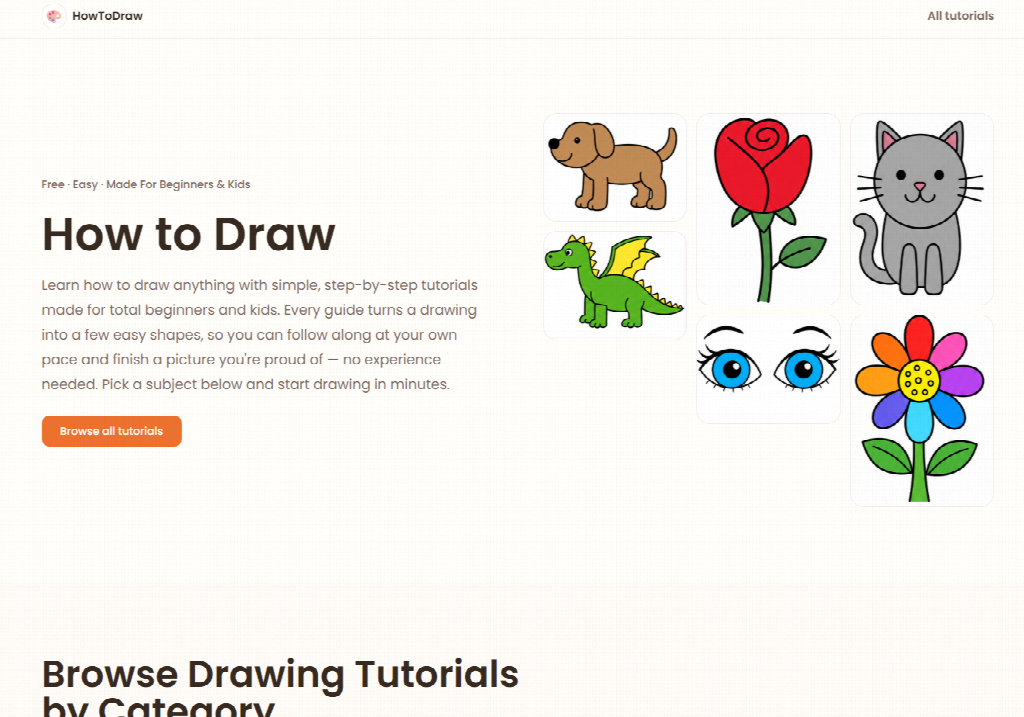
HowToDraw.ai takes a different approach. Its tutorials break subjects into simple shapes and short instructions. The site is designed for children, families, teachers, and adults who have never learned to draw.That makes the experience less like copying a mysterious artwork and more like following a visual recipe.
Why simple shapes work
A circle, rectangle, oval, or curved line is easier to control than a complete outline. It also gives the learner a reference point for size and position.
For example, drawing a cat can begin with:
- A circle for the head.
- Two triangles for the ears.
- An oval for the body.
- Curved lines for the legs and tail.
- Small details for the eyes, nose, and whiskers.
The result may not look perfect on the first attempt. That is fine. The early goal is not realism. It is learning how separate parts fit together.
My First Practice Session
I tested the beginner workflow with a simple animal subject. Instead of trying to draw from memory, I followed each step in order and used a pencil so that corrections would be easy.
The process felt surprisingly calm. Each image showed what had changed, and each instruction focused on one small action. I did not need to pause and guess which detail mattered most.
Six minutes versus a blank page
A blank page creates too many choices. A step-by-step guide removes most of them.
HowToDraw.ai says its tutorials usually contain between six and fifteen short steps. The site also describes the guides as free and suitable for beginners and children aged four and above.
The exact time will depend on the subject and the learner. Still, a short sequence creates a useful psychological advantage: finishing feels possible.
A person who says “I will practice drawing for an hour” may never begin. A person who says “I will complete six steps” is more likely to pick up a pencil.
What the Website Teaches Well
The platform currently organizes tutorials into 13 categories and lists more than 50 free step-by-step drawing guides. Each tutorial is built around large visual examples and short instructions.
Clear visual progression
The strongest feature is the visible change from one step to the next. A learner can compare the current image with the previous one rather than interpret a long block of text.
This is especially helpful for children, who may not understand technical terms such as proportion, perspective, or contour.
Subjects that feel approachable
The tutorial collection includes animals, characters, and everyday objects. These are useful starting points because learners can recognize the subject before they finish drawing it.
Recognition creates motivation. When a few lines already look like an ear, wheel, or face, the exercise feels like progress instead of homework.
Easy coloring
The final stage focuses on flat colors. There is no requirement to blend shadows or create realistic lighting.
That choice is practical. Shading can be introduced later, but it should not become a barrier during the first drawing session.
A Better Way to Use Drawing Guides
Following a tutorial once is enjoyable. Repeating it with a small change is where learning becomes more valuable.
After completing a guide, try a second version with one variation:
- Change the character’s expression.
- Give the animal a different color.
- Turn the object slightly to one side.
- Add a simple background.
- Combine two subjects in one scene.
This method keeps the structure while encouraging personal decisions. It is more useful than copying the same image repeatedly without understanding its parts.
The three-pass method
I recommend a simple three-pass routine:
Pass one: follow
Copy the guide slowly. Focus on the order of the shapes.
Pass two: remember
Look at each step briefly, then draw it without constantly checking the screen.
Pass three: change
Keep the basic structure but modify one feature, such as size, pose, color, or setting.
This routine turns a tutorial into a small creative exercise. It also helps reveal which parts you understand and which parts still need practice.
Useful for Families and Classrooms
The platform is not limited to individual learners. Its format also suits shared drawing activities.
Parents can choose a subject and draw with children at the kitchen table. Teachers can display an all-steps overview and let students work at different speeds. HowToDraw.ai specifically mentions printable step overviews for classroom use.
That matters because group activities rarely move at one uniform pace. Some students finish quickly, while others need more time to understand the first shapes.
A printable guide gives learners a reference without requiring constant verbal explanation from the teacher.
A low-cost creative activity
The basic setup is simple:
- Paper.
- A pencil or pen.
- Colored pencils or crayons.
- A screen or printed guide.
No drawing tablet or paid software is required. This makes the activity accessible for families testing whether a child enjoys drawing before buying art equipment.
Where AI Fits Into the Learning Process
The wider AI trend helps explain why visual learning tools are becoming more common. McKinsey’s 2025 global survey reported that 88% of organizations regularly use AI in at least one business function, while 79% reported regular use of generative AI.
Those figures come from organizations, not individual drawing learners. They should not be treated as proof that AI automatically improves artistic ability.
However, they do show how quickly AI-assisted tools are entering everyday workflows. For drawing education, the most useful role may not be replacing the learner’s hand. It may be organizing ideas, simplifying instructions, and reducing the fear of starting.
That distinction is important. A generated picture can be impressive, but drawing it yourself develops a different kind of understanding.
What HowToDraw.ai Cannot Replace
Step-by-step guides are useful, but they are not a complete art course.
They do not automatically teach advanced perspective, anatomy, color theory, visual storytelling, or observational drawing. A learner who wants realistic portraits or professional illustration will eventually need more detailed study.
There is also a risk of relying too heavily on fixed examples. If every drawing follows the same formula, the learner may become comfortable copying but less comfortable inventing.
The solution is not to reject guided tutorials. Use them as scaffolding, then gradually remove the scaffolding.
Who Should Try It?
HowToDraw.ai is a good fit for:
- Children who want quick, recognizable results.
- Adults who believe they are “bad at drawing.”
- Parents looking for a screen-light family activity.
- Teachers preparing accessible classroom exercises.
- Content creators who need a warm-up before visual planning.
It may be less suitable for advanced artists seeking detailed technical instruction or professional anatomy studies.
Final Thoughts
Learning how to draw does not have to begin with complicated theory. It can begin with one circle, one line, and a subject that feels fun enough to finish.
HowToDraw.ai works because it turns the intimidating blank page into a short visual path. The best way to use it is not to chase perfect copies, but to follow one guide, repeat it, and then make a small change of your own.
If you have ever searched for “How To Draw” and stopped because the tutorials looked too difficult, start with a simple subject and complete one step at a time. The finished picture may not be a masterpiece. It may be something more useful: proof that you can begin.