
How to Delegate to a Remote Assistant So Work Doesn’t Bounce Back


You hired help so you could stop doing everything yourself. A few weeks in, you notice a familiar pattern. The task comes back half finished, or finished the wrong way, and you end up doing it after all. You start wondering if delegation was a mistake, or if you just haven’t found the right person yet.
In most cases, the problem isn’t the person. It’s the handoff.
The real problem isn’t your assistant, it’s the handoff
Delegation research backs this up more often than it points to a skills gap. A widely cited Gallup study of Inc. 500 CEOs found that founders with strong delegation skills generated meaningfully more revenue and grew faster over three years than founders who scored low on the same measure. The same research noted that a majority of the entrepreneurs studied had limited or low delegation ability in the first place. That’s not a character flaw. It’s a skill most founders never had to build until they hired someone.
The classic explanation for why delegated work keeps returning to the delegator comes from a well-known Harvard Business Review piece on management time, which described how unfinished tasks quietly climb back onto a manager’s desk when the handoff never really transferred ownership. Half a century later, the pattern is just as common with remote assistants and contractors. You can hand someone a task list. You can’t hand them your judgment, your context, or your tolerance for how “done” should look, unless you build that into the handoff itself.
Why work bounces back
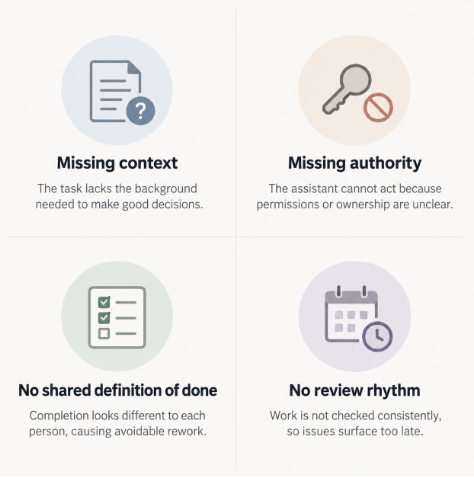
Four gaps usually explain it, and they show up together more than they show up alone.
Missing context. The assistant knows what to do but not why it matters, so edge cases get guessed at instead of handled correctly.
Missing authority. The assistant isn’t sure what they’re allowed to decide on their own, so they pause and ask, or they guess and get it wrong.
No shared definition of “done.” You have a picture in your head of the finished result. If that picture was never written down, the assistant is finishing a different task than the one you imagined.
No review rhythm. Feedback only happens when something goes wrong, so small misunderstandings never get corrected before they turn into rework.
Each of these is fixable on its own, but they compound quickly. A founder juggling a dozen open threads also pays a real cost every time a half-finished task pulls their attention back: research on workplace interruptions has found it can take close to 25 minutes to fully refocus after a break in concentration. That’s the quiet tax on a bad handoff, paid in small amounts, over and over.
The 30-day delegation runway
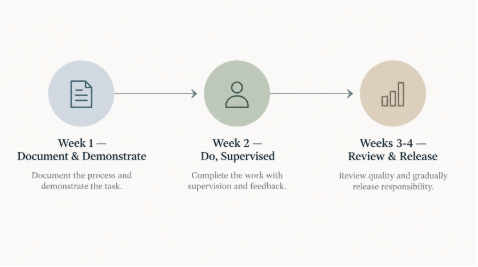
Instead of treating onboarding as a one-day event, treat the first month as a runway with three distinct phases. Each phase has a different job, and skipping one is usually where things go wrong.
Week 1: Document and demonstrate
Before you hand over a task, write down what “good” looks like for that task specifically, not for work in general. A short brief that includes the goal, the constraints, one example of a finished version, and the two or three mistakes you most want to avoid will save far more time than a longer document that tries to cover everything. If a task is repeatable, record yourself doing it once. A five-minute screen recording often communicates more than a page of instructions.
This is also the point where it helps to lean on a proven onboarding structure rather than improvising one from scratch. A structured way to onboard a remote assistant, covering how to sequence the first tasks and what to demonstrate before handing anything off, gives you a starting checklist instead of a blank page.
Week 2: Do, with light supervision
Let the assistant complete the task, but review the first few attempts closely and say specifically what was right, not just what needs fixing. Vague feedback like “this isn’t quite it” teaches nothing. Feedback like “the tone was good, but you missed the deadline field in row three” teaches the assistant exactly what to repeat and exactly what to change. This is also the week to notice which parts of the task the assistant handles instinctively well, since those are the parts you can safely hand off with less oversight going forward.
Weeks 3 to 4: Review and release
By the third week, most of the review should happen after the work is done rather than during it. This is the point where you start extending real decision rights, covered next, and where the task genuinely leaves your desk. If work still needs heavy correction at this stage, that’s useful information. It usually means the brief from week one was incomplete rather than that the person is a poor fit.
Set decision rights so your assistant stops asking permission
A brief tells someone what to do once. Decision rights tell them what they can decide without checking in again. Without this, even a well-briefed assistant will default to asking permission for everything, which quietly puts the task back on your plate.
A simple three-tier structure works for most small teams:
- Act and don’t report back. Routine, low-risk decisions the assistant should just make. Example: choosing which of three approved templates fits a given post.
- Act and tell me after. Slightly higher-stakes decisions that are fine to make independently, as long as you’re kept in the loop. Example: adjusting a posting schedule by a day to avoid a conflict.
- Ask first. Decisions with real cost, risk, or reputational weight. Example: anything involving a client-facing commitment or a spend above an agreed limit.
Most founders only ever define the third tier, which is exactly why everything ends up needing their sign-off. Naming the first two tiers explicitly is what actually reduces the back-and-forth.
A lightweight review cadence, and the two metrics that matter
You don’t need a dashboard to know if delegation is working. Two simple signals tell you almost everything: how often work comes back for rework, and how many clarifying questions a task generates before it’s finished. Track these loosely for the first couple of months, even just in a notes app. If both numbers are trending down, the handoff is working. If either one is flat or rising after week four, that’s a sign the brief or the decision rights need revisiting, not a sign to take the task back permanently.
Common handoff mistakes and quick fixes
Mistake: delegating the task but not the decision. You ask someone to “handle the inbox” but still want to approve every reply.
Fix: decide in advance which categories of email they can answer alone, and only route the rest to you.
Mistake: writing the brief after something goes wrong. Instructions created in a moment of frustration tend to be reactive and incomplete.
Fix: write the brief before the first attempt, not after the first mistake.
Mistake: measuring effort instead of outcome. Praising someone for staying busy, rather than for hitting the actual goal, trains the wrong behavior.
Fix: define what a successful outcome looks like before the work starts, and review against that.
Mistake: treating week one like week four. Expecting full independence immediately skips the demonstration and supervised-practice stages entirely.
Fix: follow the phased runway above, even if it feels slower at first.
What to keep on your own plate
Not everything should move off your desk, and a 30-day runway isn’t an argument for delegating everything. Judgment calls that shape the direction of the business, relationship-sensitive conversations, and anything that requires context only you have are usually worth keeping close, at least for now. The goal of a good handoff isn’t to empty your plate completely. It’s to make sure the things that do move off it actually stay off it.
The takeaway
Work doesn’t bounce back because the person you hired can’t do the job. It bounces back because the handoff never finished the job of transferring context, authority, and a shared definition of success. Build those three things into the first month deliberately, and most of what looks like a hiring problem quietly resolves itself.







Comment