Salesforce dominates the customer relationship management (CRM) market for a reason.
Their market share in 2025 was more than their next four competitors combined, and their CRM solutions are the industry standard for companies wanting to streamline sales, improve customer service, automate marketing, and empower their data.
Their consulting partners also drive some 70% of all Agentforce implementations.
But with more than 2,500 registered system implementers on their exchange (from one-person teams to global brands like Deloitte and Accenture), identifying the right partner can truly make your head spin.
And with AI increasingly critical to CRM value, implementation also means customizing and aligning Salesforce with your long-term business objectives.
Effective partners help design CRM strategy, customize workflows, integrate third-party applications, migrate and secure data, and ensure overall adoption, end-to-end.
This guide is all about how to navigate partner selection.
It addresses what you should evaluate, what questions to ask, common mistakes companies make, and how to ensure your Salesforce partner can really support your business objectives.
What’s So Important in Choosing the Right Salesforce Consulting Partner
Salesforce is successful in part because it’s also extremely customizable. This is both a strength and a source of complexity.
And Salesforce consulting partners can do as little or much as desired, including:
- Developing a CRM strategy that aligns with business goals
- Ensuring configuration that doesn’t limit future needs
- Integrating Salesforce with other systems (including ERP, marketing, HR)
- Safely and effectively migrating data (customer and operational)
- Identifying repetitive workflows for automation
- Improving reporting and analytics
- Ensuring adoption and training users
- Providing long-term support and ongoing optimization
Partners typically don’t just deploy the software. They can also work as strategic advisors, helping companies maximize their return on a significant Salesforce investment.
Consulting vs Implementation
While some businesses use these terms interchangeably, in the Salesforce context they have different meanings.
Salesforce consulting partners
A consulting partner’s focus is on specific business challenges. Their goal is to develop a specific Salesforce roadmap that meets your business goals.
This means providing:
- Business process analysis
- CRM strategy development
- Solution architecture
- Digital transformation consulting
- Process optimization
Consulting partners focus on identifying how Salesforce can be shaped to your business before implementation begins.
Salesforce implementation partners
Implementation means turning this plan into reality. The focus here is on configuring and deploying the Salesforce platform.
Services here include:
- Setup and configuration
- Custom Salesforce development
- Automating repetitive workflows
- Making those third-party integrations
- Migrating data
- Testing and deployment
- User training
While some providers focus more on one or the other, many—including Peterson Technology Partners—provide both.
This gives businesses the option of working with a single partner throughout their Salesforce lifecycle.
10 Factors to Consider When Choosing a Salesforce Consulting Partner
Okay, fine, but with so many consulting providers, how do you choose?
Here are 10 things to consider as you look to narrow the field.
1. Start by defining your business goals
This may sound obvious, but often firms are in motion on the cart without the horse attached. And just because Salesforce is extremely popular doesn’t mean it’s providing the same things for everyone.
Companies should begin with a realistic look at what their Salesforce buy is meant to accomplish.
This includes questions like:
- Are they replacing an existing CRM?
- Is a key goal improving sales productivity?
- Are they planning to automate any of their customer service?
- Do they want improved reporting and analytics, and if so, where?
- What integrations are needed with existing business systems?
Clearly defining these objectives is critical for knowing what expertise you need in a consulting partner.
2. Compare these to a provider’s Salesforce certifications and experience
Salesforce frequently updates its platform, and this includes rapidly growing AI capabilities and automation tools as well as all new products (and rebranding products as they shift).
Understanding their offerings is important, and not all providers have experience with all options.
This includes:
- Agentforce Sales
- Agentforce Service
- Agentforce Marketing
- Experience Cloud
- Agentforce Commerce
- Data 360
- Einstein vs Agentforce
Salesforce offers a large certification portfolio, making it important to consider certifications in areas that matter for your implementation. Certifications also demonstrate a commitment to staying current with the software.
3. Look at relevant industry experience
Industries use CRMs differently, making area experience more important than it is for some software solutions.
This is because:
- Healthcare organizations have stringent requirements on patient data
- Financial institutions have their own compliance and security requirements
- Manufacturing companies typically require ERP integrations
- Technology companies often gear for scalability and automation
Understanding industry-specific requirements and challenges helps ensure compliance and best practices.
We recommend always requesting examples of prior implementations within your industry.
4. Assess their methodology
The complexity of Salesforce implementations means providers need highly structured processes. What is theirs?
They should be able to clearly define it, and it may include:
- Discovery workshops
- Details on their business requirement gathering
- Methods used for solution design
- How they determine configuration settings
- Assessment of customization requirements
- Full testing plans and execution
- The user acceptance phase
- How they determine readiness for deployment
- Post-launch support
Getting details on methodology helps mitigate risks and brings science to the art of successful implementation.
5. Review their integration experience
Business solutions are becoming more interconnected and an effective CRM can’t just be a standalone tool.
Depending on your need, providers should be able to integrate Salesforce with:
- ERP systems
- Accounting software
- Marketing automation platforms
- HR applications
- Customer support tools
- Communication platforms
Any consulting partner should understand API integrations, but also middleware solutions and effective data synchronization and security practices to ensure seamless interaction.
6. How much customization experience do they have?
Salesforce brings a lot of functionality out of the box, but it also enables a wide range of customization. If your business has need, ensure partners can showcase their experience with:
- Custom objects and data models
- Apex development
- Lightning Web Components
- Flow automation
- Flow approval processes
- Custom reports and dashboards
- Industry-specific applications and workflows
Customization may be critical to your success but be wary of partners who recommend it without first considering if your needs can be met through standard Salesforce functionality.
7. Evaluate their data migration approach
Data is the heart and soul of a CRM, making migration absolutely critical. Partners need to have experience handling:
- Data cleansing
- De-duplication
- Data validation
- Historical data migration
- Security during migration
This strategy should also be thoroughly documented and considered and never ad hoc.
8. AI and automation expertise is now critical
While some smaller companies are experimenting with using AI to provide CRM functionality, large AI companies like Anthropic continue to invest in Salesforce.
They use the CRM in-house and have also expanded their partnership for Salesforce customers.
Since the start, Salesforce has also heavily invested in AI and they continue to leverage it for uses like:
- Sales forecasting
- Customer service automation
- Lead scoring
- Workflow automation
- Intelligent recommendations
- Predictive analytics
AI is integral to the future of CRM, making it important to ensure implementation partners are experienced with Agentforce and Einstein.
9. Do they provide long-term support?
Implementation is almost never the end of the journey with Salesforce. Most partners provide some form on ongoing support, but how does it work and where does it cut off?
As your business grows, look for partners that provide:
- Ongoing platform optimization
- User training
- Performance monitoring
- Managed Salesforce services
- Release management
There is typically greater value for customers in an effective, lasting partnership than in a one-off provider.
10. What do prior customers say and what are their success metrics?
Case studies and references are critical to evaluating a partner’s experience. When evaluating these, be sure to consider aspects like:
- Prior project complexity
- Industry experience related to your own
- Metrics from business outcomes
- Long-term client relationships
- Customer satisfaction
This is an area, too, where quality is far more important than quantity, provided there is sufficient expertise to meet your needs.
Questions to Ask Before Hiring a Salesforce Consulting Partner
Now that you’ve narrowed your focus and have an effective short-list, here are some questions to ask any provider:
- How many Salesforce implementations have they completed?
- Which Salesforce products do they support and in what ways?
- How do they manage ongoing project communication?
- What is their implementation methodology (see above)?
- What happens after deployment?
- Do they provide managed Salesforce support?
- How do they measure project success (and is it fair and sufficient)?
- Can they share relevant customer references?
These answers overall should demonstrate technical expertise and breadth to pair with the essential understanding of your key business objectives.
Red Flags and Common Mistakes
Be wary of providers that offer things too good to be true. This can include unrealistic timelines and vague or complicating pricing.
Other general warning signs include:
- Recommending heavy customization without first understanding your business
- Limited Salesforce certifications
- Lacking or leaky documentation of their implementation methodology
- Lack of post-launch support
- Few or insufficient customer references
If there’s poor communication at any stage in the sales process, don’t expect it to improve within the working relationship!
Here we detail several common mistakes companies also run into when making partnership decisions:
Choosing based mostly on price
Ultimately picking a provider for the lowest cost alone often leads to downstream financial problems, making it critical to realistically evaluate ROI.
Low price often means fewer experienced consultants, more limited support, or additional charges that aren’t considered at the outset.
Overlooking limited industry experience
This has been covered a few times here, but it’s a critical consideration: familiarity within your industry may be essential to ensuring compliance.
It can also improve configurations and reduce implementation time.
Neglecting change management
No software solution has value without effective adoption. Depending on your situation, this can be more or less significant.
Many partners provide training, documentation, adoption strategies, and ongoing support to help offset challenges in this arena.
Not building for the future, too
AI is changing fast and it’s changing business with it. Salesforce knows this, and is also rapidly changing, and that means you should consider a partner with experience in scaling and accommodating shifts in products and users.
Even if your CRM works perfectly today, without this consideration it may prove an outdated dinosaur tomorrow.
Experience vs Size
Large consulting firms bring their reputation to everything they do, and this can be good and bad, depending on your needs.
Suffice to say, biggest isn’t always best.
Global companies have greater resources to bring to bear, but they may also lack flexibility and/or the personalized attention your situation may require.
Specialized Salesforce consulting partners
Some of the benefits smaller or mid-sized consulting firms can offer:
- Easier and faster communication
- Direct access to senior consultants
- More flexibility during implementation
- More willingness to customize project approaches
- Long-term relationships with clients
More specialized firms often focus on delivering a tailored consulting approach and are often favored by mid-size and growing businesses, as well as companies that need personalized support or customized Salesforce solutions.
Global Salesforce consulting firms
Of course, this comes with a trade-off, as global firms are typically more adept at supporting international reach and multiple business units. They also likely bring more experience with complex enterprise environments.
These providers can offer extensive resources and enterprise-level delivery capabilities, and are often preferred for:
- Fortune 500 companies
- Global implementations
- Multi-cloud Salesforce environments
- Large digital transformation initiatives
Making the right choice here depends entirely on your scope, available resources, timeline, and business goals.
Peterson Technology Partners (PTP) as a Salesforce partner
PTP is an example of a firm that provides both consulting and implementation, with ongoing support throughout the Salesforce lifecycle.
They work with businesses for efficient implementation, customized workflows, integration across business applications, and ongoing optimization over time. They also can improve user adoption and provide training and have extensive AI experience.
Peterson Technology Partners often works with customers that want a balance of strategic consulting, technical implementation, and personalization.
Partner Comparison Checklist and Framework
We’ve covered a lot, so here’s an overview checklist to get you started:
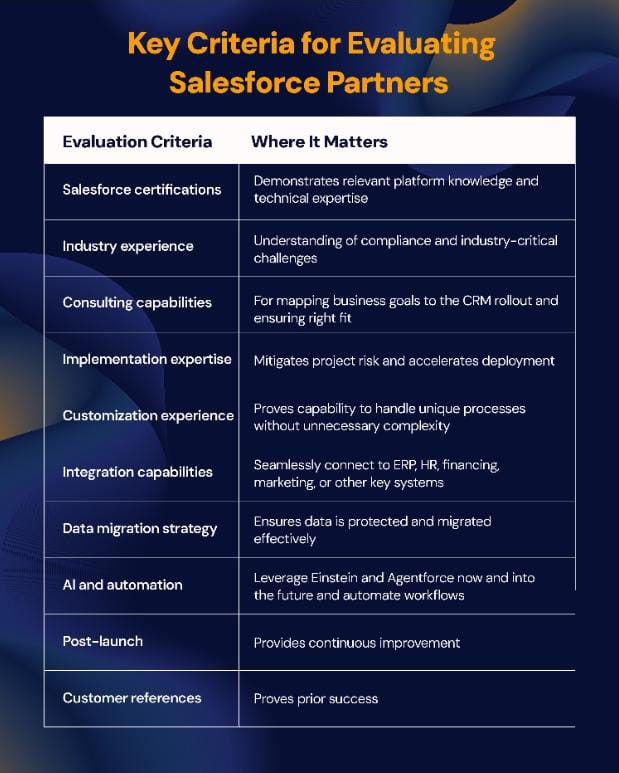
Five steps for making the right choice
And here are five easy ways to compare the partners on your shortlist:
- Define Business Objectives: Identify what success should look like.
- Shortlist Qualified Partners: Review certifications, experience, customer references, and industry expertise.
- Compare Implementation Approaches: Look at methodology, communication processes, and delivery timelines.
- Assess Long-Term Value: Do they offer managed services, optimization support, and future scalability?
- Request a Discovery Workshop: Before signing, do a discovery session—these give more hands-on insight than the sales pitches.
Frequently Asked Questions (FAQ)
What does a Salesforce consulting partner do?
Salesforce consulting partners help plan, design, implement, customize, integrate, and optimize Salesforce solutions. They align CRM capabilities with specific business objectives while providing strategic guidance and ongoing support.
What is the difference between Salesforce consulting and implementation?
While sometimes used interchangeably, Salesforce consulting is focused on business strategy, process improvement, and planning, while implementation is focused on configuring, deploying, customizing, and integrating Salesforce.
Many providers offer both services.
How long does a Salesforce implementation take?
Project timelines vary heavily depending on complexity, but common times are:
- Small implementations: 4–8 weeks
- Mid-sized projects: 2–6 months
- Enterprise transformations: 6–12 months or longer
Additional factors like integration and customization needs, data migration, and user training also impact implementation duration.
How much does Salesforce Consulting cost?
Costs depend heavily on project size, business requirements, customization needs, and overall implementation complexity.
Providers should be able to provide realistic costs, and businesses must consider long-term costs and ROI in cost calculations.
Should I hire a global consulting firm or a specialized Salesforce partner?
This depends entirely on a company’s specific needs, as both can offer unique benefits. Large firms often tend to suit enterprise organizations with complex global requirements, while more specialized Salesforce partners can offer greater flexibility, personalized service, and focused platform expertise.
What certifications should a Salesforce consulting partner have?
There are numerous certifications offered, and they show expertise and a willingness to stay up to date as Salesforce continues to grow and change. Look for providers that are certified in areas relevant to your business. These should also be paired with implementation experience and effective customer references.
The Bottom Line
There’s a lot to consider here, but then Salesforce is a powerful and potentially complex addition to your business.
Ultimately, partners should bring far more than just technical expertise. They should understand your business goals first-hand, as well as the industry, and your long-term strategic objectives.
The best partners don’t just get Salesforce up and running today—they also optimize, increase user adoption, leverage AI effectively, and ultimately ensure you maximize your return on the CRM investment over the long term.