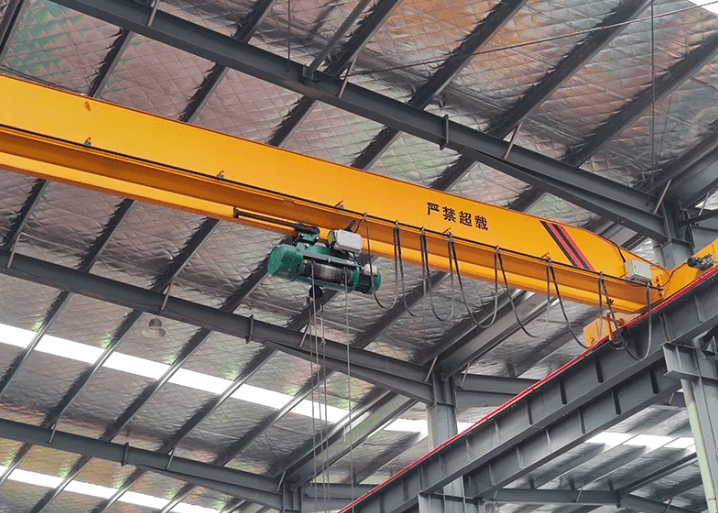
Selecting a 5 ton overhead crane is a long-term engineering decision that affects production efficiency, workshop safety, lifecycle cost, and future scalability. A poor selection leads to repeated breakdowns, excessive swing, structural deformation, and high maintenance expenses. A correct choice ensures 10–20 years of stable operation, minimal downtime, and optimized workflow.
This guide provides real decision rules, key parameters, and selection thresholds, enabling customers to make accurate choices based on measurable criteria.
For the full checklist and comparison table, click here to open the complete 5 ton overhead crane Selection Guide.
- Identify Your Lifting Requirements With Precise Engineering Criteria
Most buyers start with “I need a 5 ton crane,” but professional selection begins with quantifiable load and cycle data.
1.1 Lifting Frequency, Duty Cycle, and Fatigue Load
Mechanical components experience thermal cycles, stress reversals, and fatigue every time they start/stop or pick/release load.
Operational Categories
| Operation Pattern | Engineering Impact |
| Low frequency (5–20 lifts/day) | Lower thermal stress → A3 acceptable |
| Medium (80–150 lifts/day) | Motors run warm, brakes wear faster → A4 minimum |
| High (300–500 lifts/day) | Continuous heat → require A5, larger gearbox, stronger brake |
Why underestimating duty class destroys equipment?
Motor insulation Class F loses lifespan rapidly when running above designed temperature.
Brake lining hardens from overheating → poor braking → load slips.
Gearbox oil thins → gear pitting starts → vibration increases.
Rule of thumb:
If lifting > 2 hours/day → avoid A3 even if load is light.
1.2 Load Geometry, Load Swing, and Force Behavior
Load weight is just one variable. Engineers must evaluate:
Length & width → influence aerodynamic swing and inertia
Center of gravity offset → determines load rotation tendency
Lift point distance → affects torque on hook block
Required lifting precision → determines VFD necessity
Practical Cases
Long loads (>6 m):
High moment of inertia → slow-to-stop load
Requires VFD slow speed (2–4 m/min)
Often need dual-speed or stepless control
May require anti-sway system in advanced workshops
1.3 Lifting Height: Not Just Present Needs, But Future Constraints
Many workshops later expand production:
Install taller machines
Add larger molds
Add mezzanine platforms
Change forklift routes, reducing hook clearance
Modifying lifting height afterward requires changing drum, wire rope, hoist frame — usually more expensive than choosing correctly from the beginning.
Best Practice:
Add +1–2 m reserve in any new workshop installation.
- Evaluate Workshop Structure With Realistic Spatial Constraints
Over 60% of crane issues come from incorrect workshop evaluation, not crane quality.
2.1 Effective Headroom (H-min) and Hook Approach
1)Key Spatial Indicators
Headroom (H-min): bottom of runway beam to hook highest point
Hook approach: shortest horizontal distance hook can reach wall
Building clear height: floor to lowest obstruction
2)Why headroom matters mechanically?
More headroom allows:
Higher usable lift
Lower chance of hook collision
Better workflow space for forklifts and operators
European hoists often save 0.5–0.8 m space, allowing:
Shorter workshop columns
Lower steel consumption
Increased hook coverage zone
2.2 Span, Girder Deflection, and Structural Dynamics
Long spans suffer from elastic deflection.
Excess deflection = increased load swing
Swing increases horizontal impact force on wheels
Impacts fatigue the girder and cause micro-cracks
Engineering deflection limits
| Type | Allowable Deflection |
| Standard single girder | L/800 |
| European style | L/1000 or better |
Example: span = 20 m
L/800 = 25 mm
L/1000 = 20 mm
5 mm difference reduces swing significantly—important for precision lifting or long loads.
2.3 Runway Beam: Rail Strength, Vibration, and Alignment
1)Critical tolerances
Rail straightness: ≤ 1 mm per meter
Parallelism of two rails: ≤ 10 mm total
Rail joint step: ≤ 1 mm
2)If runway is misaligned:
Crane wheels grind on rail edges
Hoist travels unevenly → load swing
Motor draws 20–40% more current
Overload protection trips frequently
Most crane “quality problems” are actually runway problems.
- Duty Class Decision With Failure-Mode Explanation
Choosing wrong duty class creates predictable failure modes.
1)A3 Failures in A5 Conditions
Brake pads melt → hook drops slowly
Motor overheats → insulation failure
Rope drum deforms → rope jump
Electrical cabinet overheats
2)A4–A5 Benefits
Bigger gearbox → better heat capacity
Higher rope drum diameter → less rope wear
Brake torque increased by 20–40%
Bearings with higher dynamic load rating
- Hoisting Mechanism Selection With Deep Mechanical Explanation
4.1 Wire Rope vs. Chain Hoist – Under Load
| Feature | Wire Rope Hoist | Chain Hoist |
| Lifting smoothness | High | Medium |
| Noise | Low | Higher |
| Suitable height | Long lifts | Short lifts |
| Duty cycle | Higher | Lower |
| Maintenance | Rope inspection | Chain lubrication |
Mechanical Reason:
Wire rope distributes load across multiple strands → lower stress per strand.
Chains bear load on each link → higher per-link stress.
4.2 Low-Headroom Hoist – Structural Optimization
Benefits:
Reduces wheel load → lighter runway beams
Improves hook coverage → fewer blind zones
Lower center of gravity → less swing
This design is ideal for compact workshops.
4.3 VFD – Mechanical and Operational Benefits
1)Technical effects:
Soft-start reduces inrush current (from 600% → 150% of rated)
Brake opens slowly → protects brake pads
Load decelerates smoothly → reduces swing
Less gearbox impact → longer gear life
2)Operator benefits:
Precise positioning
Easier long-load handling
Safer operation around workers
- Control System Selection With Human-Factor Insights
Pendant
Simple, low cost
Operator must walk with load → fatigue risk
Remote Control
Better visibility
Distance from load → safer
Higher efficiency in repetitive cycles
Remote + VFD = Best Productivity
Common in workshops upgrading from old cranes.
- Safety and Compliance: Hidden Risks and Protection Systems
Even 5-ton cranes must meet strict safety logic.
6.1 Overload Limiter
Prevents structural deformation
Protects against brake slip
Detects rope failure risk early
6.2 Anti-Collision (For workshops with multiple cranes)
Laser or infrared sensors
Prevents severe horizontal impact loads
6.3 Electrical Protection Depth
Look for:
Overcurrent relays
Phase-sequence protection
IP54/IP55 enclosures
Emergency brake circuits
- Understand the True Cost Structure (Not Just the Crane Unit Price)
7.1 Primary Cost Drivers
Span length
Lifting height
Duty class
Hoist type
Control system
Design standard (FEM vs. CMAA vs. Chinese GB)
7.2 Hidden Costs
Runway steel beams (may cost 30–40% of crane price)
Power circuit reconfiguration
Installation machinery (crane truck, MEWP)
Load testing (typically 110% weight load)
You can click here to access a full breakdown in the 5 ton overhead crane Selection Guide.
- Installation and Commissioning: Technical Requirements
8.1 Key Installation Parameters
Runway beam straightness ≤ 3 mm per 10 m
Rail top elevation difference ≤ 10 mm
Crane wheel span tolerance ≤ ±3 mm
8.2 Load Testing Requirements
Static test at 125% load
Dynamic test at 110% load
Brake performance test
Safety device function test
Without proper testing, the crane cannot be approved for production use.
- Maintenance and Lifecycle Prediction
9.1 Daily Maintenance (70% of failures preventable)
Check:
Rope broken wire count
Hook throat opening
Brake clearance
Oil levels of gearbox
9.2 Predictive Maintenance
Record:
Motor running hours
Brake usage cycles
Hoist temperature trend
Rope replacement frequency
- Supplier Evaluation: Key Verification Parameters
A professional supplier should provide:
10.1 Engineering Drawings
General arrangement drawing
Rail and runway beam drawing
Electrical schematic
Foundation layout (if freestanding)
10.2 Manufacturing Standards
Look for:
EN 15011
FEM 1.001
CMAA 70
ISO 9001, CE markings
10.3 After-Sales Indicators
Spare parts availability within 7–10 days
Remote installation support
18–24 month warranty
If the supplier cannot provide these, consider switching.
Conclusion
Selecting a 5-ton overhead crane requires analyzing load behavior, workshop structure, mechanical duty, safety systems, and lifecycle cost. A data-driven, engineering-oriented approach ensures your crane runs smoothly, safely, and cost-effectively for 10–20 years.