
How to Choose Between Hiring AI Developers and Building a Dedicated AI Development Team

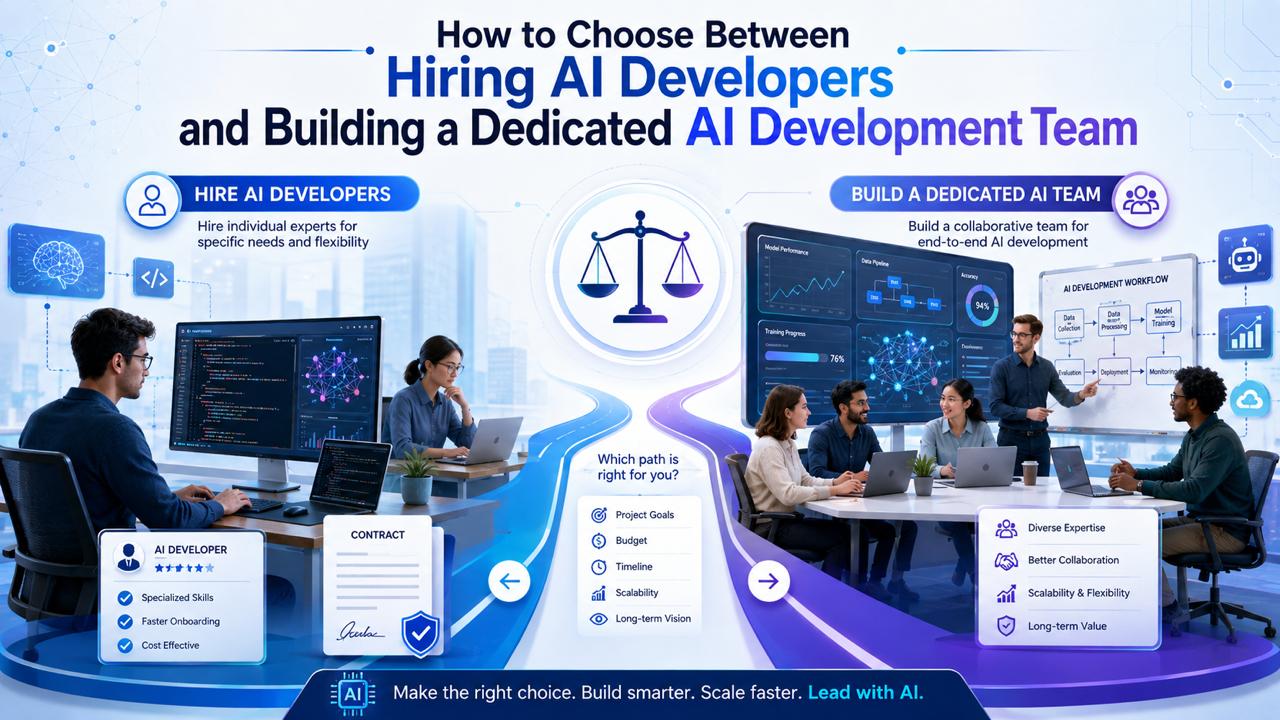
Artificial intelligence has become a practical business technology rather than an experimental concept. Companies across healthcare, fintech, manufacturing, logistics, retail, real estate, education, and professional services are investing in AI to automate processes, improve decision making, enhance customer experiences, and create new digital products.
However, one challenge continues to slow down many AI initiatives.
Finding the right technical talent.
Building an AI solution often requires much more than traditional software development. Depending on the project, businesses may need expertise in machine learning, generative AI, natural language processing, computer vision, data engineering, cloud architecture, model deployment, security, and application development.
As a result, companies frequently face an important decision.
Should they hire individual AI developers to strengthen their existing technology team, or should they assemble a complete dedicated AI development team?
Both models can work extremely well. The right choice depends on your current capabilities, project complexity, timeline, budget, and long term AI strategy.
Why AI Development Requires Specialized Talent
Modern AI applications are becoming increasingly sophisticated.
Consider a company building an intelligent customer support platform. The final solution might include a conversational AI interface, company knowledge search, integration with CRM software, customer authentication, analytics, automated ticket creation, sentiment detection, and escalation to human agents.
A predictive maintenance platform may require machine learning models, IoT data pipelines, asset management integration, dashboards, alerts, and mobile applications.
A healthcare AI platform may involve document analysis, patient data management, workflow automation, compliance requirements, secure cloud infrastructure, and integration with existing healthcare systems.
Each of these projects requires several technical disciplines working together.
This is why companies should first determine what capabilities they already have before deciding how to expand their AI engineering capacity.
When Hiring Individual AI Developers Makes Sense
Many organizations already have experienced software development teams.
They may have backend developers, frontend engineers, database specialists, cloud engineers, QA professionals, and project managers.
What they lack is specialized AI expertise.
In this situation, adding one or more experienced AI professionals can be a practical approach.
For example, a SaaS company may already have a mature application but want to introduce an intelligent assistant powered by large language models. Instead of creating an entirely new engineering department, the company may simply need specialists who understand generative AI, retrieval augmented generation, vector databases, model evaluation, and prompt engineering.
Companies in this position can consider options to hire AI developers who can work alongside their existing software team and provide the specific AI expertise required for the project.
This approach allows organizations to preserve their existing engineering structure while quickly filling important capability gaps.
Situations Where Individual AI Developers Work Best
Hiring individual AI specialists can be particularly effective in several situations.
You Already Have Strong Technical Leadership
If your organization already has a CTO, technical architect, engineering manager, or experienced development leadership, integrating additional AI specialists may be relatively straightforward.
Your internal team can continue managing architecture, project planning, security, development processes, and product decisions.
The AI specialists can focus on their specific areas of expertise.
You Need a Specific AI Capability
Sometimes the requirement is very focused.
You might need:
- A machine learning engineer to build a forecasting model
- A generative AI developer to create an enterprise assistant
- A computer vision specialist for image analysis
- A natural language processing expert for document classification
- A data scientist to develop predictive models
- An MLOps engineer to deploy and monitor models
In these situations, building an entire AI team may be unnecessary.
You Want to Scale Your Existing Team
Technology companies often need additional capacity during product expansion.
Rather than recruiting permanent employees immediately, they can extend their existing team with external AI developers.
This can help organizations accelerate development while maintaining control over architecture and product strategy.
When a Dedicated AI Development Team Is the Better Choice
The situation becomes different when the organization needs to build a complete AI product or platform.
Imagine a company planning an enterprise AI solution from the ground up.
The project may require:
- Business analysis
- AI architecture
- Machine learning development
- Generative AI development
- Data engineering
- Backend development
- Frontend development
- Cloud infrastructure
- Quality assurance
- DevOps
- Security
- Model monitoring
- Product management
Managing these capabilities through separate contractors can quickly become complicated.
This is where organizations often consider working with a dedicated AI development team that can provide multiple specialists working together under one development process.
Instead of coordinating several independent resources, the organization gets a structured engineering team focused on the same product roadmap.
Signs That You May Need a Dedicated AI Team
There are several indicators that a dedicated team may be more suitable than individual specialists.
You Are Building a New AI Product
If your company is creating an AI platform from the beginning, you may need broader technical expertise.
A dedicated team can handle architecture, development, testing, deployment, integrations, and ongoing improvements.
This allows business stakeholders to focus on product strategy while the engineering team manages technical execution.
The Project Requires Multiple Technologies
Complex AI platforms often combine many different technologies.
A generative AI application may require:
- Large language models
- Vector databases
- APIs
- Cloud infrastructure
- Databases
- Authentication
- Document processing
- Search technology
- Analytics
- Security controls
When many systems must work together, having one coordinated team can significantly simplify development.
You Have Multiple AI Initiatives
Some organizations initially launch one AI project but quickly identify additional opportunities.
For example, a logistics company might begin with an AI customer support assistant and later expand into route optimization, predictive maintenance, demand forecasting, document automation, and intelligent analytics.
A dedicated team can create shared infrastructure and reusable AI components that support multiple initiatives.
You Need Faster Execution
Recruiting AI professionals individually can take considerable time.
Companies need to advertise roles, evaluate candidates, conduct interviews, negotiate offers, and onboard each employee.
For organizations with aggressive product roadmaps, assembling an external dedicated team can help accelerate development.
Individual AI Developers Versus Dedicated AI Team
The decision becomes easier when businesses compare the two models based on their actual requirements.
Choose Individual AI Developers When
Your organization already has a strong software team.
You need one or two specialized AI skills.
Your internal team can manage architecture and project delivery.
The AI project is relatively focused.
You want additional development capacity.
You want to maintain complete internal technical leadership.
Choose a Dedicated AI Team When
You are building a complete AI product.
Your project requires several technical disciplines.
You need architecture and engineering leadership.
You want one team responsible for development.
You expect continuous product development.
Your organization has multiple AI initiatives.
You want to accelerate execution without recruiting every role individually.
Neither approach is automatically better.
The best model depends on the maturity of your technology organization.
Important Skills to Look for in AI Developers
Whether you hire individual developers or a complete team, technical evaluation is essential.
Businesses should look for experience in areas relevant to their specific project.
Machine Learning
Machine learning engineers should understand model development, feature engineering, evaluation, optimization, and deployment.
Generative AI
Generative AI developers should understand large language models, prompt design, retrieval augmented generation, embeddings, vector databases, model evaluation, and application integration.
Data Engineering
Reliable AI applications depend on reliable data.
Data engineers should be able to build pipelines, transform information, integrate data sources, and manage large datasets.
Cloud Architecture
Production AI systems often run on platforms such as AWS, Microsoft Azure, or Google Cloud.
Developers should understand cloud deployment, security, performance, scalability, and cost management.
Application Development
AI models rarely operate independently.
They usually need to connect with websites, mobile applications, enterprise platforms, databases, APIs, and third party systems.
Strong application development capabilities are therefore essential.
Look for Production Experience
One of the most important evaluation criteria is whether the developers have built production AI applications.
There is a major difference between creating an AI demonstration and operating a real application used by customers or employees.
Production systems must handle:
- Security
- Authentication
- Performance
- Reliability
- Model errors
- Data privacy
- Monitoring
- Scalability
- System failures
- Cost management
Ask potential developers or development partners to explain projects they have delivered.
Useful questions include:
What problem did the application solve?
What models were used?
How was performance evaluated?
How was user data protected?
How was the AI system integrated with existing software?
How was inaccurate output handled?
How was the application monitored after launch?
The quality of these answers provides valuable insight into the team’s practical experience.
Start With a Clear Business Objective
Businesses sometimes begin AI projects by selecting technology first.
For example, someone may decide that the company needs a generative AI application simply because generative AI is popular.
A better approach is to define the business problem first.
You might want to:
- Reduce customer service workload
- Automate document review
- Improve sales forecasting
- Detect manufacturing defects
- Analyze customer feedback
- Automate internal knowledge search
- Improve asset maintenance
- Create personalized recommendations
Once the problem is clear, the required AI architecture becomes easier to define.
Begin With a Focused Initial Scope
AI development usually benefits from incremental implementation.
Instead of trying to automate an entire organization immediately, start with one high value use case.
Create a proof of concept.
Validate the technology.
Measure the results.
Then expand.
For example, a company interested in enterprise knowledge search might begin with documentation from one department.
A manufacturer might test predictive maintenance on a limited number of machines.
A healthcare organization might initially automate one specific document workflow.
This approach reduces risk while generating useful feedback.
Define How Success Will Be Measured
AI projects should have measurable business outcomes.
Possible metrics include:
- Reduction in manual work
- Faster customer response times
- Improved prediction accuracy
- Lower operational costs
- Reduced processing time
- Higher employee productivity
- Better customer satisfaction
- Fewer operational errors
Without measurable objectives, organizations may build technically impressive AI applications that provide limited business value.
Remember That AI Development Does Not End at Launch
AI systems require continuous improvement.
Models change.
Business data changes.
Users discover new requirements.
New AI technologies become available.
Security expectations evolve.
Organizations therefore need to think beyond the first release.
A long term AI strategy should include:
- Model evaluation
- Performance monitoring
- Data updates
- Security reviews
- User feedback
- New integrations
- Feature development
- Cost optimization
- Infrastructure improvements
This is another factor when deciding between individual specialists and a dedicated team.
A small AI requirement may only need a developer for a limited period.
A strategic AI platform may benefit from a stable team that continues improving the product over time.
Final Thoughts
The success of an AI initiative depends heavily on having the right people working on the right problems.
Companies with established engineering departments may benefit from adding specialized AI developers to strengthen their existing teams.
Businesses building a complete AI product, managing several AI initiatives, or requiring multiple technical disciplines may find that a dedicated AI development team provides better coordination and continuity.
The most important step is to evaluate your existing capabilities before choosing a hiring model.
Ask what skills you already have.
Identify what expertise is missing.
Define who will own architecture and delivery.
Understand the complexity of the product.
Establish measurable business goals.
Then choose the team structure that provides the right combination of expertise, speed, flexibility, and ownership.
Artificial intelligence technology will continue to evolve rapidly. Companies that build flexible development teams around real business objectives will be better positioned to turn those advances into practical and sustainable business value.






Comment