By Andre Myhre CASE STUDY: BROADWALK RESIDENCY
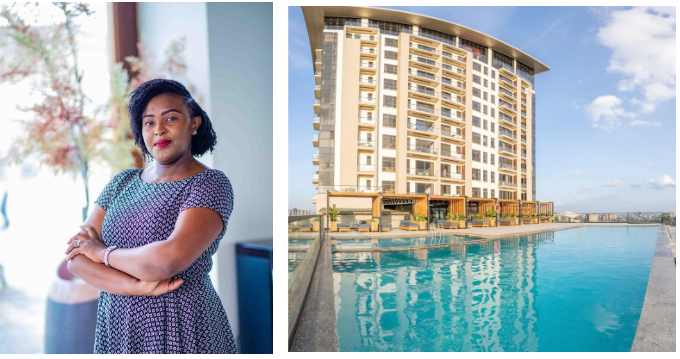
Faith Wausi-Ndirangu, General Manager, Broadwalk Residency. Photo courtesy of Broadwalk Residency.
Broadwalk Residency, Nairobi. Photo courtesy of Broadwalk Residency.
 cross Africa, a quiet technology shift is taking place inside independent hotels.
Reservations that once required manual coordination can now move between booking platforms. Rates can be distributed across multiple channels from a single system. Guest information can travel with
employees on their phones.
At Nairobiʼs Broadwalk Residency, however, the most interesting result of that technology is not what happens on a screen.
It is what happens when employees look up from one.
It might be a housekeeper who notices that a guest seems uncomfortable. It might be a security officer who remembers where a regular visitor likes to park. Neither moment involves software. But at Broadwalk, the people involved work inside a system designed to take routine coordination offtheir hands, and the propertyʼs general manager believes that matters.
That is the argument at the centre of this story. Technology is not replacing hospitality. Used well, it removes operational friction and gives hotel employees better information and more time to deliver the experiences guests remember.
Technology behind the experience
A hotel stay now begins long before a guest reaches reception. Travellers compare prices and availability online and reserve rooms through different platforms. Each booking then has to reach the property-management system, the hotelʼs central record of rooms, reservations and guests. Availability and rates have to stay consistent everywhere a room is offered for sale.
For an independent property without a large specialist team, keeping those pieces connected can be complex. HotelOnline is one of the companies working in that layer of the industry. It combines property-management technology, channel management, booking engines, revenue management and commercial support, with the aim of simplifying the operational work that happens behind the guest experience.
Its chief operating officer describes the role in deliberately limited terms.

Martha Kerubo, COO of HotelOnline, speaking at a tourism industry event in Kenya. Photo supplied for this feature.
Technology should never take the hospitality out ofhospitality.
Our role is to remove the friction behind the scenes — reservations, distribution, pricing and operations — so hotel teams can spend more time doing what technology cannot do: understanding the guest, solving problems and creating experiences people remember.
MARTHA KERUBO · COO, HOTELONLINE
Broadwalk Residency puts the idea into practice
Broadwalk Residency, an apartment property in Nairobi, opened in 2023. It has
run on HotelOnline as its property-management system from the start. “HotelOnline has been our property management system since we opened our doors in 2023,” says General Manager Faith Wausi-Ndirangu.
Asked which parts of the platform make a practical difference, she describes a set of everyday tools rather than a single headline feature.
WHAT BROADWALK USES, AS DESCRIBED BY ITS GENERAL MANAGER
Booking engine Takes reservations for the property.
Channel management Connects Broadwalkʼs inventory to the booking platforms
where it is sold.
Rate distribution Rate updates made in HotelOnline are reflected across
connected channels.
Market insights The HotelOnline team reviews market demand and advises
on which rates to push, which she says helps build occupancy.
Mobile access Staffcan confirm information away from the front desk.
Repeat-guest information Records of returning guests can be retrieved quickly.
Pre-arrival information Details supplied by guests before arrival help the team
prepare for a faster check-in.
None of these tools is unusual on its own. What makes Broadwalk a useful case study is how the team describes using them.
From data to human judgement
One of the most practical changes is also one of the simplest. Employees do not always have to walk back to reception to find what they need.
“The mobile version makes it easy for our staffto confirm
information where they are and not necessarily at the front desk.
FAITH WAUSI-NDIRANGU · GENERAL MANAGER, BROADWALK RESIDENCY
Information supplied before arrival helps the team prepare. But Wausi-Ndiranguʼs most telling example is about what happens when the standard process is the wrong one.
A guest arrives visibly tired. The usual routine would be a full arrival briefing at the desk. Instead, an employee can escort the guest straight to the apartment, send a short message explaining the essentials, and leave the full briefing until the guest is ready for it.
Nothing in that sequence is automated. The system has done its work in advance: the reservation and the guestʼs details are already in hand. What remains is a decision about a person, and only someone standing in front of that person can make it.
THE SYSTEM PROVIDES INFORMATION.
THE EMPLOYEE DECIDES WHAT THE GUEST ACTUALLY NEEDS.
The details no algorithm should replace
“
We offer personalised services where we want all our guests to feel
at home and not just in an apartment.
FAITH WAUSI-NDIRANGU · GENERAL MANAGER, BROADWALK RESIDENCY
Some of Broadwalkʼs most revealing examples have almost nothing to do with technology.
Wausi-Ndirangu recalls a housekeeper who noticed that a guest appeared uncomfortable and added extra pillows to the couch and the bed. Security employees learned that a regular guest preferred a particular parking space and began reserving it.
Neither gesture requires sophisticated technology. What technology can do is help employees recognise returning guests and retrieve what the property knows about them. Human observation, empathy and judgement are what turn that information into hospitality. At Broadwalk, daily briefings and training are part of how that happens.
Asked how she helps staffadopt the tools, Wausi-Ndirangu keeps her answer short. “Training and lots of training. Encouraging the team to ask until they understand.”
When guests praise the property, she says, they most often mention its cleanliness, its spacious apartments and its friendly, professional staff. The software is not on that list. It shapes the operation guests rarely see. The people are the part they remember.
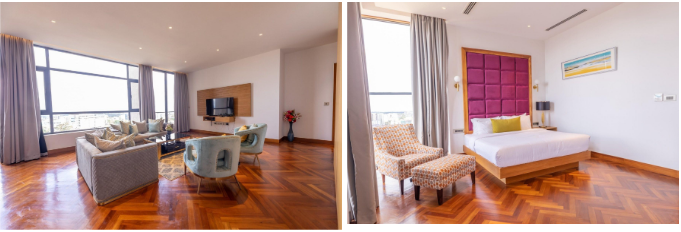
Inside Broadwalk Residency. Photo courtesy of Broadwalk Residency.
The business case for smarter hospitality
The technology story is also a commercial one. According to Broadwalk, HotelOnlineʼs involvement extends beyond software to stafftraining, 24-hour online support and monthly market-insight reports.
“The insight reports we get monthly have influenced our
marketing strategies.
FAITH WAUSI-NDIRANGU · GENERAL MANAGER, BROADWALK RESIDENCY
Wausi-Ndirangu says the propertyʼs revenue has followed an upward trajectory. That is Broadwalk managementʼs own assessment. It is not independently audited financial data, and this article does not include revenue or occupancy figures that would allow it to be tested. It should be read as an operatorʼs view rather than a verified performance result.
The structure of the arrangement is still instructive. The system supports daily delivery: bookings, rates and guest records. The market information supports a different kind of decision, about how to price and promote the property. For an independent property, receiving both from one provider is part of the proposition.
Greater reach for independent African hotels
The wider shift behind the Broadwalk example is the move to cloud-based hotel systems. These give independent properties access to distribution and revenue-management capabilities that once required more internal infrastructure and specialist staff. For hotels competing for international travellers, that can
narrow part of the technology gap between independent properties and global
hotel groups.
African hotels have an enormous opportunity. Independent
properties can now access technology and distribution capabilities that were once mainly available to large international hotel groups, while still keeping the personality, local knowledge and human service that make them unique.
MARTHA KERUBO · COO, HOTELONLINE
How far that opportunity extends will vary from property to property. Access to a channel manager does not fill rooms on its own, and one hotelʼs experience says little about a continentʼs market. What Broadwalk shows is narrower and more concrete: what the model looks like when an independent property adopts it from day one.
Technology with a Kenyan identity
For Wausi-Ndirangu, the value of the technology lies partly in how it supports a service culture that existed long before the software did. 
“Kenyan hospitality is warm by
tradition, and technology helps us to know more about our guests and what they prefer. We encourage more travellers to come
to Kenya and experience our authentic hospitality.
FAITH WAUSI-NDIRANGU
Technology is increasingly global.
Faith Wausi-Ndirangu, General Manager, Broadwalk Residency. Photo courtesy of Broadwalk Residency.
Booking engines, channel managers and property-management systems are used by hotels around the world. Hospitality remains local. It depends on a particular team, a particular city and a particular idea of what a good welcome looks like.
The opportunity for independent African hotels is not to make them resemble international chains. It is to give them sophisticated tools while preserving their individual character, local knowledge and service culture.
The next chapter of hospitality
Connected hotel systems will take over more administrative work. Reservations can be automated. Inventory can be synchronised. Pricing can be informed by data. Check-in can become faster.
THE INTERESTING QUESTION IS NOT SIMPLY
HOWMUCH CAN HOTELS AUTOMATE?
IT IS
WHAT SHOULD EMPLOYEES DO WITH THE
TIME AUTOMATION GIVES BACK TO THEM?
You can automate a reservation. You can automate inventory and
pricing. You can make check-in almost instantaneous. But you
cannot automate genuine hospitality. The future is using technology to give people more opportunity to deliver it.
MARTHA KERUBO · COO, HOTELONLINE
Broadwalk Residency offers a tangible illustration of that future.
Software coordinates reservations, rates and guest information.
People notice when somebody needs to rest. People remember a preferred parking space. People add the extra pillow.
Technology can make those employees faster, better informed and better prepared.
It still takes a human being to make someone feel welcome.
And make them want to come back.
LINKS
- HotelOnline: hotelonline.co
- Broadwalk Residency:
PHOTO CREDITS
Broadwalk property photography and Faith Wausi-Ndirangu portraits courtesy of Broadwalk Residency. Martha Kerubo event photograph supplied for this feature.