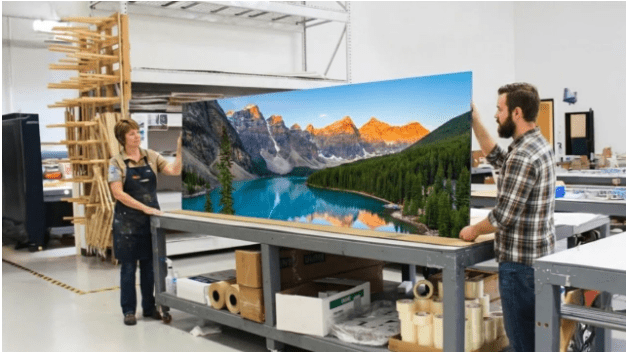
The shift from warehouse-first to order-first production is quietly revolutionizing how we decorate our homes
There’s something almost counterintuitive about the way we’ve manufactured home decor for decades. Companies would guess what customers might want, produce thousands of units, stack them in warehouses, and hope the predictions were right. Sometimes they were. Often, they weren’t.
Print-on-demand technology flips this entire model on its head. Instead of making products and waiting for buyers, production only begins after someone clicks “purchase.” It sounds simple, but the technological infrastructure required to make this work at scale is anything but.
How the Technology Actually Works
At its most basic level, print-on-demand is a production method where items are manufactured individually, in response to specific customer orders. No forecasting. No bulk production runs. No warehouses full of inventory that may or may not sell.
Modern print-on-demand isn’t just a printer in a back room. It’s an interconnected ecosystem of hardware, software, and logistics working together seamlessly. Industrial-grade digital printers connect directly to ecommerce platforms through sophisticated APIs. When you order a canvas print at 2 AM, the production file is automatically generated, routed to the nearest facility, queued for printing, and scheduled for shipping, often before you wake up the next morning.
The software layer is where the real sophistication lies. Order management systems serve as the central nervous system, ingesting orders from multiple sales channels and making split-second routing decisions. Should this order go to the facility in Nevada or North Carolina? The software considers available materials, current production queues, shipping distance, and facility capacity, all in milliseconds.
Color management presents another technical challenge. Ensuring the ocean blue a customer sees on their screen matches the ocean blue coming off the printer requires sophisticated color science. Screens emit light while printed materials reflect it. Bridging that gap consistently across thousands of orders demands regular calibration and standardized protocols across all production facilities.
Why Home Decor Is the Perfect Match
Print-on-demand could theoretically apply to many industries, but home decor represents something of an ideal use case.
First, home decor is inherently personal. People want pieces reflecting their individual taste, not mass-produced items identical to their neighbors’. This desire for uniqueness creates demand for variety that traditional manufacturing struggles to satisfy economically.
Second, trend cycles have accelerated dramatically. What’s fashionable in interior design shifts faster than ever, influenced by social media and cultural moments. Traditional production cycles, taking six to twelve months from design to retail shelf, can’t keep pace. Print-on-demand compresses this timeline to days.
Third, home decor spans an enormous range of sizes and formats. A small accent piece requires different handling than a massive wall canvas. Print-on-demand systems handle this variability efficiently, producing each item to exact specifications without retooling.
The Supply Chain Transformation
Traditional home decor supply chains involve multiple stages: raw materials move to centralized factories, finished goods move to distribution centers, then to retailers, and finally to consumers. Each step adds time, cost, and risk.
Print-on-demand streamlines this dramatically. Raw materials like blank canvases and inks still need positioning, but they’re generic inputs rather than finished goods. A blank canvas can become any of ten thousand different designs; a finished print can only ever be one image. This distinction matters enormously for inventory management and business risk.
Perhaps the most significant development is distributed production networks. Rather than operating from a single facility, sophisticated operations maintain production capabilities across multiple geographic locations. When an order arrives, algorithms determine the optimal production site based on proximity to the delivery address, current queue depths, and available materials. An order from Seattle might produce in Oregon; an order from Miami might produce in Georgia.
Jessie’s Home, an artist-focused wall art brand, demonstrates how contemporary home decor companies leverage these distributed networks to serve customers efficiently while offering broad design catalogs, something that would require enormous capital under traditional inventory-based models.
Sustainability and Waste Reduction
Environmental considerations increasingly influence both business decisions and consumer preferences. Print-on-demand offers genuine sustainability advantages.
The most straightforward benefit is waste elimination. Traditional forecasting inevitably creates overstock, items manufactured but never sold. Significant percentages of produced goods across consumer categories end up in landfills or liquidation channels. Print-on-demand eliminates this overproduction by definition; every item produced already has a buyer.
Distributed production networks also reduce transportation emissions by shortening distances between production and delivery. A canvas produced regionally travels far fewer miles than one manufactured overseas, shipped to a central warehouse, and redistributed domestically.
Worth noting: print-on-demand likely offers net environmental benefits for many home decor applications, but it’s not a sustainability silver bullet. Individual shipping may generate more packaging waste per unit than bulk distribution to retailers.
Looking Ahead
The technology continues advancing rapidly. Printing speeds keep increasing while quality improves. Substrate innovation expands the range of products suitable for on-demand production. Textiles, dimensional objects, and functional items increasingly join flat printed goods in the ecosystem.
What we’re witnessing in home decor is part of a broader shift in manufacturing philosophy. The twentieth-century model, centralize, standardize, produce at scale, emerged from constraints that digital technology is now dissolving. When production can happen anywhere, on demand, at quality levels matching traditional methods, the entire logic changes. Inventory becomes liability rather than asset. Variety becomes affordable rather than expensive.
For the home decor industry specifically, these changes align remarkably well with evolving consumer preferences. People want unique pieces, they want them quickly, and they’re increasingly conscious of the waste embedded in traditional retail models.
Print-on-demand won’t entirely replace conventional manufacturing. Some products and price points will continue favoring traditional approaches. But the balance is shifting, and the home decor on your walls five years from now may well be produced by systems that barely exist today.