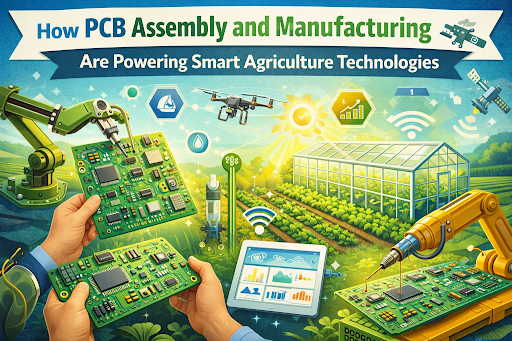
Smart agriculture is reshaping the way food is grown, monitored, and delivered across the world. From precision irrigation to automated livestock tracking, modern farms are no longer driven only by soil and climate knowledge. They are increasingly powered by advanced electronics working quietly behind the scenes. At the heart of this transformation are printed circuit boards that enable sensors, controllers, and communication systems to function reliably in demanding outdoor environments. Understanding how pcb assembly and pcb manufacturing support these innovations helps explain why electronics have become essential tools for today’s farmers.
The Digital Shift in Modern Agriculture
Agriculture has entered a data-driven era. Farmers now rely on real-time insights rather than assumptions passed down through generations. Smart agriculture systems collect information on soil moisture, temperature, humidity, crop health, and equipment performance. These systems must operate continuously, often in harsh conditions such as heat, dust, vibration, and moisture.
Electronic hardware forms the backbone of this digital shift. Without reliable circuit boards, smart devices would fail to deliver accurate data or long-term performance. This is where careful pcb design for agriculture plays a critical role, ensuring that every component works together efficiently while withstanding environmental stress.
Why Printed Circuit Boards Matter in Agricultural Technology
Printed circuit boards are not just platforms for holding electronic components. They are engineered foundations that determine how effectively a device performs. In agriculture, reliability is non-negotiable. A failed sensor during a critical irrigation cycle can lead to crop loss or wasted resources.
High-quality pcb manufacturing ensures consistent electrical performance, proper insulation, and durability. These factors directly affect how well smart agriculture devices function over time. Boards must resist corrosion, handle power fluctuations, and maintain signal integrity across long distances.
When combined with precise pcb assembly, where components are placed and soldered accurately, the result is equipment farmers can trust day after day.
Key Smart Agriculture Applications Powered by PCBs
Smart agriculture covers a wide range of applications, each relying on specialized electronics. Some of the most impactful uses include:
- Soil monitoring systems that measure moisture and nutrient levels
- Weather stations that collect local climate data
- Automated irrigation controllers that optimize water usage
- GPS-enabled machinery for precision planting and harvesting
- Livestock tracking devices that monitor health and location
Each of these applications depends on circuit boards designed for low power consumption, stable connectivity, and long operational life. The integration of sensors, microcontrollers, and communication modules requires thoughtful pcb design for agriculture to balance performance with cost efficiency.
Designing PCBs for Harsh Agricultural Environments
Unlike consumer electronics used indoors, agricultural devices face constant exposure to nature. Rain, mud, chemicals, and extreme temperatures can quickly degrade poorly designed electronics. This makes design choices especially important.
Engineers focus on several considerations during pcb design for agriculture:
- Selecting materials that resist moisture and corrosion
- Using protective coatings to shield circuits from contaminants
- Designing layouts that minimize heat buildup
- Ensuring strong mechanical support to handle vibration
These design strategies help extend the lifespan of agricultural equipment. When boards are designed correctly from the start, farmers experience fewer failures and lower maintenance costs.
The Role of PCB Assembly in Device Reliability
Even the best design can fail if assembly is inconsistent. pcb assembly involves placing components such as resistors, chips, and connectors onto the board with precision. In smart agriculture, accuracy during assembly is essential because devices often operate unattended for long periods.
Advanced assembly techniques improve reliability by ensuring strong solder joints and proper alignment. Automated inspection processes detect defects before devices reach the field. This attention to detail reduces the risk of malfunction during critical farming operations.
Reliable assembly also supports scalability. As demand for smart farming tools grows, manufacturers must produce large volumes without compromising quality. Consistent pcb assembly processes make this possible.
How PCB Manufacturing Supports Scalability and Innovation
The rapid adoption of smart agriculture technologies depends on the ability to produce electronics at scale. pcb manufacturing bridges the gap between innovative ideas and real-world deployment. Efficient manufacturing processes allow new designs to move from prototypes to full production quickly.
Modern manufacturing techniques support:
- High-volume production with consistent quality
- Custom board shapes and sizes for specialized equipment
- Integration of advanced materials for better performance
- Cost control for large agricultural deployments
By enabling scalability, pcb manufacturing helps innovative solutions reach farms of all sizes, from small family operations to industrial-scale producers.
Connectivity and Data Flow in Smart Farming Systems
Smart agriculture thrives on connectivity. Devices must communicate with each other and with centralized platforms that analyze data and provide actionable insights. Circuit boards play a key role in managing this communication.
PCBs integrate wireless modules for technologies such as cellular, LoRa, or Wi-Fi. These modules require careful layout and shielding to prevent interference and signal loss. Effective pcb design for agriculture ensures stable data transmission even in remote rural locations.
When communication systems are reliable, farmers can make informed decisions based on accurate, timely information rather than guesswork.
Energy Efficiency and Power Management
Many agricultural devices rely on batteries or solar power. Energy efficiency is therefore a major concern. Circuit boards must be designed to minimize power consumption while maintaining performance.
Smart power management features include sleep modes, efficient voltage regulation, and optimized component selection. These features are implemented during design and realized through precise pcb assembly.
Energy-efficient boards reduce the need for frequent battery replacement or maintenance visits, saving time and labor for farmers.
Supporting Sustainable Farming Practices
Sustainability is a growing priority in agriculture. Smart technologies help reduce water usage, minimize chemical inputs, and optimize resource allocation. Electronics enable these benefits by delivering accurate measurements and automated control.
Through durable pcb manufacturing and reliable assembly, devices can operate for years with minimal waste. Long-lasting electronics contribute to sustainability by reducing the need for frequent replacements and lowering electronic waste.
In this way, circuit board technology supports not only productivity but also responsible farming practices.
Quality Standards and Compliance in Agricultural Electronics
Agricultural electronics must meet strict quality and safety standards. These standards ensure that devices perform consistently and safely in challenging environments. Manufacturers follow rigorous testing procedures throughout pcb manufacturing and assembly.
Testing may include thermal cycling, vibration testing, and exposure to moisture. Boards that pass these tests are better suited for long-term agricultural use. High standards protect both farmers and the technology providers who support them.
Future Trends in Smart Agriculture Electronics
As technology advances, smart agriculture will continue to evolve. Emerging trends include artificial intelligence at the edge, more advanced sensor networks, and greater automation. These innovations will place even higher demands on electronic hardware.
Future circuit boards will need to handle increased data processing while remaining energy efficient and durable. Continued improvements in pcb design for agriculture will enable these advancements, supporting smarter and more responsive farming systems.
Manufacturers that invest in advanced pcb assembly techniques will be better positioned to meet these future requirements and support innovation.
Cultivating the Future with Smart Electronics
Smart agriculture is no longer a concept of the future. It is a practical reality transforming farms today. Behind every sensor, controller, and connected machine is a carefully designed and manufactured circuit board working reliably in the background. Through thoughtful pcb design for agriculture, precise pcb assembly, and scalable pcb manufacturing, technology providers are empowering farmers to grow more with fewer resources.
As agriculture continues to modernize, the role of electronic hardware will only become more important. By focusing on quality, durability, and efficiency, printed circuit boards are helping cultivate a more productive, sustainable, and resilient agricultural future.