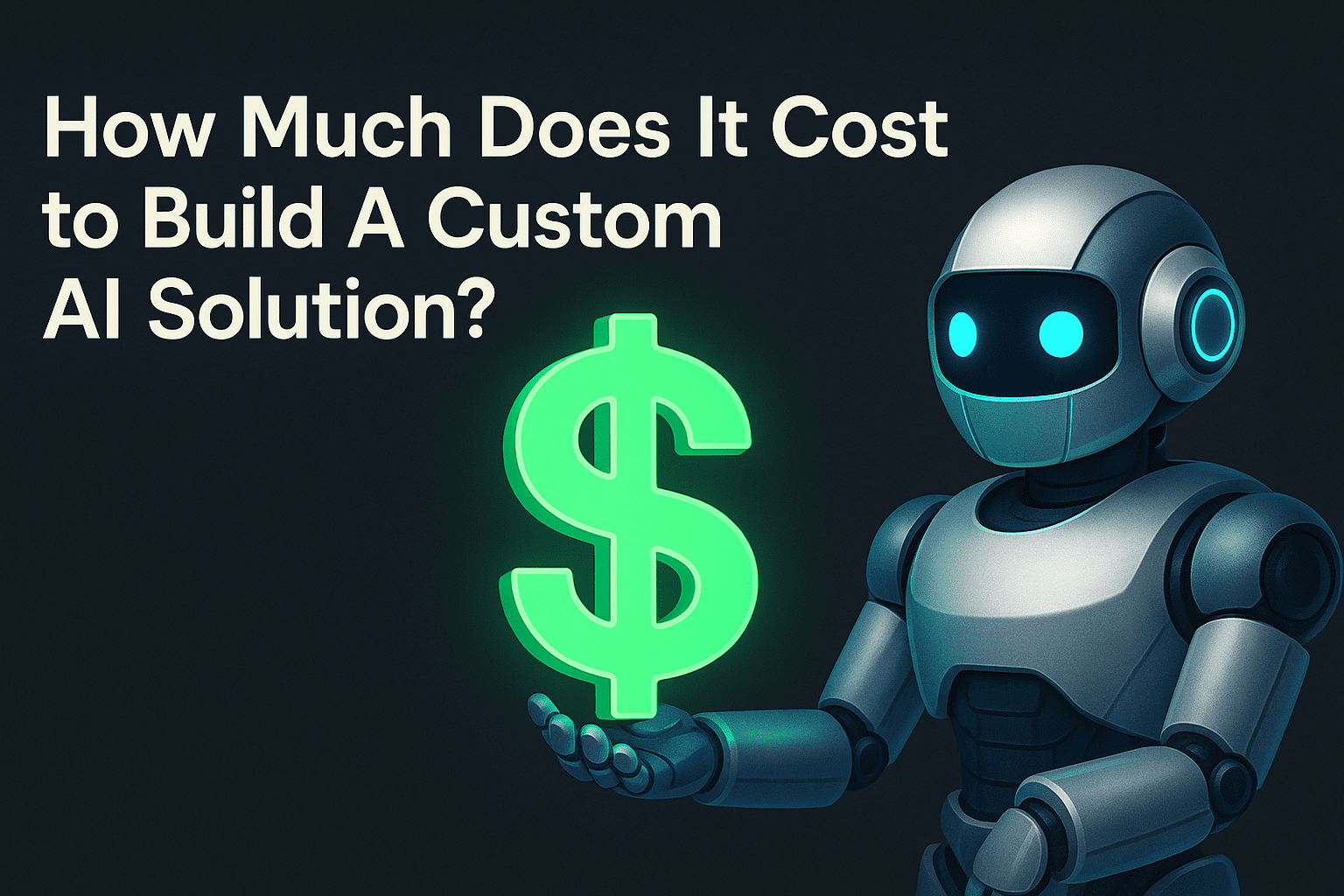
If you ask any business owner about the cost of building an AI system, you’ll hear mixed responses, because there is no fixed number. It’s a myth that someone can give you a fixed price tag that works according to the one-size-fits-all pricing approach. Every custom AI solution is different because of its unique data ecosystem, technical challenges, goals, integration needs, and compliance requirements, which all contribute to building the AI solution price.
In simple words, the custom AI solution cost entirely depends on the outcomes or values you are expecting to be generated by AI, and not merely the approach, such as a basic automation bot implementation or a full-scale AI platform deployment.
Therefore, when designing a custom AI solution, it is important to analyze the cost drivers, all the hidden costs, expected ROI insights, and implement the right cost-daving strategies that can make your AI investment a strategic advantage in the long term.
The Core Cost Drivers: What Really Impacts Your AI Budget
Several realistic factors actually drive the custom AI pricing for your business:
Project Complexity Factors
The complexity of solutions has a significant impact on the cost of AI development. In comparison to the predictive analytics engine, a basic chatbot would require less architecture, data training, and testing. If you want AI to analyze real-time data, automate tough operations, or generate insights, in that case the cost to build an AI solution increases with the requirements for strong models, deeper system integrations, and large-scale data processing.
Technical Requirements
The cost of AI development is shaped by the technologies used behind it. Your needs for scalability, algorithms, computing infrastructure, and model choice are integral to the overall project cost. Industries that require high-security environments, cloud-native setups, and those with compliance-heavy requirements need additional investment.
Team and Expertise
The cost can also vary depending on the type of AI development partner you choose; the price can rise based on whether you hire an in-house team, an AI automation agency, or a freelancer. Though senior AI engineers, architects, and data scientists charge higher rates, they deliver cleaner, faster, and more strong results.
The Price Spectrum: From Simple To Enterprise AI Solutions
- Basic AI applications
The basic AI applications that include simple chatbots, small-scale data models, and basic automation tools could cost around – $10,000 – $50,000.
- Medium-complexity solutions
These projects include real-time analytics, integrated AI workflows, advanced automation, and multi-layer models that can cost between – $50,000 – $150,000.
- Enterprise-grade AI platforms
Enterprise-level AI implementations demand deep system integrations, long-term scalability planning, and extensive architecture. Thus, the enterprise AI pricing structure can cost between $150,000 – $500,000+.
- Ongoing maintenance and support
AI is not something that can be built as a one-time model. It requires regular updates, retraining, and monitoring, and these upgrades may require regular maintenance costs.
Breaking Down The Costs: Where Does Your Money Go?
The cost of custom AI implementation increases gradually with different phases of AI integration:
- Discovery & Planning Phase
This phase includes an architectural blueprint, research, requirements mapping, and feasibility checks. It ensures that your solution is practical before beginning the development.
- Development Phase
This stage is the most resource-intensive, covering model training, code testing, data cleaning, and complete integration with your existing systems. The more data-focused the solution, the more time and cost this stage will bring.
- Deployment & Beyond
Deployment requires secure infrastructure setup, ongoing optimization, and team training and knowledge transfers to ensure that the model performs as per the requirements in the real-world application.
Hidden Costs: What Many Businesses Overlook
Despite having a clear budget, several hidden factors may cause a substantial price increase for a tailored AI solution.
- Data collection and preparation
AI is very dependent on clean and reliable data. A significant amount of time and money is usually required to collect, label, and structure datasets in a way that businesses expect.
- Cloud and infrastructure expenses
Training models need computing power. Cloud use fees and storage charges can quickly become costly, depending on the size of the AI.
- Team training and change management
Employees need time to adapt. The cost of training the teams to become familiar with the new system and learn how to use and manage it is a necessary investment, which is mostly neglected by many organizations.
- Scalability and future requirements
As you start using the custom AI model, you will come to know about what additional features you need at present and for your future growth.
- Security and compliance needs
Specific industries like finance, medical, and stepping into the international markets might need adherence to several compliance and industry regulations.
What are the Cost-Saving Strategies that can Help Maximize Your AI Budget?
Several cost-saving strategies implemented with a solid AI implementation plan can actually help maximize your AI budget.
- Begin with an MVP: Starting with a minimum viable product allows you to understand the fundamental concepts and response before actually investing largely in the complete product.
- Use open-source technologies: Make use of different open-source frameworks such as LLaMa variants and Transformers, which are reliable and reduce license costs.
- Select the right development partner:Working with the right AI development partner that understands your business-specific needs can accelerate deliveries and minimize the chances of expensive mistakes.
- Implement in phases: Start implementing the custom AI solution in phases to avoid paying for features that are not needed at present.
- Reuse components and architecture: Opting for reusable systems and components can help develop a cost-effective architecture for the long term.
ROI Calculation: Is Custom AI Worth The Investment?
The long-term benefits justify the investment but not the cost. Here’s how to measure the ROI for AI investment:
- Measuring business impact: AI solutions can improve speed, accuracy, and results. Thus, track each metric carefully to measure ROI.
- Reducing operational costs:Automation reduces the chances of manual errors and repetitive work, hence minimizing the operational costs.
- Creating new revenue opportunities: With streamlined processes and personalization, AI can drive conversions and sales.
- Gaining a competitive advantage: Early AI adoption can help companies stand out from their competitors.
- Strengthening long-term strategy: A systematic AI implementation supports innovation, scalability, and future growth.
Choosing Your Development Partner: Impact On Cost And Quality
Your AI partner plays a major role in the final AI development cost and overall quality.
- Offshore vs. onshore teams
Offshore teams are less expensive, and onshore teams are likely to have easier communication. The selection is based on the needs of your project.
- Agency vs. freelancers
Agencies offer structured procedures and a complete experience; freelancers are suitable for smaller works, but might lack an end-to-end experience.
- Assessing expertise
Examine portfolios, case studies, and technical competencies to ensure your AI partner fits your industry and objectives.
- Understanding the pricing models
There are benefits and drawbacks to fixed-cost, time-and-material, or milestone-based pricing models. All of them offer a straightforward approach with the initial cost, which eliminates surprises as the project progresses.
The Bitontree Approach: Transparent AI Development Pricing
Bitontree enhances AI pricing with a clear and confident structure based on value.
- Clear, phased cost breakdown
Our prices encompass all phases – discovery to deployment – and therefore clients are aware of what they are paying.
- No hidden charges
Dependency and integrations are also revealed upfront to prevent the unexpected costs.
- Focused on measurable ROI
Bitontree develops performance-based, scaled, and real business-performing AI systems.
- Flexible engagement models
Our AI solutions fit various needs and budgets, whether it is full-cycle development or support for specific stages.
Next Steps: Planning Your AI Investment
A well-developed roadmap allows you to estimate and create the price of an AI solution.
- Request detailed project quotes: Obtain a realistic quote by sharing how you will use the project, data availability, and system requirements.
- Ask critical questions: Before committing, ensure you are aware of timelines, responsibilities, technology preferences, and plans of deployment.
- Prepare an implementation roadmap: This is a step-by-step plan that allows continuous development and monitored expenditure.
- Plan your budget smartly: Set aside money to develop, test, roll out, and update in the future, ensuring you do not strain your finances in the future.
The Bottom Line
Developing an AI solution is not just a technical project but a strategic action towards improved operations and innovation that will be long-term. Done carefully, AI can not only eliminate your workforce, but it will also open up new business opportunities, provide more choices, and equip your company for the future. It is a secret of selecting the right scope, the right strategy, and the right partner.
Collaborate with Bitontree to create a custom AI application based on corporate objectives, cost, and business expansion.
FAQs
- What’s the typical timeline for custom AI development?
The duration of most projects is 3 -6 months, depending on complexity, data quality, and integrations.
- Can we start small and scale later?
Yes. The most intelligent method of reducing risks and controlling costs is a staged approach.
- What ongoing costs should we budget for?
Cloud hosting plan, retraining model, updates, monitoring, and support.
- How do we ensure we get value from our investment?
Define specific objectives at the beginning, track the performance, and streamline the work results based on the data.
- What payment models do AI development agencies offer?
They mostly use milestone-based pricing, fixed cost models, or hourly engagement depending on the project scope.