The human body is made up of cells that work together to support every structure and function, from movement to digestion to cognition. Because cells are the basic units of life, many people are curious about how many exist in a single body, what that number represents, and how helpers like HealthyCell supplements can support their overall well-being.
Questions about cell count often appear alongside discussions about wellness, nutrition, and cellular support as part of a broader interest in cellular health. Understanding the number of cells in the body provides useful context for appreciating human complexity, even though the number itself is not a direct measure of health or performance.
What Is a Cell?
A cell is the smallest structural and functional unit of living organisms. Each cell performs specific tasks that contribute to the body’s overall operation. Some cells generate energy, others transmit signals, and many provide structure or protection. Cells contain specialized components that allow them to grow, divide, and respond to their environment.
Without cells working together in coordinated systems, tissues and organs would not be able to function. Because cells vary widely in shape, size, and purpose, they are not interchangeable. This diversity is one reason the human body can adapt to a wide range of conditions and demands.
How Many Cells Are in the Human Body?
Current scientific estimates suggest that the human body contains approximately 30 to 40 trillion cells. This figure is not exact and represents an average rather than a fixed value. Researchers arrived at this estimate by analyzing the mass and volume of different tissues and calculating the number of cells typically occupying those spaces.
Advances in biology and imaging have refined earlier estimates that were significantly higher. While the commonly cited number provides a helpful reference point, it should be understood as an approximation rather than a precise count.
Why Is Counting Human Cells So Difficult?
Counting cells in the human body is challenging because cells differ dramatically in size, density, and lifespan. Some cells, such as red blood cells, are extremely small and numerous, while others, like muscle fibers, are larger and less abundant.
Additionally, cells are constantly being created, damaged, and replaced. This ongoing turnover means that cell count changes over time, even within the same individual. Scientists must rely on models and averages rather than direct counting because there is no method to tally every cell at a single moment.
Different Types of Cells and Their Distribution
Not all cells contribute equally to the total count. Red blood cells make up a large percentage of the body’s total number of cells because they are small and produced in high quantities. Skin cells are also numerous due to the constant process of shedding and replacement.
In contrast, nerve cells are fewer in number but play essential roles in communication and coordination. Muscle cells are relatively large and long-lived, contributing a relatively small percentage to the overall cell count but a significant portion to body mass. This uneven distribution highlights that cell function is often more important than cell quantity.
How Does Cell Count Change Over Time?
Cell count is not static throughout life. During growth and development, the number of cells increases as tissues expand and organs mature. In adulthood, cell production and cell loss tend to balance each other more closely. As aging progresses, some types of cells regenerate more slowly, while others continue to renew regularly.
Injury and illness can also affect cell numbers temporarily as the body repairs damaged tissues. Because cells are continually turning over, the body maintains function through renewal rather than preserving a fixed number.
The Role of Cell Turnover and Renewal
Cell turnover is a fundamental process that helps maintain healthy tissues. Many cells have a limited lifespan and are replaced through a process of controlled division and differentiation. For example, blood cells are replaced frequently, while some nerve cells may last for decades.
This renewal process supports adaptation and repair but means that the total number of cells fluctuates. Efficient turnover allows the body to respond to stress, injury, and environmental changes. Problems with cell renewal can affect tissue function even if the overall cell count remains within typical ranges.
Cell Health vs. Cell Quantity
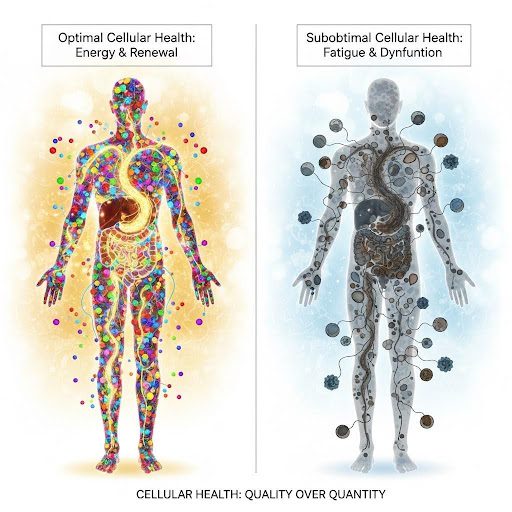
While it may be interesting to know how many cells are in the body, overall health depends more on how well those cells function. Healthy cells communicate effectively, produce energy efficiently, and respond appropriately to signals.
A higher number of cells does not necessarily indicate better health, just as a lower number does not automatically signal a problem. Factors such as cellular efficiency, resilience, and coordination are more meaningful indicators of biological health than total cell count alone.
Understanding Cell Numbers in a Greater Context
The human body contains tens of trillions of cells, but this number is best viewed as a reference point rather than a definitive measure. Cell diversity, turnover, and function play a far greater role in maintaining health than sheer quantity. Understanding how scientists estimate cell counts and why they vary helps place the number in context.