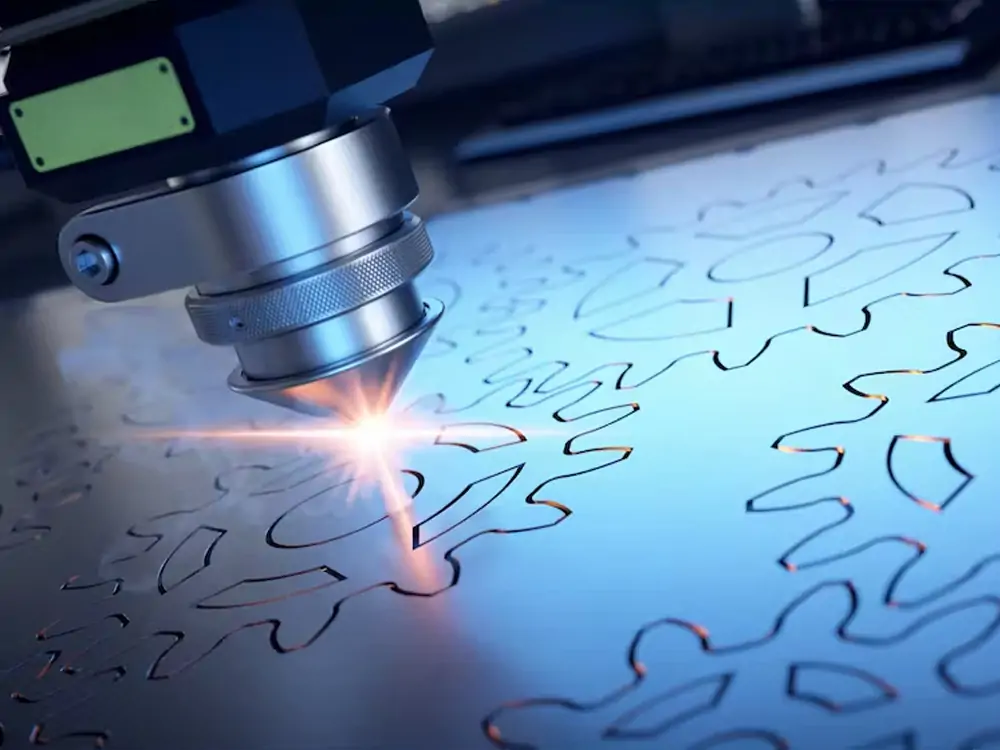
Manufacturing is becoming increasingly connected. Machines are no longer operating as isolated pieces of equipment; production lines now combine automation, software, sensors, machine vision, databases, and real-time production information.
One technology that is often overlooked in this transformation is laser marking.
At first glance, laser marking appears to be a relatively simple manufacturing process: a laser creates text, numbers, symbols, logos, or codes on a product. In a modern factory, however, that mark can become much more important. It can serve as the physical link between a manufactured component and the digital information stored about it.
Companies such as JQ Laser develop laser marking systems for applications involving metal components, electronics, industrial tools, automotive parts, and product identification.
Laser Marking Is More Than Printing Information on a Product
Traditional product identification often relied on labels, ink printing, stickers, or manually applied markings.
These methods can still be useful, but many industrial applications require identification that remains associated with the physical component throughout its useful life.
A manufacturer may need to identify a component with:
- A serial number
- A product number
- A batch number
- A QR code
- A Data Matrix code
- A manufacturing date
- A company logo
- A material or specification code
- A traceability identifier
Laser marking can create this information directly on the product surface.
The important point is not simply that the information is visible. The mark can become part of a larger identification system.
From a Physical Mark to a Digital Identity
Consider a simple industrial component.
The component is manufactured on a production line and receives a unique Data Matrix code. That code can then be associated with information stored in a manufacturing database.
The database might contain information such as:
- Production batch
- Manufacturing date
- Production line
- Supplier information
- Inspection results
- Operator or workstation information
- Shipment information
The laser mark itself does not store all of this information. Instead, it provides a physical identifier that allows production systems to connect the object with its digital record.
This distinction is important.
The laser is creating the physical identification layer. Software, databases, MES platforms, ERP systems, and inspection equipment can provide the digital layer.
Together, they form a traceability workflow.
Why Permanent Identification Matters in Manufacturing
Modern supply chains can involve multiple factories, suppliers, distributors, and service organizations.
A component manufactured in one country may be assembled into a larger product somewhere else and eventually serviced several years later.
If its identification disappears during handling or production, tracing its origin can become difficult.
Permanent marking can help manufacturers maintain identification through these stages, provided that the marking process is designed for the material and environment.
For example, a metal automotive component may need a mark that remains readable after handling, cleaning, assembly, and normal industrial exposure.
An electronic enclosure may require a different marking process because excessive heat can damage or deform some plastics.
This is why laser marking should be treated as an application engineering problem rather than simply a machine specification problem.
Different Materials Require Different Laser Technologies
One of the most important decisions in laser marking is matching the laser wavelength and process characteristics to the material.
| Laser Technology | Typical Wavelength | Common Applications |
|---|---|---|
| Fiber Laser | 1064 nm | Many metals, including stainless steel, aluminum, carbon steel, brass and titanium |
| UV Laser | 355 nm | Plastics, electronics, PCB, glass and selected heat-sensitive materials |
| CO₂ Laser | Around 10.6 μm | Wood, acrylic, paper, leather and various non-metallic materials |
This is not a universal compatibility rule. A particular material may respond to more than one laser technology, but the resulting contrast, thermal effect, depth, speed, and long-term readability can be different.
For that reason, manufacturers should test their actual production material rather than selecting a machine based only on a general material list.
Fiber Lasers and Industrial Metal Identification
Fiber laser systems operating around 1064 nm are widely used for metal marking.
Typical applications include:
- Automotive components
- Industrial tools
- Machine parts
- Bearings
- Electrical components
- Hardware products
- Metal nameplates
- Product identification plates
The same general laser platform can be configured for different marking objectives.
A manufacturer may only need a shallow identification mark for a serial number. Another application may require high-contrast marking, annealing, coating removal, or deeper engraving.
These processes can require substantially different parameter settings.
Laser power is therefore only one part of the engineering decision.
Why Laser Power Alone Does Not Define Marking Performance
It is common for buyers to compare laser marking machines by wattage.
A 20W machine, for example, is often compared directly with a 30W or 50W machine.
Power matters, but it does not tell the complete story.
Marking performance can also depend on:
- Laser source characteristics
- Pulse duration
- Pulse frequency
- Galvanometer scanning system
- Focusing lens
- Marking field size
- Material properties
- Marking content
- Number of passes
- Focus position
- Hatch settings
- Software configuration
Two machines with the same nominal laser power can therefore produce different results when applied to the same workpiece.
This is particularly important for industrial buyers because production quality is determined by the complete system, not by one number on the specification sheet.
Machine Vision Adds Another Layer
Laser marking becomes even more interesting when combined with machine vision.
A modern production cell can use one system to create an identification code and another system to verify whether the code was correctly produced.
A simplified workflow might look like this:
- The production system assigns an identification number.
- The laser receives the marking data.
- The laser marks the component.
- A camera captures the finished mark.
- Software checks readability and position.
- The inspection result is stored with the production record.
This creates a closed loop between production and quality control.
The benefit is not necessarily that every factory needs this level of automation. The important concept is that marking can become one component of a larger digital manufacturing process.
Connecting Laser Marking With MES and ERP Systems
In larger manufacturing environments, identification data may already exist inside an MES or ERP system.
Instead of manually entering information into the laser marking software, the production system can provide the required information automatically.
This can be particularly useful for products that require unique serial numbers.
For example, a production sequence could work like this:
| Production Stage | Digital Information |
|---|---|
| Order creation | Product and customer information |
| Production planning | Work order and batch information |
| Marking | Serial number or traceability code |
| Inspection | Marking verification result |
| Shipment | Product and logistics information |
The physical mark becomes the identifier that connects these different stages.
Why Production Cycle Time Is More Useful Than Maximum Scan Speed
Another common misunderstanding concerns scanning speed.
Laser marking equipment may advertise a maximum scanning speed measured in millimeters per second. This specification is useful for understanding the capability of the scanning system, but it does not represent the production cycle time of every application.
A simple line of text may require very little processing time.
A dense Data Matrix code, filled logo, deep engraving process, or multi-pass application may take considerably longer.
For production planning, manufacturers should therefore measure the complete process:
Loading → Positioning → Marking → Inspection → Unloading
This provides a much more useful number for calculating production capacity.
Testing Is More Important Than a Perfect Sample
A supplier can usually produce a good sample under controlled conditions.
The more important question is whether the process remains stable across repeated production cycles.
Before purchasing a system, manufacturers should ideally test multiple samples using the actual production material.
A useful evaluation can include:
- Marking contrast
- Marking depth
- Code readability
- Positioning accuracy
- Cycle time
- Repeatability
- Heat-affected area
- Surface damage
- Parameter stability
This approach helps separate a laboratory demonstration from a production-ready process.
For manufacturers working with several metals, plastics, and industrial materials, Find more info can be useful when comparing how different laser technologies behave across different materials.
Laser Marking in Automotive and Industrial Manufacturing
Automotive manufacturing is one example where identification and traceability are closely connected.
Components may need permanent identification throughout assembly, distribution, servicing, and sometimes recycling.
The same principle applies to industrial tools, electronics, machinery components, medical devices, batteries, and other manufactured products.
The exact marking process will vary according to the application, but the underlying requirement is similar: the physical product needs an identifier that can remain associated with its digital production information.
This makes laser marking relevant to the broader development of connected manufacturing.
What Buyers Should Consider Before Adding Laser Marking to a Production Line
Manufacturers considering a laser marking system should begin with the production requirement rather than the machine catalogue.
Important questions include:
- What material will be marked?
- What information needs to be marked?
- Does every product require a unique identifier?
- How large is the marking area?
- Is surface marking sufficient, or is deeper engraving required?
- How fast must each part be processed?
- Will the mark be inspected automatically?
- Does the system need to communicate with MES or ERP software?
- Will the process be manual, semi-automatic, or fully automatic?
- What environmental conditions will the finished mark experience?
Once these questions are answered, the manufacturer can evaluate the appropriate laser technology, power level, lens, scanner, software, and automation configuration.
Click here to explore an example of how laser marking can be applied to industrial metal identification.
The Broader Role of Laser Marking in Smart Manufacturing
Smart manufacturing is often discussed in terms of artificial intelligence, robotics, cloud platforms, and industrial IoT.
But digital manufacturing also depends on something much simpler: reliable identification.
A factory cannot effectively track a physical component if the component cannot be uniquely identified.
This is where technologies such as laser marking can provide an important connection between physical production and digital information.
The laser itself does not create a smart factory. Instead, it provides one of the physical data points that a smart factory can use.
When combined with machine vision, production databases, automation controllers, MES platforms, and quality systems, marking can become part of a much larger manufacturing workflow.
Final Thoughts
Laser marking is sometimes viewed as a simple finishing operation, but its role in modern manufacturing can be much broader.
A permanent identification code can connect a physical component with production information, inspection records, batch data, and downstream service information.
As factories become more connected, this physical-to-digital connection becomes increasingly useful.
The most successful implementation is not necessarily the machine with the highest laser power or the highest advertised scanning speed. It is the system that produces the required mark consistently, at the required cycle time, on the actual production material, while fitting into the factory’s wider information and automation workflow.
That is why laser marking deserves to be considered not just as a marking technology, but as one small yet important component of digital manufacturing.