
How Integrated Solar, Storage and EV Charging Systems Are Changing Commercial Energy Infrastructure

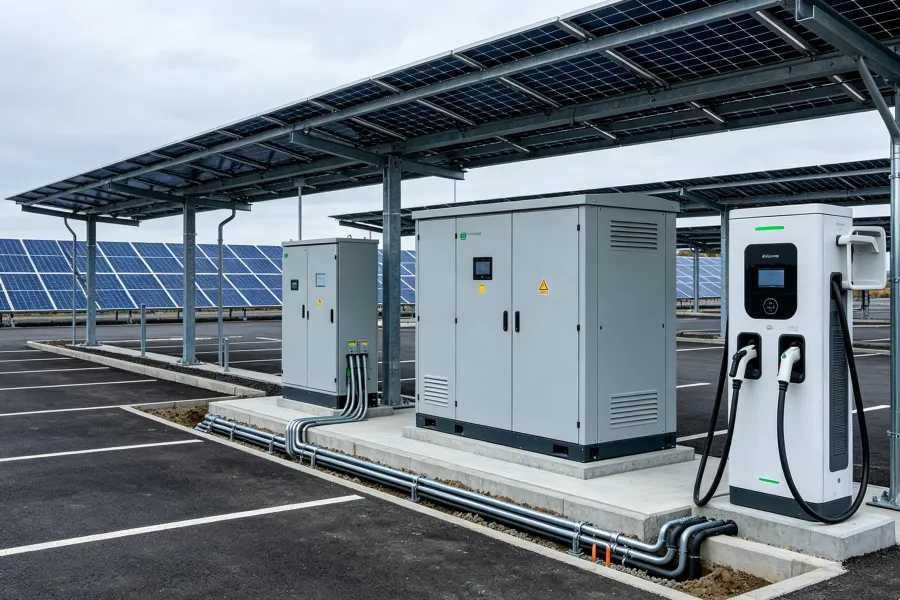
Commercial energy projects are moving beyond standalone rooftop solar. More businesses are combining photovoltaic generation with battery storage, EV charging, and smarter electrical distribution so that generation, consumption, and backup power can be managed as one system.
The benefits are practical: higher solar self-consumption, lower peak demand, better resilience, and more capacity for transport electrification. The trade-off is greater electrical complexity. Solar arrays, batteries, chargers, inverters, protection devices, and building loads must be sized and coordinated around the same operating plan.
Why Are Commercial Energy Systems Becoming More Integrated?
A commercial building that once used solar only to reduce grid consumption may now need battery storage, multiple EV chargers, and more active load management.
These technologies affect one another. Solar output changes throughout the day. Batteries charge and discharge according to tariffs, load, or backup priorities. EV chargers can add large loads at specific times, especially at fleet depots, workplaces, and commercial car parks.
That is why businesses increasingly look for integrated energy solutions instead of selecting each system independently. A workable design needs to show how electricity is generated, stored, converted, distributed, protected, and consumed across the site.
For factories, warehouses, offices, and retail facilities, the system should also account for future expansion. A design that works for two chargers today may not work when the site adds ten more.
Solar Is Only One Part of the Energy System
PV modules are the generation source, but they are only the first stage of the electrical chain.
Power moves from PV strings through DC combining and protection equipment to the inverter, where it is converted into AC electricity for building loads or grid export. Battery storage may connect on the DC or AC side, while EV chargers create another major point of consumption.
Each interface affects equipment selection. Inverter capacity should match the PV array and operating strategy. Cables, breakers, isolators, surge protective devices, and distribution equipment must match system voltage, current, fault conditions, and installation environment.
The most useful design question is therefore not “Which product should we buy?” but “How should power move through the site under normal operation, peak demand, faults, and maintenance?”
How Do Storage and EV Charging Reshape the Load Profile?
Battery storage can absorb surplus solar generation and release it when demand rises. Depending on the site, this can support peak shaving, load shifting, backup power, and higher solar utilization.
EV charging changes the load profile in a different way. Several vehicles charging at once can create a concentrated demand peak that was never considered in the original building design. Fast chargers make this issue more pronounced because their power demand can be significant relative to the site connection.
Before adding storage or charging, project teams should review transformer capacity, main distribution capacity, charging schedules, expected simultaneous demand, battery operating strategy, and grid limits.
A coordinated system can use storage to reduce charging peaks or shift energy use to lower-cost periods. A poorly coordinated system may require expensive electrical upgrades or create avoidable operating restrictions.
Why Does Electrical Protection Matter More in an Integrated System?
More connected equipment means more electrical interfaces, and each interface needs the right protection and isolation strategy.
On the solar DC side, this may include PV fuses, DC circuit breakers, isolators, surge protective devices, and combiner boxes. On the AC side, protection must be coordinated between inverters, storage equipment, EV chargers, distribution panels, and the building grid connection.
This is where commercial solar protection should be treated as part of the wider site architecture rather than as a separate product category.
Current rating alone is not enough when selecting a protective device. Engineers also need to consider system voltage, fault current, breaking capacity, DC or AC duty, cable characteristics, environmental conditions, and coordination with upstream and downstream equipment.
Maintenance matters as well. A technician should be able to isolate a PV array, inverter, battery system, or charging circuit without unnecessarily shutting down the rest of the facility. Clear isolation points and circuit identification make troubleshooting and future upgrades easier.
What Should Commercial Buyers Check Before Procurement?
Procurement teams should compare systems on more than headline power ratings or equipment price.
A practical review should cover:
- System voltage and current compatibility
- Protection coordination between DC and AC circuits
- Inverter, storage, and EV charger integration
- Communication and monitoring protocols
- Product-specific certifications and applicable standards
- Environmental protection for outdoor equipment
- Maintenance and isolation access
- Expansion capability
- Technical documentation, commissioning scope, and supplier support
Buyers should also clarify who is responsible for system integration. One supplier may provide only hardware, while another may support design, commissioning, monitoring, and after-sales service. Those differences can materially affect project risk.
For multi-technology projects, a clear responsibility matrix can prevent gaps between the solar contractor, storage supplier, charging provider, and electrical installer.
Building Commercial Energy Infrastructure for Long-Term Flexibility
Solar, storage, and EV charging create the most value when they are designed around the same electrical architecture.
For project developers and commercial buyers, the priority should be a system that can manage changing loads, isolate faults, support maintenance, and expand without major redesign. That requires attention to energy flow, protection coordination, communication, and responsibility boundaries before equipment is ordered.
The result is not simply a collection of renewable-energy products. It is commercial energy infrastructure designed to remain usable as generation, storage, and electrified transport continue to grow.







Comment