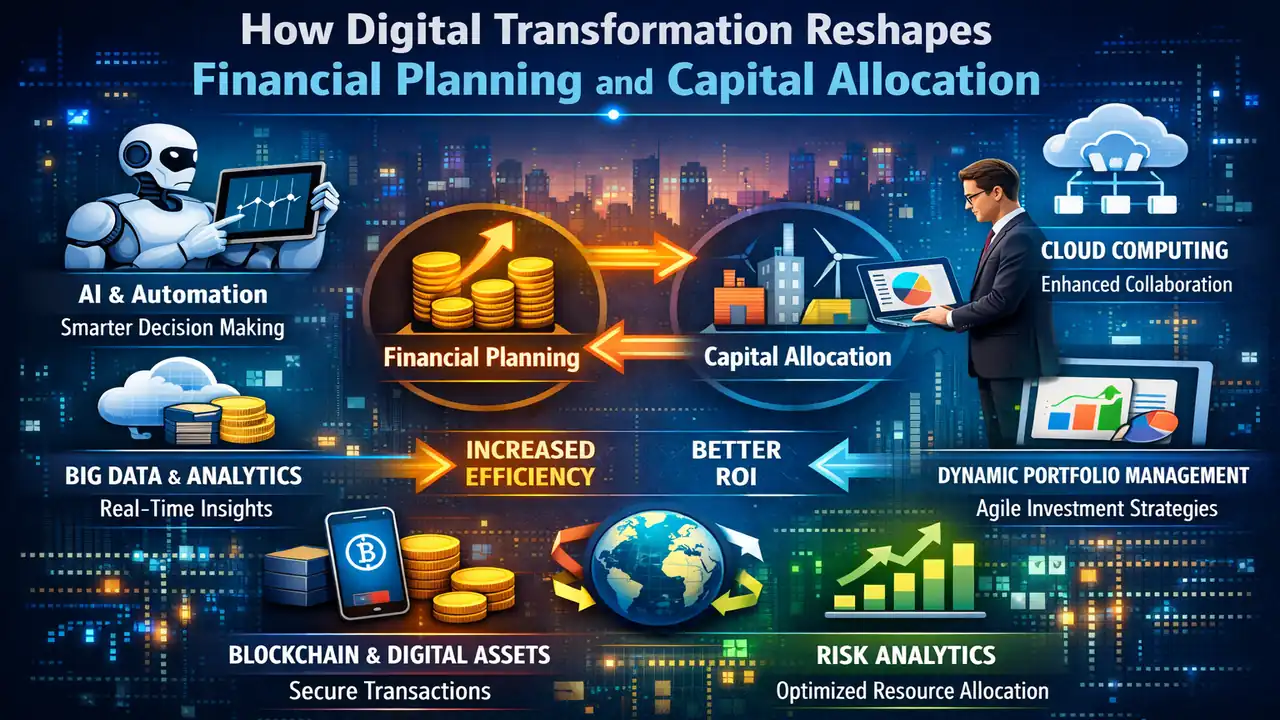
“Digital transformation” is more than just a word these days; it’s changing the way organizations handle their money in big ways. In several disciplines, such as educational management and corporate finance, technology is transforming how budgets, projections, and investment decisions are made. If you keep relying on spreadsheets and your gut, the game of catch-up has already begun. The discussion starts strong as the how digital transformation reshapes financial planning and capital allocation clarifies intent.
It’s not only about new software; it’s also about building financial management systems that are smarter and better able to respond to real-world situations. Both public and commercial institutions are finding that old ways of allocating resources aren’t working as well as they used to in today’s fast-paced economy.
How Digital Transformation Reshapes Financial Planning and Capital Allocation
The financial industry needs to switch from manual procedures to data-driven ones in order to fully embrace digital transformation. Imagine a university’s bursar’s office that can now keep track of spending across all of its campuses in real time, instead of spending weeks reconciling budgets by hand. The technology stack is crucial, but what really matters is how people use these tools to make decisions faster and better.
The financial institutions was one of the first to make the transition, but today every business that deals with money is doing the same. Automated reporting, cloud-based platforms, and AI-driven forecasts are becoming necessary for making smart decisions about where to put money. Even small educational NGOs are now using tools that were formerly only available to Wall Street.
From Guesswork to Data-Driven Decisions
Do you remember when budget meetings were all about arguing about reports from last quarter that were no longer relevant? The days of it are coming to an end. Modern technology that extract data in real time from enrollment numbers, donation streams, and operational costs provide you a real-time view of your finances. You will be able to predict and avoid cash flow problems and put extra money back into the business.
The Financial Calculator Renaissance
Modern technology has turned the simple financial calculator into a formidable tool for making decisions. It would have taken weeks to manually figure out five different tuition pricing plans, but I just saw an administrator accomplish it with built-in sensitivity analysis.
The Cloud Changes Everything
In the past, you needed to have expensive servers on-site to organize your finances, but that’s no longer the case. Using cloud computing, school administrators may safely access their financial details from anywhere. The chief financial officer of a school district can approve purchase orders while on site tours and observe how they affect the budget right away.
AI-Powered Forecasting Accuracy
It’s scary how well predictive analytics can guess how much money you’ll need. My last job was at a community college. They utilized machine learning to forecast a drop in enrollment 18 months in advance, which let them make changes to their staff and program budgets before human analysts could identify the pattern. That is what digital change at work is really all about.
Automating the Grunt Work
Robotic Process Automation (RPA) can be used to do everyday tasks like matching invoices or reporting grants. Now the finance department can concentrate on strategy. Just think about all the things you could do with nine more days. For example, I helped one university cut its monthly shutting period from twelve days to three days after using RPA.
Real-Time Scenario Planning
Digital technologies now make it easy to test budgets in real time with “what-if” scenarios. In what situation is a 15% drop in enrollment thought to be? What will happen if the government money is approved? I have seen institutions do twelve simulations in the time it used to take to perform one hand projection.
Breaking Down Silos
Modern finance is no longer split up. You can get to financial planning, human resources, and campus operations all from one place. When the math department asks for new lab equipment, it affects both the capital expenditures and the price of ongoing maintenance.
Democratizing Financial Insights
Intuitive dashboards make it easy for department leaders to get the financial information they need. A chair of a biology program can simply keep track of how much money the program spends compared to its budget without having to wait for monthly reports. Warning: this means that you need to train those who don’t work in finance how to read data correctly.
Risk Management Gets Smarter
Digital systems are always on the lookout for strange spending patterns, compliance violations, and investment hazards. Before the money was given out, one college’s system found illegal grant spending, which saved them from a big audit problem.
Capital Allocation as Competitive Advantage
Institutions can get ahead of their competitors by becoming experts in digital financial instruments. Their plan is to quickly move money to projects that are in high demand and get rid of areas that aren’t doing well. I’ve seen colleges and universities use these resources to start innovative online programs that make a lot of money.
Overcoming Implementation Pitfalls
That was the biggest mistake? Not paying attention to the cultural change and instead concentrate on the IT project at hand. The financial team is involved in effective implementations from the very start. Not thinking about the necessity for data cleansing is another mistake. The saying “garbage in, garbage out” is still true even with spanking new technology.
Future-Proofing Your Finance Function
Be sure that your digital approach may change. Blockchain technology for honest transactions and Internet of Things devices that keep an eye on building costs in real time are two things that are already starting to happen. Smart leadership is using new technologies in a planned way without having to renovate often.
Bridging the Skills Gap
Digital change requires new talents. Train your accountants to think like data analysts. Hire hybrids who are good at both financial technology and running schools. In my opinion, the best chief financial officers spend just as much time and energy on training and educating their workers as they do on keeping an eye on their finances.
FAQ for How Digital Transformation Reshapes Financial Planning and Capital Allocation
How long does digital transformation take in finance?
It’s more of a journey than a destination, but most institutions see big changes in 6 to 9 months. Automated reporting is a very important area that should be worked on initially, before moving on to more difficult tasks.
Are these tools affordable for small colleges?
Of course. Many SaaS firms set their prices based on the size of the institution. Some community colleges can install more efficiently than big schools since they have fewer legacy systems to connect.
What’s the biggest cultural challenge?
Getting over the “this is how we’ve always done it” frame of thinking. Finding early adopters in each department and giving them the power to make changes through peer pressure instead of orders from above has changed the game for me.
How do we ensure data security?
Work with service providers who know a lot about educational financing and are conversant with FERPA rules. Set up security training programs and limit access based on the roles of users. It’s surprising that cloud systems are often more secure than on-premise ones.
Can we phase the implementation?
Yes, and I strongly suggest it. First, automate the processes for accounts payable and receivable. Next, work on budgeting, and ultimately, get ready for capital expenditures. Celebrate modest wins to get yourself going for the harder parts.
Conclusion
The aim of digital transformation in financial planning should not be to replace finance professionals but to enhance their autonomy in their roles. Schools and groups that are leading this trend see it as a strategic rethinking of how resources are used, not as a tech project. They can make judgments faster with better data, which makes organizations stronger.
This wrap-up ensures a smooth conclusion through the how digital transformation reshapes financial planning and capital allocation. If you only remember one thing, let it be this: companies who see financial data as a competitive advantage will do well in the future. You have the tools to completely change how you manage and allocate resources, whether you’re in control of a university endowment or a K–12 district budget. You shouldn’t ask yourself if you can afford to make these changes. Instead, you should ask yourself if you can afford to wait.