
How Businesses Can Improve the Data Security Resolutions of Their Electronic Signature Workflows


Most businesses now rely on electronic signature technology to obtain signatures for their documents because the process is much faster and easier than sending out physical documents and waiting for them to return with signatures. By using this eSignature technology, companies and business professionals can quickly hire employees, seek approval for contracts, and process financial agreements.
However, protecting the sensitive information on the documents is critical for shielding confidential data, reducing unauthorized access, and maintaining compliance with all relevant governmental regulations. The best way to achieve this objective is to enforce the appropriate data security resolutions each time you transmit an electronic document for an eSignature.
Why Use Data Security Resolutions in Electronic Signature Workflows?
Electronic signature workflows represent the entire process of creating and sending an electronic document for signature, and then having it be digitally signed, sent back, and stored. Since these documents contain highly sensitive information and are transmitted to multiple locations, they can become easily susceptible to hacking, tampering, and identity theft.
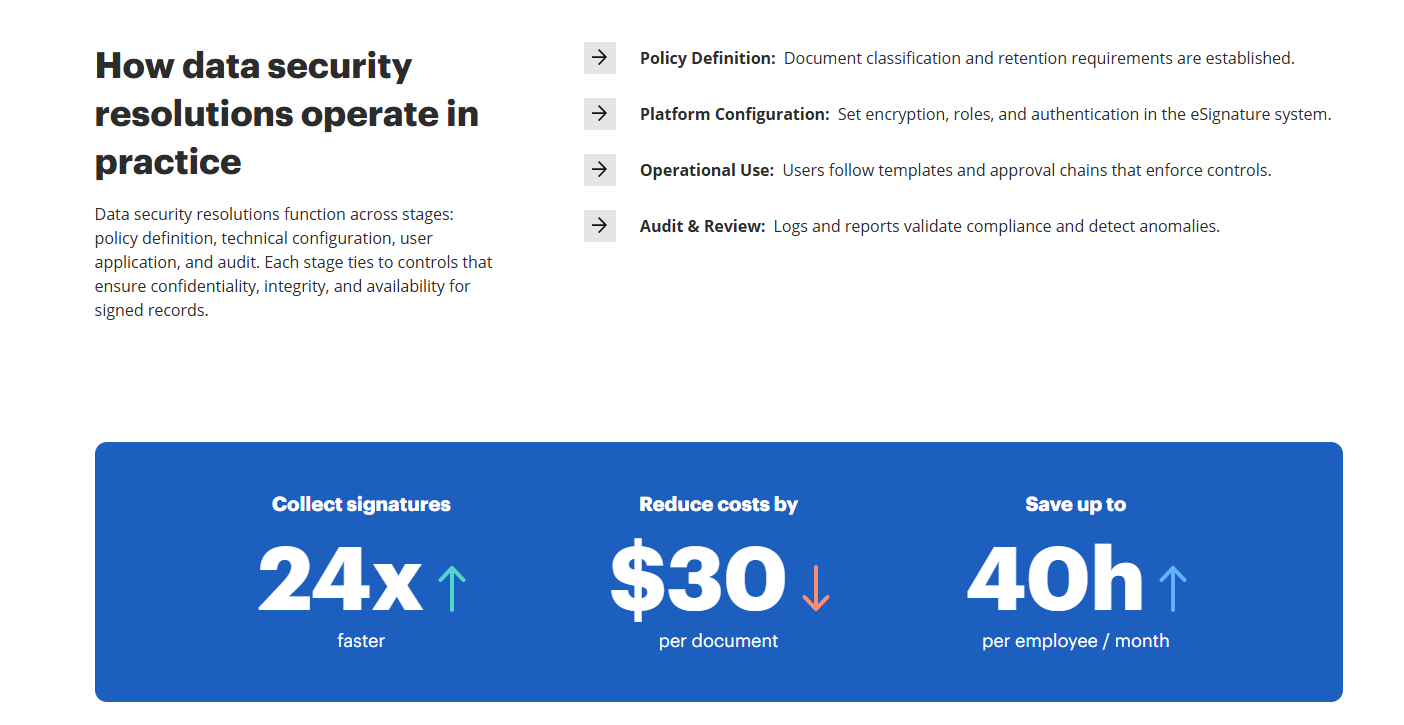
Data security resolutions are the safeguards put in place to protect sensitive documents throughout the entire electronic signature workflow process. They typically administer and enforce the following four security features and safeguards:
Policy Definitions Established
Businesses can use data security resolutions to establish formal standards and policies that explain how sensitive information is electronically accessed, handled, secured, and stored. All employees must follow these standardized rules whenever they work with electronic documents and electronic signature workflows.
The policy definitions established will normally include document classification, encryption standards, retention periods, and incident reporting procedures. For instance, certain types of electronic documents, such as financial agreements, might have stricter access controls and encryption standards than others. These exceptions would be defined in the policy definitions.
Advanced Encryption
As you may know, encryption technology encodes information by converting it from a readable format into an unreadable format. That way, unauthorized third parties won’t be able to see or understand the information if they are able to retrieve it.
Encryption is one of the most important safeguards for protecting electronic documents when they are “at rest” and “in transit.” Encryption in transit protects information being transmitted between different people, software applications, and computer servers. Encryption at rest protects stored documents from unauthorized access.
Stronger Access Controls / Multi-Factor Authentication
It is not enough to encrypt electronic documents. Businesses must also make sure that only the intended recipients are the ones accessing them. Data security resolutions provide and enforce access controls that determine which parties can view, modify, distribute, or manage each electronic document, whether employees or individual recipients.
Two-factor authentication adds an extra layer of protection to prevent unauthorized entities from accessing the electronic documents. Instead of merely providing a password to view the documents, someone would have to also provide a PIN, fingerprint, or some other login credential.
Audit Trails
Businesses must verify that their electronic documents received legitimate eSignatures from the intended signers to avoid future problems. Audit trails are how businesses can verify the integrity and validity of the electronic signature information obtained.
For example, a company could use data security resolutions with audit trails to investigate when an electronic document was sent, when it received an eSign, and all the other actions that took place during the electronic signature workflow.
Having records of the workflow is extremely valuable if a future disagreement were to arise over the signed documents. Managers can view the signing history rather than depending on an employee’s memory or what was discussed in email exchanges.
What is the Best Electronic Signature Software Platform?
A variety of electronic signature software platforms can be found online. Businesses must find the most reliable one to protect their interests, or else they could face negative consequences.
Here are some of the traits of a trustworthy electronic signature software platform:
Reputation
Any platform with an outstanding reputation is more likely to be trustworthy. Having a good reputation means that millions of users and high-value companies use the software for their electronic signature workflows.
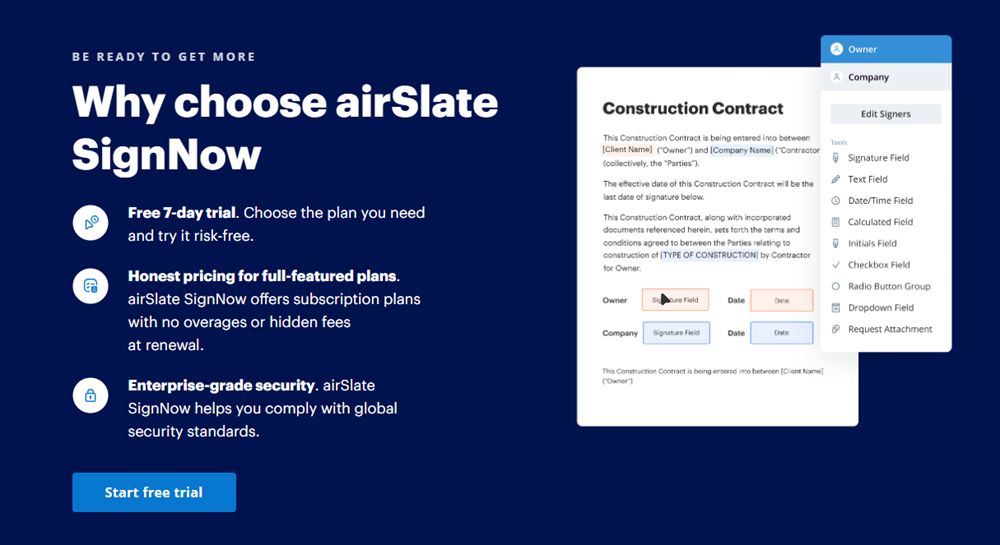
Let’s look at signNow as an example. Around 28 million people use this electronic signature management software platform. In addition, approximately 352 Fortune 500 companies use signNow as well, including Apple, Walmart, FedEx, Tesla, and Xerox.
The best part is that it only charges $8 per month for each user. Each paid plan can have unlimited users. Compare this to another service like DocuSign, which limits organizations to 100 users per year.
Compliance
The platform should comply with state or federal laws governing electronic signatures or electronic transactions. For instance, the United States passed two critical laws governing the use of electronic signatures and records. They are the Electronic Signatures in Global and National Commerce (ESIGN) Act and the Uniform Electronic Transactions Act (UETA).
Any American business should definitely ensure that they comply with the legal frameworks surrounding these two pieces of legislation if they want to seek electronic signatures from others residing in the United States. However, even if you obtain a valid electronic signature, it doesn’t automatically mean that every workflow upholds industry-specific regulations.
Healthcare is a good example of this. Hospitals, private medical practices, and any other healthcare organization have an obligation to protect each patient’s health information under the guidelines of HIPAA. Therefore, you would want your electronic signature platform to comply with those guidelines if you manage a healthcare organization.
Good Historical ROI
Research the return on investment (ROI) for users of the electronic signature software platform. Try to see if it has a high historical ROI percentage, along with significant time savings and a high document completion rate.
Take a look at signNow. Records show that its users achieve an average 700% ROI within the first year, and each employee saves up to six hours per week. It even has an 80% document completion rate, which is quite high for the industry. Historical ROIs like this would definitely make you consider using the software.
Electronic Signatures: Key Questions Answered
Are electronic signatures confidential and secure?
Yes, electronic signatures will remain confidential and secure when transmitted and stored, as long as the appropriate safeguards are in place. Only a reputable and robust eSignature platform can provide the protections needed to maintain this security.
What is the difference between encryption and an audit trail?
Encryption is when data is encoded or hidden to prevent unauthorized access. An audit trail records all the activities that take place within an electronic signature workflow, including the eSignature. Both are invaluable for protecting and processing electronic signature data.
Does a secure electronic signature platform guarantee governmental compliance?
No, you should never assume that an electronic signature platform automatically complies with government rules and standards. You should take it upon yourself to research the platform to see if it complies with government standards, especially if they are industry-specific standards.
Why are document retention policies important for electronic signatures?
Document retention refers to how long electronic documents and signatures are stored before they are securely disposed of. Since some businesses and organizations might want to preserve their electronic records for legal or operational purposes, they need strong document retention policies to determine which specific types of documents will be stored and for how long.






Comment