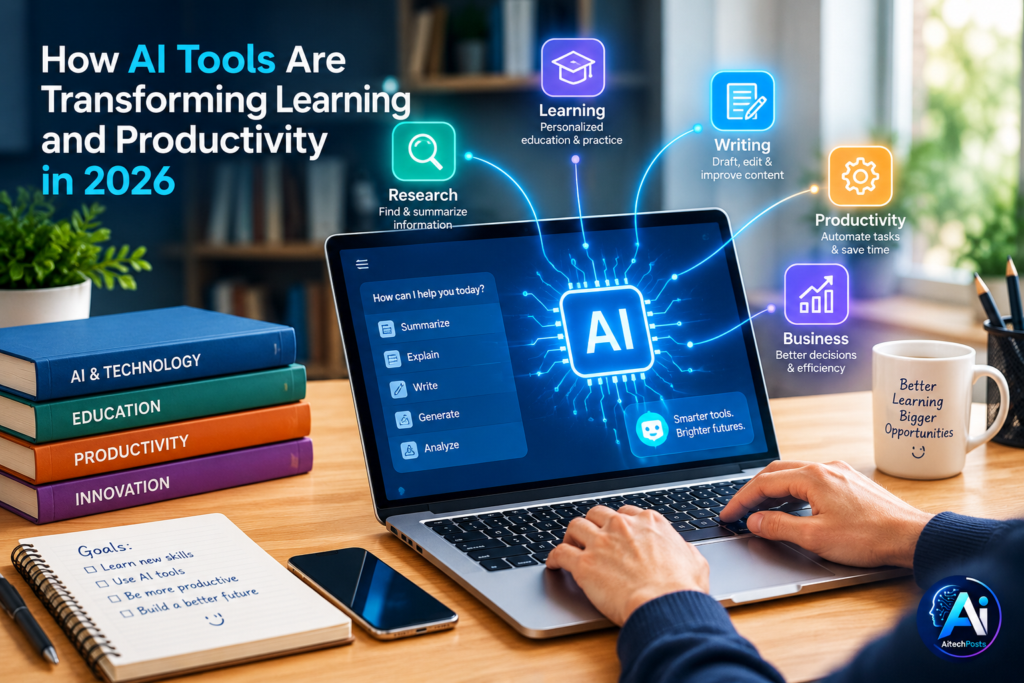
Artificial intelligence has moved far beyond being a futuristic concept. In 2026, AI-powered tools are becoming an increasingly common part of how people learn, work, research, write, and manage their daily responsibilities.
Students use AI to organize information and improve their study processes. Professionals rely on intelligent platforms to automate repetitive tasks and summarize complex documents. Businesses are experimenting with AI-driven systems to improve efficiency and decision-making.
The biggest shift is not simply that AI tools are becoming more capable. It is that they are becoming easier to access.
AI-powered platforms can now support many tasks that once required specialized software or advanced technical knowledge. This accessibility is changing expectations around productivity and creating new opportunities for people to work and learn more effectively.
AI Is Changing the Way People Access Information
Traditional search engines require users to find information, open multiple sources, and manually compare the results. AI-powered tools are beginning to change that process.
Instead of searching through dozens of pages, users can ask questions in natural language and receive summaries, explanations, suggestions, and structured responses.
This does not mean traditional research is becoming unnecessary. Reliable information still requires verification, critical thinking, and the use of credible sources.
However, AI can reduce the amount of time required to process large volumes of information.
For example, a student researching a complex topic may use AI to create an initial overview before exploring academic sources. A business professional might use an AI assistant to summarize a lengthy report and identify the most important points.
The value of AI in these situations comes from speed and organization.
Rather than replacing human thinking, effective AI tools can help people spend less time on repetitive information processing and more time analyzing, creating, and making decisions.
How AI Tools Are Transforming Learning
Education is one of the areas where AI is having a particularly visible impact.
Every learner has different strengths, weaknesses, and preferred ways of understanding information. Traditional educational systems can find it difficult to provide personalized support to every individual.
AI tools can help bridge some of that gap.
Students can use AI platforms to explain difficult concepts in simpler language, generate practice questions, organize notes, and receive feedback on their writing.
For example, someone studying a technical subject can ask an AI assistant to explain the same concept at different levels of complexity.
A beginner may request a simple explanation, while a more advanced learner can ask for a detailed technical breakdown.
This flexibility can make learning more accessible.
AI can also support productivity by helping students create study plans, organize research, summarize long materials, and prepare for examinations.
However, the most effective use of AI in education requires active participation.
Students should not simply copy AI-generated answers. The real benefit comes from using AI as a learning assistant rather than a replacement for understanding.
Students exploring different platforms can find useful resources and comparisons of the best AI tools for students to understand how different AI applications can support learning, research, writing, and productivity.
The ability to choose the right tool for a specific task is becoming an important digital skill in itself.
AI and the Evolution of Workplace Productivity
AI is also changing how professionals approach everyday work.
Many office tasks involve repetitive processes that consume significant amounts of time. Writing routine emails, summarizing meetings, organizing information, creating first drafts, and reviewing documents are examples of activities that can be supported by AI.
The purpose is not always full automation.
In many cases, AI is most useful as an assistant that helps professionals complete the first stages of a task more efficiently.
A marketing professional, for instance, may use AI to brainstorm campaign ideas before developing the final strategy independently.
A software developer might use AI to identify potential errors or explain unfamiliar code.
A business manager could use AI to summarize reports and identify recurring patterns in customer feedback.
These applications can reduce the amount of time spent on routine tasks.
As a result, professionals may have more time to focus on strategic thinking, creativity, communication, and problem-solving.
This shift could redefine how productivity is measured.
Instead of focusing only on the number of tasks completed, organizations may increasingly focus on the quality and impact of the work produced.
The Growing Importance of AI-Assisted Creativity
One of the most interesting developments in artificial intelligence is its role in creative work.
AI tools can now assist with writing, image generation, design concepts, presentations, video editing, and idea development.
For creative professionals, this can accelerate the early stages of a project.
Generating ideas is often one of the most time-consuming parts of creative work. AI can provide multiple directions quickly, giving creators a starting point to refine.
However, AI-generated content does not automatically equal creativity.
Human experience, judgment, emotion, and cultural understanding remain essential.
The strongest results often come from collaboration between human creativity and AI capabilities.
A writer can use AI to explore potential ideas but still develop the final argument independently.
A designer may generate several visual concepts before selecting and refining the strongest option.
In this way, AI can function as a creative assistant rather than a replacement for creative professionals.
The ability to direct AI effectively may become one of the most valuable skills in modern creative industries.
Choosing the Right AI Tool for the Task
The rapid growth of AI platforms has created a new challenge: choosing the right tool.
Not every AI application is designed for the same purpose.
Some tools are better suited for research and writing, while others focus on design, automation, data analysis, coding, or communication.
Users should begin by identifying the actual problem they want to solve.
Someone struggling to organize research may need a different tool from someone who wants to automate repetitive business tasks.
It is also important to consider the limitations of AI systems.
AI-generated information can sometimes be inaccurate, outdated, incomplete, or misleading. Users should verify important claims, especially when working with academic, financial, legal, or professional information.
Privacy is another important consideration.
Before uploading sensitive information to an AI platform, users should understand how the platform handles data and what privacy controls are available.
The most effective AI strategy is not necessarily using the largest number of tools.
It is identifying a small number of reliable tools that fit specific workflows.
Responsible AI Use Will Become More Important
As AI becomes more integrated into daily life, responsible usage will become increasingly important.
Users need to understand both what AI can do and where its limitations begin.
Blindly trusting AI-generated information can create serious problems.
This is particularly important in areas involving education, business decisions, healthcare, law, and financial information.
AI should support informed decision-making rather than replace human responsibility.
Organizations will also need clear policies regarding how employees can use AI tools.
Questions around data privacy, intellectual property, accuracy, and transparency will continue to become more important.
For individuals, responsible AI use means maintaining critical thinking.
AI can provide suggestions, but people should evaluate those suggestions before acting on them.
The future of AI productivity will depend not only on more powerful technology but also on better human judgment.
The Future of AI-Powered Productivity
AI is likely to become increasingly integrated into the digital tools people already use.
Instead of opening separate AI platforms for every task, users may interact with AI assistants directly inside productivity software, communication tools, educational platforms, and business systems.
This integration could make AI less visible but more useful.
The most successful AI experiences may eventually be the ones that feel like a natural part of existing workflows.
For students, this could mean more personalized learning support.
For businesses, it could mean smarter automation and faster access to insights.
For professionals, it could mean spending less time on repetitive administrative tasks.
The future will not simply be about replacing human work with artificial intelligence.
It will be about creating better collaboration between people and intelligent systems.
Those who learn how to use AI strategically, verify its output, and combine it with human expertise may gain a significant advantage.
Conclusion
AI tools are transforming learning and productivity by making information easier to access, repetitive tasks easier to manage, and creative processes faster to explore.
Students, professionals, and businesses are all finding new ways to integrate artificial intelligence into their workflows.
The key is not to use AI for everything.
The real value comes from understanding where AI can provide meaningful support and where human expertise remains essential.
As AI technology continues to develop, digital literacy will increasingly include the ability to work effectively with intelligent tools.
The people who benefit most from this transformation are unlikely to be those who rely entirely on AI.
Instead, they will be the ones who learn how to combine artificial intelligence with curiosity, critical thinking, creativity, and human judgment.