Hardware has always moved slower than software. Getting a custom part made meant long quoting cycles, opaque lead times, and multiple prototype rounds that burned calendar and capital.
AI is changing that.
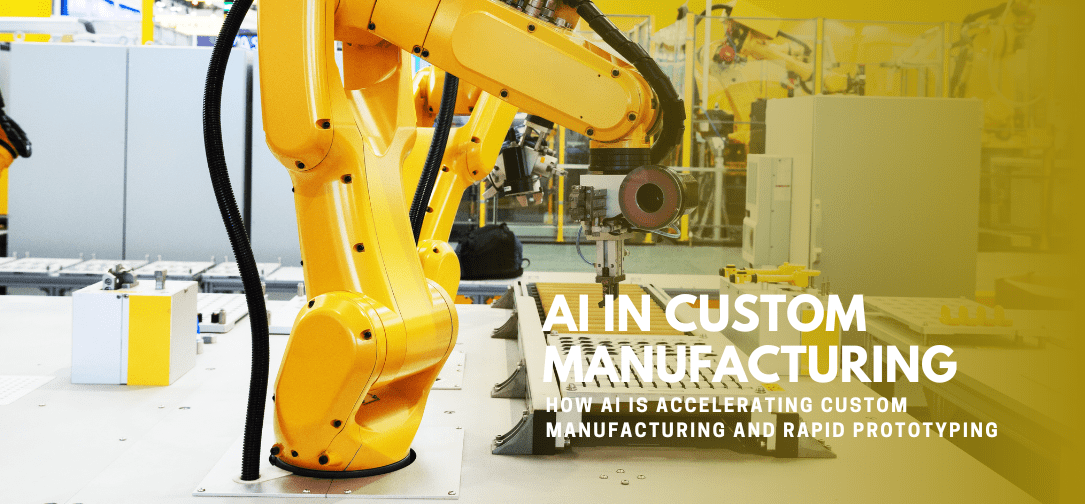
Across factories and machine shops, AI is collapsing the distance between a CAD file and a finished part. It automates quoting, surfacing manufacturability issues early, routing work to the best-fit suppliers, and even predicting quality problems before a single chip is cut.
The stakes are high. The global digital manufacturing market is projected to grow from about $574 billion in 2024 to nearly $2 trillion by 2033, a compound annual growth rate of over 13%. In that environment, teams that embrace AI-enabled workflows will ship faster, iterate more, and win more markets.
The Traditional Bottlenecks in Custom Manufacturing
Before AI, custom manufacturing had some predictable friction points:
- Slow, manual quoting. Engineers sent out drawings and waited days for human review and pricing.
- Late-stage manufacturability surprises. Thin walls, deep pockets, and tight tolerances often weren’t flagged until parts failed or needed rework.
- Opaque supplier selection. Work was awarded based on relationships, guesswork, or limited historical data.
- Reactive quality control. Issues were caught at the end of the line, after time and material were already sunk.
Every one of these constraints added delay and risk. For a startup trying to get to a first customer shipment—or a large OEM racing rivals to a new platform—those delays are often the difference between “first” and “also-ran.”
AI-Powered Quoting: From Days to Minutes
Quoting is one of the clearest proof points for AI in manufacturing.
Traditional quoting often involves complex manual calculations and expert review. That makes it accurate, but slow and hard to scale. AI-driven quoting engines learn from thousands of past jobs, analyzing geometry, material, tolerances, and cycle times to predict cost and lead time automatically.
Recent analyses of AI for quotations and cost estimation suggest that manufacturers can improve pricing accuracy by up to 40% while significantly cutting turnaround time.
For engineers, that means:
- Quotes in minutes instead of days
- More realistic trade-offs between cost, lead time, and complexity
- The ability to explore more design options without getting bogged down in email threads
Digital manufacturing platforms like Fictiv offer examples of this AI-driven, networked approach to custom manufacturing: engineers upload a CAD file and get near-instant quotes across processes like CNC machining, 3D printing, injection molding, and sheet metal fabrication, powered by data rather than guesswork. This also connects engineers to a global supply base through an intelligent digital layer they wouldn’t otherwise have access to. Human experts are strategically integrated to make sure that important details are reviewed.
AI-Enhanced Design for Manufacturability (DFM)
Even the best quoting engine is only as good as the design it receives. That’s where AI-enhanced DFM comes in.
Using geometric analysis and computer vision, AI systems scan CAD models for manufacturability risks:
- Thin walls that could warp or break
- Deep cavities that require long, unstable tooling
- Sharp internal corners that can’t be milled
- Unsupported overhangs for additive processes
AI-powered tools can flag issues automatically and, in some cases, offer alternative design suggestions—long before a job hits the shop floor.
This isn’t theoretical. AI-powered visual inspection and quality systems are already outperforming manual methods on speed and consistency, particularly for subtle defect detection. The same underlying techniques applied earlier in the workflow help engineers design parts that are both innovative and manufacturable.
For product teams, that translates into fewer design loops, less scrap, and more predictable lead times.
Intelligent Supplier Matching in Distributed Manufacturing Networks
In a world of global, distributed manufacturing, choosing where a part is made is just as important as how it’s made.
Historically, supplier selection in custom manufacturing relied on personal networks, past experience, or manual RFQ processes. That model doesn’t scale well when you’re juggling dozens of suppliers, multiple regions, and fluctuating demand.
AI-driven networks change that by evaluating:
- Supplier capabilities and certifications
- Real-time machine availability and capacity
- Historical performance, yield, and lead time
- Material availability and logistics constraints
Based on these signals, an AI system can automatically match each job to the “best fit” supplier—optimizing for speed, quality, cost, or some combination.
Reports on AI adoption in manufacturing show that over 40% of manufacturers globally already use some form of AI on the factory floor, with some regions, like the UK, approaching or surpassing the 50% mark and planning near-universal adoption. That adoption is being driven in no small part by gains in smart routing and planning.
Companies like Fictiv embody this approach: a digital layer orchestrates a vetted global network of manufacturing partners, using data to ensure each part lands where it’s most likely to succeed.
Predictive Quality Control and Maintenance
Quality and uptime are where AI begins to have compounding effects.
On the maintenance side, multiple studies from firms like McKinsey and Deloitte indicate that AI-enabled predictive maintenance can:
- Lower maintenance costs by up to 25%
- Cut unplanned downtime by as much as 50–70%
- Extend equipment life by 20–40%
If you’re running capital-intensive equipment, those aren’t marginal gains—they’re strategic.
On the quality side, AI-powered visual inspection systems have been shown to catch defects that humans routinely miss, with higher consistency and in real time. Automotive manufacturers, for example, are deploying AI camera systems to detect millimeter-scale misalignments and assembly errors on the line, aiming to reduce costly recalls and rework.
Combine predictive maintenance with AI-based quality inspection and you get a factory that:
- Breaks down less
- Produces more first-pass-yield parts
- Catches issues closer to the moment they occur
For custom manufacturing and rapid prototyping, that means more reliable outcomes and fewer nasty surprises after a tight deadline.
The Compounding Effect: Faster Iteration, Faster Innovation
Individually, AI-powered quoting, DFM, supplier matching, and quality control are compelling. But the real breakthrough comes when you connect them.
A modern, AI-enabled custom manufacturing workflow looks something like this:
1) An engineer uploads a CAD file.
2) AI instantly evaluates manufacturability and suggests adjustments.
3) A quoting engine prices multiple process options in minutes.
4) The job is routed automatically to an optimal supplier based on data.
5) AI-enabled inspection and predictive maintenance keep quality and uptime high.
Each step feeds the next. Faster quoting unlocks more design exploration. Better DFM reduces failed builds. Smarter routing cuts lead times. Predictive quality and maintenance reduce delays and rework.
The result is a development loop that’s weeks faster—and that speed compounds over multiple prototype cycles and product generations.
In other words, AI is making hardware iteration start to resemble software iteration.
What Comes Next: Toward Autonomous Manufacturing Workflows
We’re still early.
The next chapter of AI in custom manufacturing is likely to include:
- AI CAD copilots that co-design parts with engineers and prevent unmanufacturable features by default.
- Self-optimizing supply chains that dynamically reroute work across regions based on risk, cost, or carbon intensity.
- Natural-language engineering assistants that bridge LLMs and manufacturing data, letting teams ask, “What’s the fastest way to make this part in aluminum at 1,000 units?” and get an actionable answer.
- Closed-loop “no touch” workflows where quote → DFM → routing → scheduling → inspection are continuously optimized by AI.
With the digital manufacturing market projected to add well over $1 trillion in value over the next decade, these capabilities won’t be fringe—they’ll be table stakes.
Conclusion: From Friction to Flywheel
AI isn’t a silver bullet, and it doesn’t eliminate the need for human expertise in manufacturing. What it does do is remove friction from every stage of the custom manufacturing process:
- Turning quoting into a real-time capability
- Catching manufacturability issues before they’re expensive
- Matching jobs to the right suppliers across a distributed network
- Keeping machines running and defects down
AI in custom manufacturing isn’t just a cost lever. It’s a pace-of-innovation lever. Those who adopt it early will iterate faster, learn faster, and ultimately ship better products into the market.