The cosmetic dentistry market is being reshaped by technologies that make personalised products easier to design, manufacture and sell online.
Snap-on veneers are a good example of that shift. These removable cosmetic covers sit over existing teeth and can temporarily change the appearance of gaps, staining, uneven teeth and other visible imperfections.
Interest in the wider snap-on veneer market has grown alongside advances in ecommerce, digital manufacturing and direct-to-consumer fulfillment. What makes the category particularly interesting is that it increasingly sits at the intersection of dentistry, consumer technology and personalised manufacturing.
From Dental Appointments to Digital Customer Journeys
Traditional cosmetic dentistry is built around the dental practice. A patient books an appointment, receives an examination, discusses treatment options and undergoes treatment in person where appropriate.
The direct-to-consumer snap-on veneer model works differently.
Customers can research providers online, select a shade, order an impression kit and return a mould of their teeth to a laboratory. Technicians then use that information to manufacture a customised removable veneer before shipping the finished product back to the buyer.
From the customer’s point of view, the experience increasingly resembles ecommerce.
Behind the scenes, however, providers have to combine logistics, customer service, custom manufacturing and quality control into a single digital workflow. Unlike a normal ecommerce company selling identical products from a warehouse, almost every snap-on veneer order can require a unique design.
That is where technology becomes particularly valuable.
The Impression Process Is Still a Weak Point
At-home impressions remain one of the biggest challenges in the direct-to-consumer model.
Most providers send customers dental putty and trays. The customer creates a mould of their teeth and returns it to the laboratory.
The problem is that creating a usable impression is not always straightforward.
If the tray moves, the mould does not capture enough detail or the material becomes distorted, technicians may be unable to manufacture an accurate product.
The result can be another impression kit, additional shipping, more customer support and a delay in production.
For manufacturers, reducing impression failures could therefore be one of the most valuable technological improvements available.
Smartphone Scanning Could Change the Model
Professional dentistry already uses digital intraoral scanners to create detailed 3D models of patients’ teeth.
The next major step could be bringing some form of that technology into the home.
Modern smartphones combine high-quality cameras, increasingly powerful processors and computer vision systems capable of analysing physical objects in detail.
A future snap-on veneer customer may therefore be able to scan their teeth using a smartphone rather than creating a physical mould.
An app could guide the user through different camera angles, automatically identify areas that have not been captured properly and ask the customer to repeat individual sections.
That would provide an important advantage over the current process.
Instead of mailing an impression to a laboratory and waiting to discover whether it is usable, customers could potentially receive feedback almost immediately.
Digital scans could also be stored.
If a customer’s teeth had not changed, a manufacturer might be able to create a replacement set from the existing digital model rather than asking for another impression.
This could make replacement orders much easier and create a stronger repeat-purchase model for providers.
AI Could Help Consumers Design Their Smile
Artificial intelligence could also transform the buying process before manufacturing begins.
Consumers currently choose removable veneers using product photographs, before-and-after images and a limited selection of shades.
That still leaves buyers trying to imagine how a particular smile will look on their own face.
AI-based visualisation could make this much easier.
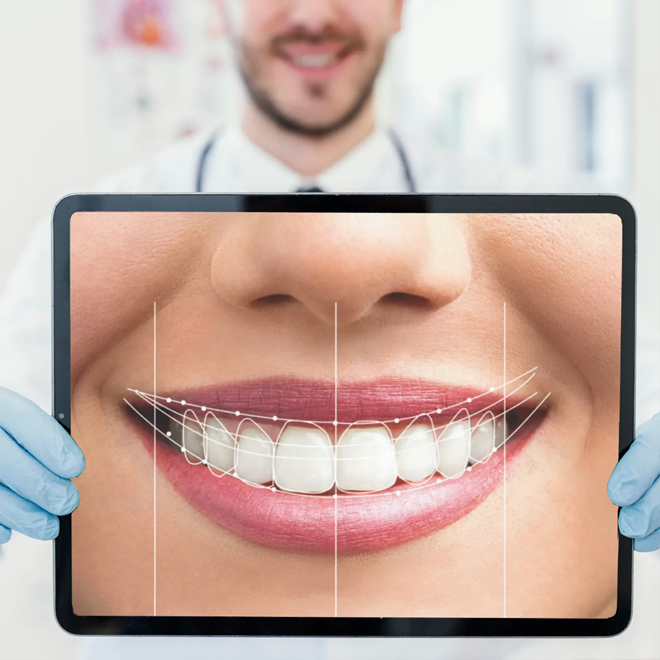
A customer could upload a photograph and preview several potential smile designs. One version might show brighter teeth, another a softer natural shade and another slightly different tooth proportions.
This could be particularly useful because the brightest shade is not necessarily the most natural-looking choice for every person.
Instead of simply describing the difference between shade options, companies could show customers how each one might look.
That may also help reduce dissatisfaction.
Cosmetic products create problems when the customer’s expectation is very different from the physical result. Better visualisation before purchase could help narrow that gap.
Personalisation Could Go Beyond Shade
AI could eventually do more than change tooth colour.
Software may be able to analyse facial proportions, lip shape and smile width before suggesting tooth dimensions that better suit the individual.
Instead of offering one idealised “Hollywood smile”, providers could present several designs.
A consumer might choose between a dramatic bright smile, a more natural version or a design that closely follows the proportions of their existing teeth while correcting specific cosmetic concerns.
That would turn AI from a marketing feature into part of the product-design process.
Digital Manufacturing Is Becoming More Important
Once an impression or scan reaches the laboratory, computer-aided design can be used to create the finished veneer.
Technicians can adjust tooth shapes, spacing and thickness before manufacturing begins.
This matters because a veneer can technically fit while still looking unnatural.
A product may be too bulky, overly uniform or poorly proportioned even when it sits securely over the natural teeth.
Better digital design gives manufacturers more control over these details.
Three-dimensional printing and other computer-controlled manufacturing techniques are particularly relevant because every customer requires a slightly different product.
Traditional mass production works well when thousands of identical items are needed. Snap-on veneers have the opposite requirement.
Digital manufacturing makes it possible to produce individually customised products without building new tooling for every order.
It can also simplify remakes. If a particular part of the design needs adjusting, the laboratory may be able to modify the digital file instead of starting again from scratch.
Materials Still Matter
Advanced manufacturing does not automatically produce a good veneer.
The physical material remains critical.
The materials used in snap-on veneers need to balance flexibility, strength, appearance and durability.
The product has to fit securely over existing teeth while remaining strong enough to retain its shape during normal use.
Appearance creates another challenge.
Lower-quality cosmetic teeth are often criticised for looking too opaque, bulky or obviously plastic.
Natural teeth interact with light in complex ways. Future materials could therefore place greater emphasis on translucency and surface finish while maintaining the flexibility required for removable products.
Improvements in polymer technology could eventually be just as important to the category as AI or 3D printing.
Ecommerce Has Changed the Economics
Technology has also changed how cosmetic dental products are priced and sold.
Traditional cosmetic dentistry includes the cost of professional appointments, dental premises, specialist equipment and clinical labour.
Direct-to-consumer businesses remove much of that infrastructure from the buying process.
That helps explain why custom removable veneers can cost hundreds of dollars while permanent cosmetic treatments may cost thousands.
Digital payment services expand accessibility further.
Many providers offer instalment plans or Buy Now, Pay Later options, allowing consumers to spread the cost rather than paying everything upfront.
This significantly broadens the potential customer base.
Data Could Become the Real Competitive Advantage
As manufacturers process more orders, the data generated by those transactions could become increasingly valuable.
Providers may eventually be able to identify which impressions are most likely to fail, which tooth arrangements lead to fitting problems and which designs produce the most remakes.
Machine-learning systems could use that information before manufacturing begins.
A questionable scan could be flagged automatically. A customer could be asked for another image. A design might be adjusted based on similar cases that produced better outcomes.
The larger and more accurate the dataset becomes, the better these systems could potentially perform.
That may eventually give established providers an advantage beyond simply having a recognised brand.
The Future Could Be Almost Entirely Digital
Within the next several years, the snap-on veneer customer journey could look significantly different.
A customer could scan their teeth using a smartphone, upload a photograph of their face and preview several AI-generated smile designs.
Once a design is selected, the digital model could move directly into a manufacturing workflow.
The finished veneer could then be produced, checked and shipped, while the customer’s digital model remains stored for easier replacement orders in the future.
A process that currently depends heavily on physical impression kits and postal logistics could become substantially more digital.
A New Type of Personalised Consumer Product
Snap-on veneers are often described simply as a cheaper alternative to permanent veneers.
The technology story is more interesting than that.
The category shows how artificial intelligence, computer vision, digital manufacturing, materials science and ecommerce can combine around a highly personalised physical product.
The companies that ultimately perform best may not simply be those offering the lowest price.
The stronger advantage may come from making the process more predictable.
Better scanning can improve fit. Better visualisation can help customers make more realistic choices. Better materials can improve appearance, while better manufacturing and data can reduce mistakes.
The most significant innovation may therefore not be a completely new type of veneer.
It may be creating a digital process reliable enough to make a complex personalised cosmetic product feel simple to buy online.