Agile project management is an iterative, customer-centric approach to delivering work that prioritizes flexibility, collaboration, and continuous learning over rigid, upfront planning. Unlike traditional project management methods that follow a linear path from start to finish, Agile breaks work into small, testable increments—allowing teams to adapt quickly as requirements evolve and new information emerges.
At its core, Agile is more than a collection of meetings and boards. It’s a mindset grounded in the Agile Manifesto, published in 2001 by a group of software practitioners who wanted a better way to build products. The 12 principles that accompany it emphasize delivering valuable software frequently, welcoming change, and trusting self-organizing teams to find the best solutions.
This article will walk you through Agile’s core values, key roles, popular frameworks like Scrum and Kanban, the benefits of agile practices, common challenges, and practical steps for getting started in your organization.
Key Takeaways
- Agile project management delivers work in short iterations (sprints), enabling teams to respond to change and customer feedback throughout the project lifecycle rather than only at the end
- The agile methodology is built on four core values and 12 core principles from the Agile Manifesto, emphasizing people, working outcomes, collaboration, and adaptability over rigid processes
- Popular agile frameworks include Scrum (structured sprints with defined roles) and Kanban (continuous flow with visual boards), and teams often blend these into hybrid approaches
- Becoming an Agile organization requires cultural change, leadership support, and the right collaboration tools—not just new ceremonies
- Unified platforms like ClickUp, Lark, and Jira help agile teams reduce context-switching by centralizing communication, planning, and documentation in one workspace
What is Agile project management?
Agile project management is an iterative way of delivering projects in small, testable increments instead of a single big release at the end. Rather than spending months planning every detail upfront, agile teams work in short cycles—often called sprints—that typically last one to four weeks.
Each cycle follows a predictable rhythm:
| Phase | What happens |
| Planning | The team selects work from the backlog based on priority and the team’s capacity |
| Execution | The development team builds the agreed-upon features |
| Review | Stakeholders see working software and provide customer feedback |
| Retrospective | Team members regularly reflect on what went well and what to improve |
This pattern repeats continuously, with each iteration delivering working software that can be tested, validated, and refined.
While the agile approach emerged from software development in the early 2000s, it’s now widely used across marketing, HR, operations, and other business teams. The agile way of working translates into everyday practices like daily check-ins, visible backlogs, shared boards, and collaborative documents.
This iterative development model means teams can validate ideas early and pivot when needed—rather than discovering problems after investing significant time and resources.
Core values and principles of Agile
The agile manifesto was published in February 2001 by 17 software developers who were frustrated with documentation-heavy, linear processes like Waterfall. They articulated four foundational values that continue to guide agile practices today:
- People and collaboration over processes and tools: While processes and agile project management tools are important, the interactions between team members matter more. Face-to-face conversation (or its digital equivalent) beats formal documentation exchanges.
- Working outcomes over comprehensive documentation: Delivering valuable software that solves real problems takes priority over producing extensive documentation that may never be read.
- Customer collaboration over contract negotiation: Ongoing dialogue with customers and stakeholders produces better outcomes than trying to nail down every requirement in a contract upfront.
- Responding to change over following a plan: Plans are valuable, but the ability to adapt quickly when circumstances change is more important than rigid adherence to the original plan.
The agile alliance expanded these values into 12 principles of agile that form the operational backbone of agile project management. Key among them:
- Satisfy customers through early and continuous delivery of valuable software
- Welcome changing requirements, even late in development
- Deliver working software frequently, with a preference for shorter timescales
- Maintain a sustainable development pace that sponsors, developers, and users can sustain indefinitely
- Give continuous attention to technical excellence and good design enhances agility
- Simplicity—maximizing the amount of work not done—is essential
These principles translate into daily behaviors: frequent communication, lightweight documentation, shared ownership, and open feedback loops that drive continuous improvement.
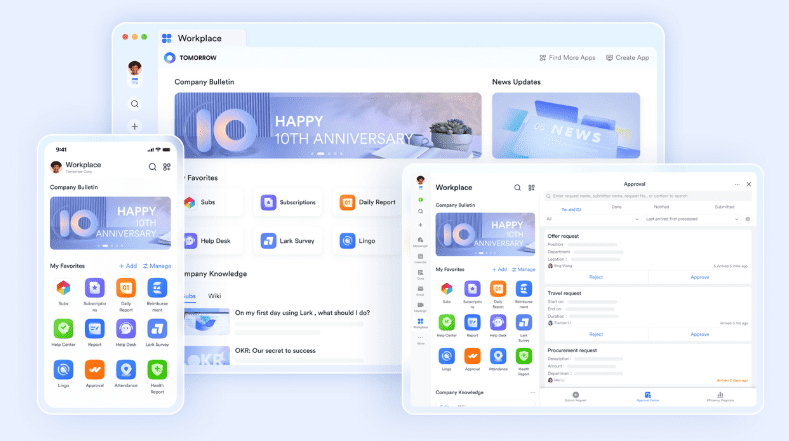
An all-in-one collaboration platform like Lark makes these values tangible by combining messaging, meetings, docs, and shared workspaces in a single view—so teams can practice customer collaboration and continuous innovation without switching between disconnected tools.
Becoming an Agile organization
“Becoming Agile” is a cultural and organizational change, not just adopting Scrum ceremonies or buying new software. It requires shifting from command-and-control management to trust-based empowerment.
Common resistance points include:
- Managers worried about losing control who equate visibility with detailed upfront plans
- Teams wary of new rituals who’ve seen process initiatives come and go
- Stakeholders who are used to fixed long-term plans struggle with iterative scope
Successful adoption requires leadership sponsorship, clear communication about why Agile is being adopted, and realistic expectations about the pace of change. The agile mindset takes time to develop.
Psychological safety is critical. Team members need to feel comfortable raising risks, admitting mistakes, and experimenting with new ways of working. Without it, retrospectives become performative rather than productive.
Training, agile coaching, and internal champions sustain the shift. Traditional project managers often evolve into agile project managers or scrum masters, using their organizational knowledge to facilitate rather than direct.
Common myths about Agile project management
Several misconceptions persist about what Agile actually means in practice:
“Agile means no planning”: In reality, Agile includes planning at multiple horizons—product vision, roadmap, release plans, and sprint planning. The difference is that planning is flexible and revisited regularly rather than locked in upfront.
“Agile is only for software”: While the agile manifesto originated in software development, the principles apply to any knowledge-based project. Marketing campaigns, HR initiatives, and product launches all benefit from iterative approaches with regular feedback cycles.
“Agile teams don’t need documentation”: Agile favors working software over comprehensive documentation, but “over” doesn’t mean “instead of.” Teams still document decisions, architectures, and how-to guides—they just focus on what’s genuinely useful rather than producing paperwork for its own sake.
“Agile means chaos”: This is perhaps the most damaging myth. Agile processes are structured, with defined roles, cadences, and clear commitments. Scrum, for example, has specific ceremonies and artifacts. The structure simply allows for adaptation within a disciplined framework.
Agile vs. Waterfall: What’s the difference?
Waterfall is a sequential, phase-driven project management approach where each phase—requirements, design, implementation, verification, maintenance—must be completed before the next begins. Agile, by contrast, is iterative and incremental, delivering value in small batches throughout the project.
Here’s how they compare across key dimensions:
| Dimension | Waterfall | Agile |
| Requirements | Fixed upfront | Evolving throughout |
| Risk management | Issues discovered late | Risks surfaced early through iteration |
| Feedback timing | End of project | Every sprint |
| Stakeholder involvement | Beginning and end | Continuous |
| Change handling | Formal change control | Welcomed and incorporated |
| Project success metric | Delivered to spec | Delivered value to users |
Waterfall can still be appropriate in certain contexts—heavily regulated projects with stable requirements and strict stage gates, for example, or waterfall projects where scope is genuinely fixed and well-understood from the start.
But agile excels in complex, uncertain, or innovative initiatives that require continuous learning. When you don’t know exactly what you need to build, iterative development helps you discover it.
Many organizations end up with a hybrid approach, combining Agile delivery with traditional governance and portfolio oversight. Modern project management tools can support both styles—using calendars, docs, and task tracking to coordinate linear phases as well as sprints.
Agile frameworks and methodologies
“Agile” is the umbrella philosophy. Multiple frameworks and methodologies implement it in different ways, each with its own emphasis and structure.
Teams can adopt a single framework like Scrum or Kanban, or blend elements into a hybrid that fits their context (such as Scrumban). The right choice depends on:
- Team size and composition
- Type of work (projects vs. ongoing operations)
- Regulatory environment
- How frequently priorities change
You don’t need to master every framework. Understanding the basics well enough to choose a starting point—and then adapting based on experience—is the agile way.
Scrum
Scrum is a structured agile project management framework that organizes work into fixed-length sprints, typically two weeks. It defines clear roles, artifacts, and ceremonies that create predictable delivery rhythms.
Key roles:
- Product owner: Accountable for maximizing value, prioritizing the product backlog, and representing customer and business needs
- Scrum master: A servant leader who facilitates the process, removes impediments, and coaches the scrum team
- Development team: Cross-functional contributors who collectively own delivery, quality, and estimation using story points
Key artifacts:
- Product backlog: Prioritized list of everything that might be needed
- Sprint backlog: Items selected for the current sprint
- Increment: The sum of completed backlog items, representing potentially shippable working software
Key ceremonies:
- Sprint planning: The team selects work based on priority and the team’s capacity
- Daily scrum: Brief daily stand-up to sync on progress and blockers
- Sprint review: Demonstration of completed work to stakeholders
- Retrospective: Team reflection on process improvements
For example, a product team might plan a sprint to deliver a minimum viable feature set—say, a basic search function. They build it, review it with stakeholders at the end of the sprint, gather feedback, and refine the backlog for the next iteration.
Scrum teams benefit from having a shared digital board, meeting spaces, and documentation—capabilities that can be combined within Lark Suite to keep everyone aligned.
Kanban
Kanban is a flow-based method that focuses on visualizing work, limiting work in progress, and improving throughput rather than working in fixed sprints.
A kanban board typically includes columns like:
| To Do | In Progress | In Review | Done |
| Task A | Task B | Task C | Task D |
| Task E | Task F | – | Task G |
Each card represents a piece of work, and cards move across the board as work progresses. This visual approach makes bottlenecks immediately obvious.
Kanban is well-suited to teams handling continuous streams of requests:
- Customer support queues
- Operations and maintenance work
- Bug fixes and small enhancements
- Any work that arrives unpredictably
Work In Progress (WIP) limits are central to Kanban. By capping how many items can be in any column at once, teams prevent overloading and expose bottlenecks. If the “In Review” column is always full, that’s a signal to address the review process.
Digital Kanban boards integrated with chat and notifications—for example, in Lark Suite—keep everyone aligned in real time. When a card moves, relevant team members can be automatically notified.
Other Agile approaches (XP, Lean, hybrid models)
Extreme Programming (XP) is an agile approach focused on software development that stresses engineering practices:
- Test-driven development (writing tests before code)
- Pair programming (two developers working together at one workstation)
- Continuous integration (integrating code frequently to catch issues early)
- Simple design and refactoring
XP emphasizes technical excellence as the foundation for sustainable development and long-term agility.
Lean thinking originated in manufacturing but applies well to knowledge work. It focuses on:
- Eliminating waste (unnecessary work, handoffs, delays)
- Maximizing value delivered to customers
- Continuously improving the flow of work
Hybrid approaches like Scrumban combine Scrum’s structure with Kanban’s focus on flow and flexibility. Teams might use sprints for planning, but manage daily work on a Kanban board with WIP limits.
Regardless of the framework, teams need reliable agile tools to visualize work, track progress, and share knowledge effectively.
Roles, responsibilities, and self-organizing teams
Agile redistributes traditional project manager responsibilities across roles and the team itself. The project coordinator role transforms from directing tasks to enabling successful outcomes.
Product Owner: The product owner is accountable for maximizing value. They prioritize the backlog, make trade-off decisions, and represent customer and business needs. They don’t tell the team how to build—they clarify what to build and why.
Scrum Master / Agile Coach: The scrum master is a servant leader who facilitates the process, removes impediments, and supports continuous improvement. They’re not a traditional manager; they help the team work more effectively without directing their work.
Development Team / Team Members: Developers and other contributors are cross-functional and collectively own delivery, quality, and estimation. In Agile, the distinction between roles blurs—everyone contributes to getting work done.
Shared Responsibilities: Risk management, communication, and stakeholder updates become shared responsibilities rather than the sole domain of a project manager. Modern collaboration platforms support this distribution by making information accessible to everyone.
The concept of self-organizing teams is fundamental. Teams decide how to approach work within a clear set of goals and constraints. Leadership sets direction; teams determine execution.
Leadership in Agile: from control to enablement
Leaders in Agile environments shift from directing tasks to setting outcomes, providing context, and enabling teams to succeed. This requires developing different soft skills than traditional project managers might have emphasized.
Effective agile leaders:
- Remove organizational blockers that slow teams down
- Align teams to strategy without micromanaging execution
- Model openness to feedback and willingness to change
- Create psychological safety for experimentation
Transparent communication channels—chat, video, shared docs—let leaders stay informed without hovering. They can see progress on shared boards and join sprint reviews without demanding constant status updates.
Metrics and dashboards should be tools for learning and support, not punitive performance monitoring. Velocity, for example, helps teams forecast—not compare themselves against other teams or face judgment for variation.
Benefits and challenges of Agile project management
Agile offers significant advantages, but it also comes with real-world challenges that must be managed deliberately.
Key benefits:
- Faster feedback loops: Problems surface early when the stakes are lower
- Improved customer alignment: Regular reviews ensure you’re building what users actually need
- Earlier value delivery: Working software ships every sprint, not just at the end
- Greater transparency: Visible backlogs and boards show exactly where work stands
- Higher team engagement: Autonomy and ownership increase motivation
- Competitive edge: Organizations that adapt quickly outperform slower competitors
- Better customer satisfaction: Products evolve based on real user input
The continuous improvement practices embedded in Agile—especially retrospectives—help teams steadily enhance both processes and outcomes. Agile reports show progress in terms of delivered value, not just completed tasks.
Common challenges:
- Loss of direction: Without a clear product vision, iteration can become aimless
- Forecasting difficulty: Predicting long-term dates is harder with an evolving scope
- Collaboration dependency: Agile works best with engaged stakeholders; the absence of sponsors creates problems
- Scope creep risk: Welcome to change, which can become an uncontrolled expansion without discipline
- Documentation gaps: Favoring working software can leave maintenance teams without context
These challenges can often be mitigated with disciplined product management, clear roadmaps, and robust communication practices—supported by integrated tools that keep everything visible and connected.
Typical Agile pitfalls and how to avoid them
“Cargo cult Agile”: Going through the motions—holding daily stand-ups, using story points, calling work “sprints”—without understanding the intent behind these practices. Teams do the rituals but don’t embrace the agile principles.
Prevention: Invest in training that explains why, not just how. Use retrospectives to question whether practices are actually helping.
Overloaded teams: Taking on too many initiatives simultaneously, destroying focus and creating constant context-switching.
Prevention: Enforce WIP limits. Say no to new work until the current work is complete. Protect the sprint from scope addition.
Under-investing in discovery: Iterating rapidly on ideas that don’t solve real user problems because no one validated the problem first.
Prevention: Build discovery practices alongside delivery. Talk to users before and during development, not just after.
Skipping documentation and architecture: Treating Agile as an excuse to avoid thinking about system design, resulting in technical debt that slows future work.
Prevention: Remember that technical excellence is an agile principle. Allocate time for refactoring and documentation as part of sustainable development.
Regular health checks, feedback surveys, and metrics reviews uncover process issues early. The best agile teams iterate on their ways of working just as deliberately as they iterate on their products.
Agile metrics and visibility
Agile teams rely on lightweight, meaningful metrics rather than complex, rigid reporting structures. The goal is insight that drives improvement, not paperwork that satisfies bureaucracy.
Common Agile metrics:
| Metric | What it measures | How teams use it |
| Velocity | Work completed per sprint (often in story points) | Forecasting future sprints |
| Cycle time | Time from start to finish of a task | Identifying slow spots |
| Throughput | Items completed over a period | Tracking delivery rate |
| Burndown | Work remaining vs. time left in sprint | Visualizing sprint progress |
Visual tools like burndown charts and cumulative flow diagrams help teams see progress and bottlenecks at a glance. A quick look tells you whether the sprint is on track or whether work is piling up somewhere.
Consolidated dashboards inside agile resources and tools help teams, leaders, and stakeholders stay aligned on status without endless status meetings.
Agile project management in practice with modern tools
Agile ways of working are supported and amplified by digital platforms that bring communication, planning, and content together. Fragmented tool stacks—separate chat, documents, calendars, and boards—create friction and slow down agile teams.
This is where project management tools become essential. Choosing integrated project management tools reduces context switching and improves real-time collaboration for agile teams. Instead of bouncing between apps to find conversations, update tasks, or check the schedule, everything lives in one workspace.
Tools That Help with Agile Project Management
Lark is an all-in-one collaboration platform that integrates chat, video meetings, cloud-native documents, task tracking, calendar, and automation into a unified workspace. Its seamless communication and real-time collaboration features make it ideal for Agile teams seeking to reduce context switching and improve transparency. Lark’s customizable workflows and automation capabilities help teams streamline Agile processes, from sprint planning to daily stand-ups and retrospectives, supporting continuous improvement and fast adaptation.
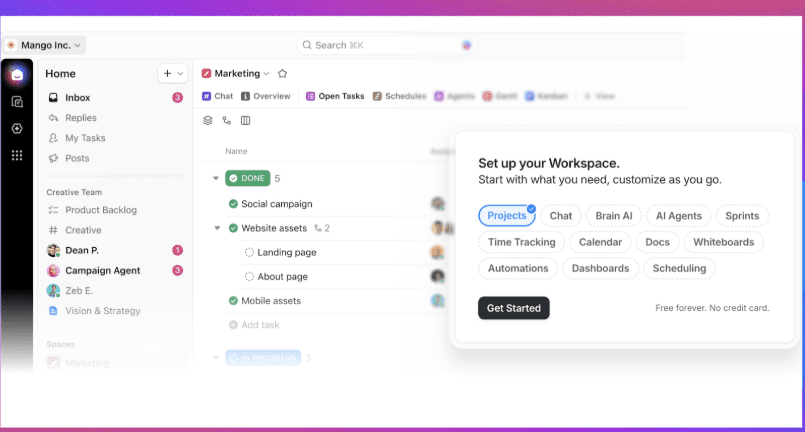
ClickUp is a versatile project management tool designed to support Agile methodologies with features like customizable task statuses, sprint management, time tracking, and goal setting. Its highly flexible interface allows teams to tailor workflows to their specific Agile framework, whether Scrum, Kanban, or hybrid. ClickUp also offers robust reporting and visualization tools such as burndown charts and dashboards, helping Agile project managers track progress, velocity, and team performance effectively.
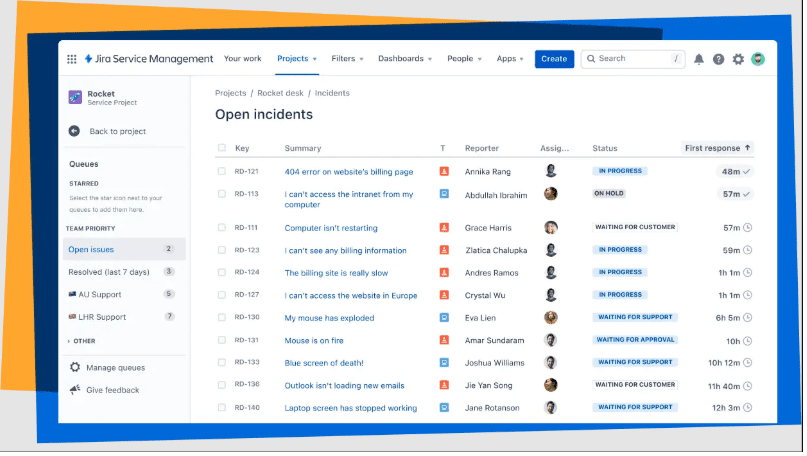
Jira by Atlassian is one of the most popular Agile project management tools, especially in software development teams. It provides comprehensive support for Scrum and Kanban frameworks, including backlog management, sprint planning, issue tracking, and release management. Jira’s rich ecosystem of plugins and integrations enables teams to customize their Agile workflows and automate repetitive tasks. Its detailed reporting and real-time insights empower teams and stakeholders to maintain alignment and drive continuous delivery throughout the project lifecycle.
Multilingual support, mobile access, and automation capabilities become especially important for distributed agile teams and global organizations.
Automating workflows and reducing manual overhead
Automation supports agile processes by handling repetitive tasks that would otherwise consume time and attention.
Practical automation examples:
- Automatically notify a channel when a task moves to “Ready for Review.”
- Trigger an approval workflow when a feature is marked complete
- Update the dashboard when a sprint finishes
- Send reminders before ceremonies are scheduled to start
- Create recurring tasks for regular maintenance activities
Automation keeps information consistent across calendars, boards, and documentation—reducing human error and saving time that can be spent on valuable work instead.
In platforms like Lark, non-technical team members can configure simple automations without writing code. This makes process improvement accessible to everyone, not just developers.
Getting started with Agile in your organization
Here’s a pragmatic, step-by-step approach for teams and companies beginning their Agile journey:
- Define the problem you’re solving: Why are you considering Agile? Slow delivery? Lack of visibility? Building features customers don’t want? Be specific about what success would look like.
- Choose a pilot team: Pick a cross-functional team that owns a well-scoped product or initiative. Don’t attempt company-wide change immediately. Build projects with teams that are motivated to experiment.
- Adopt foundational practices: Start with the basics:
- Create a visible backlog of work
- Hold regular planning sessions at the start of each iteration
- Conduct brief daily check-ins to sync the team
- Run retrospectives at the end of each iteration to inspect and adapt
- Standardize on a collaboration platform: Choose and standardize on a project management platform early. This creates a single source of truth for work items, communication, and documentation. Unified workspaces like Lark Suite reduce friction from day one.
- Learn and iterate: Review what’s working after each sprint. Invest in training for team members. Gradually refine your framework rather than rigidly copying any model. The goal is continuous innovation in how you work, not just what you deliver.
- Celebrate and share successes: When the pilot team demonstrates improvements, share those stories. Success builds momentum for broader adoption.
Scaling Agile beyond a single team
Organizations consider scaling Agile when multiple teams must coordinate—several product streams, a large transformation initiative, or enterprise-wide delivery.
Scaling introduces challenges:
- Dependency management between teams working on shared systems
- Backlog alignment to ensure teams are pulling in the same direction
- Consistent governance without drowning in bureaucracy
Many organizations begin by:
- Synchronizing sprint cadences so teams plan and review together
- Sharing roadmaps across teams for visibility
- Using common tooling to create shared language and processes
Some adopt formal scaling frameworks, but even without these, basic alignment practices go a long way.
A central enablement function—sometimes called an Agile Center of Excellence or part of a PMO—can provide training, guidelines, and shared templates while allowing teams autonomy in execution.
A unified collaboration suite is especially important at scale. Teams need to coordinate cross-team work, share knowledge, and maintain alignment without excessive meetings or email chains.
Conclusion
Agile project management transforms how teams deliver value by embracing flexibility, collaboration, and continuous improvement throughout the project lifecycle. Moving away from rigid traditional methods, Agile empowers teams to adapt quickly to changing requirements, engage stakeholders regularly, and deliver working software in short, manageable iterations. By adopting Agile frameworks like Scrum and Kanban and leveraging unified collaboration platforms such as Lark Suite, organizations can enhance transparency, accelerate delivery, and foster a culture of innovation. Whether you’re a growing SME or a large enterprise, embracing Agile project management can help your teams stay aligned, responsive, and competitive in today’s fast-paced business environment.
RELATED ITEMS: DEVELOPMENT, SOFTWARE, SOFTWARE DEVELOPMENT, SOFTWARE PROJECTS