
How 40% Tolerance Reductions Save Tech Startups $50K in Hardware Prototyping

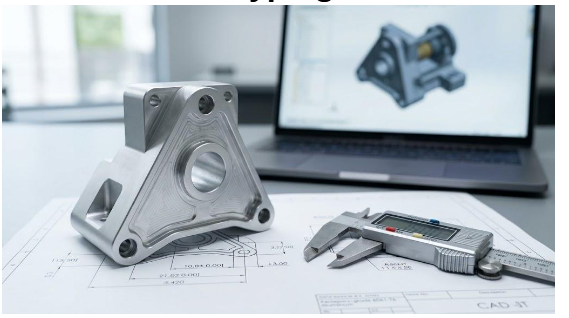
It is extremely expensive for hardware startups to transition mechanical designs from CAD drawings to physical testing. Engineering teams frequently spend $50,000 fixing prototypes because of issues such as tolerance issues and interference. By implementing early Design for Manufacturability (DFM) reviews and assigning realistic dimensional limits, companies eliminate up to 40% of physical rework loops and protect product development budgets.
Why Do Modern Tech Startups Struggle with Hardware Prototyping Costs?
Modern hardware development progresses rapidly, but physical structural components are still limited by physics. Many emerging tech startups run into sudden cash-flow bottlenecks during initial hardware prototyping cycles. A typical error occurs in the use of a standard tolerance of ±0.005mm on the entire part without separating critical dynamic fits from non-critical clearances.
Submicron machining of structural metal demands special setup of the tooling, very low feed rate of the spindle, and continuous measurement of the parts. Lack of this feedback results in binding assemblies, deformation of thin walls, and increased scrap rate. Setting stepped tolerances cuts cycle times substantially while maintaining high precision where needed to CNC machining metal.
How Does Metal CNC Machining Bridge the Gap Between Design and Scale?
Rapid 3D printing is suitable for fast visuals, but structural testing of the part in high temperature conditions or under stress calls for subtractive manufacturing techniques. Continuous isotropic strength, stiffness, and finish that subtractive metal CNC machining offers cannot be matched by additive plastic manufacturing.
In functional prototype cycles, multi-axis machining results in production-quality CNC machining metal parts with accurate geometric tolerances and material stability. In order to get an idea about the correct reach of cutting tools and avoid wall deflection during pocketing operations, one should consult the metal CNC machining guide prior to drawing finalization.
Which Materials Offer the Best Balance for Advanced Structural Components?
Choosing the proper raw stock material involves finding a balance between yield strength, thermal properties, corrosion resistance, and machining speed.
- Aerospace-Grade Aluminum (6061-T6, 7075): Provides excellent thermal conductivity, good strength to weight ratio and rapid chip removal. Engaging a competent aluminum CNC machining service cuts down on spindle time and allows for the application of anodized finishes.
- Titanium Alloys (Ti-6Al-4V Grade 5): Good material for marine machinery, aerospace brackets or medical housings that require great strength and chemical resistance. The low thermal conductivity means heat builds up at the cutting edge, demanding rigid fixturing and copious high pressure coolant for CNC machining titanium.
Verifying standard raw material test reports (MTR) through facilities audited under ISO 9001 confirms chemical consistency across every prototype batch.
When Should Engineers Outsource to Custom CNC Machining Services?
Purchasing 5-axis machining equipment and building in-house metrology labs requires heavy capital expenditure. Growing hardware companies stay flexible by partnering with established machine shops offering on-demand custom CNC machining services.
Machine shops that contract out perform tool maintenance, stock management, and metrology costs while providing instant feedback on cutter availability and fillet radius values. JS Precision, which is one of the top manufacturing partners, uses precision machining capabilities with multi-axis milling coupled with AS9100D quality control systems.
Figure 2: In-line CMM metrology inspection verifying tight dimensional tolerances on complex milled pockets before final dispatch.
How Can Teams Verify Supplier Standards Without Delaying Timelines?
Evaluating manufacturing vendors requires verifiable operational metrics instead of marketing promises. Engineering teams should focus on documented quality assurance workflows.
- First Article Inspection: Examine complete FAI kits and inspect CMM dimensional inspection documentation.
- By quality Audit: Work with companies having registered quality CNC machining inc capabilities for total material lot traceability.
- Environmental Requirements: leading suppliers like JS Precision have ISO 14001 approved standards and recycle their cutting fluids and minimize waste while adhering to strict delivery deadlines.
Design for manufacturing when hardware is designed to be manufacturable, teams more easily achieve design for manufacturing success. By performing early DFM checks, choosing the right structural alloys and collaborating with trusted machine shops, teams avoid costly redesigns and can scale seamlessly.
Before final production files are released, this can be provided for 3D CAD step files to a qualified machinist for a DFM review to address tolerance stack-up and to obtain short production lead times.
Author Bio
Doris Wu is an expert in rapid prototyping to volume production, custom CNC machining, sheet metal fabrication and close-tolerance DFM tuning, ISO 9001:2015.
FAQ
What makes CNC machining more cost-effective than 3D printing for functional prototypes?
Subtractive machining employs high-grade production billet metals instead of bonded powders or photopolymers. Machined components deliver true mechanical yield strength, verified heat dissipation and strong threads, eliminating surprises and physical failures during structural validation and costly delays due to redesign.
Why does tightening tolerances drastically increase component machining expense?
When the tolerances are lowered from the standard ±0.1 mm to ±0.005 mm, special micro-tooling, slower machine feeds, and multiple measurements need to be done. This raises the cost of machining each unit.
How does early DFM review enable hardware engineering teams to save money?
Early DFM review pinpoints any unmachinable geometric shapes such as deep internal corners, unreachable surfaces, and extremely thin ribs. Altering them helps avoid extra cost for special tooling, no tool deflections, and reduces total manufacturing time.
Why is ISO 9001 compliance critical when selecting an industrial manufacturing partner?
ISO 9001 certification verifies that a supplier follows disciplined quality management procedures, uses calibrated inspection instruments, and maintains traceable material batch records. This ensures reliable dimensional precision across single test pieces and repeat production volumes.
When should design teams choose Titanium over 6061-T6 Aluminum?
Go for Titanium Grade 5 when you work with parts operating in high temperature and corrosive conditions or need ultimate strength-to-weight ratio. In case of electronics casing and heat sinks, 6061-T6 Aluminum is cheaper and faster to produce.







Comment