In an apartment in Lisbon, a mother keeps her children’s school year in four places. The week’s assignments sit in a shared calendar. Grades go into a spreadsheet she rebuilds every August. Reading logs fill a paper notebook. Photographs of finished projects live in a phone album nobody has backed up. Her older daughter will apply to universities in the United States in three years, and each application will ask for a record of secondary school that does not yet exist in one piece.
Before any of that becomes a record, she has to decide what her children will study. American home education has no standard package, and the programs on offer number in the hundreds, sold subject by subject rather than as a finished year. See Numa School’s guide to picking the best homeschool curriculum. Numa School is itself a homeschool planning and record-keeping platform, and most of what it does begins after that decision, with the weekly schedule, the attendance count and the work a child produces across nine months. Choosing materials takes a few weeks in summer. Keeping the year takes the other ten months.
What the Software Actually Does
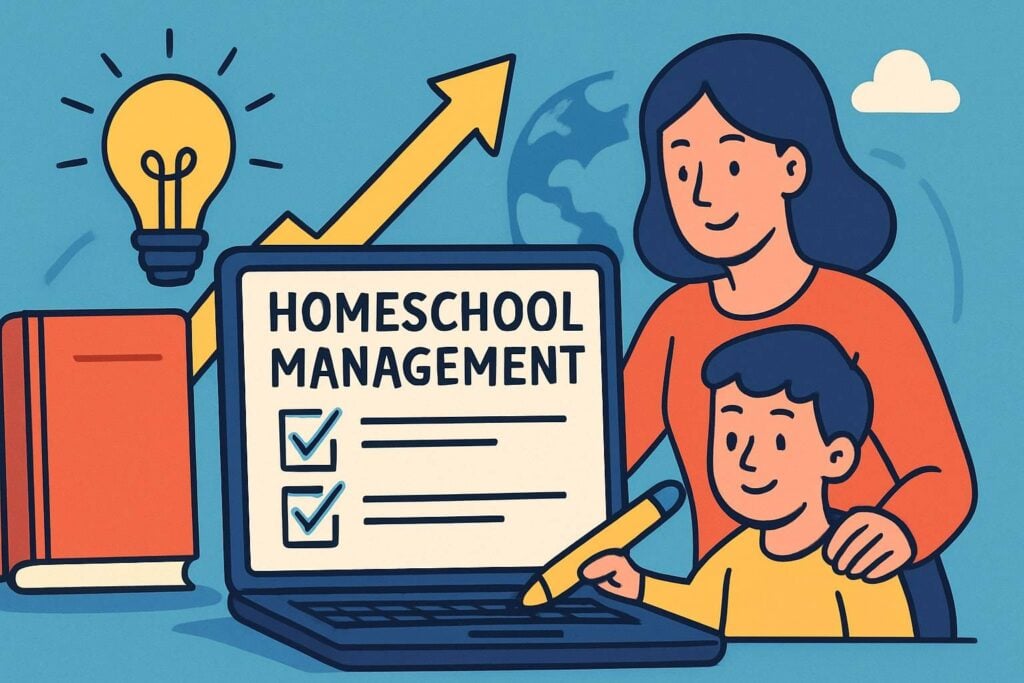
Homeschool management software handles the administrative half of teaching at home. A typical product schedules lessons, records attendance in whichever unit a family’s state counts, stores samples of work, tracks grades and credits, and at the end assembles something a district, an evaluator or an admissions office will accept. The individual features are unremarkable. Together they decide whether a school year can be produced on request or has to be reconstructed from memory two winters later.
The parent using it holds three jobs at once. She teaches, she keeps the register, and she is the person the paperwork is addressed to. Calendars and spreadsheets serve the first job well enough and ignore the other two. A spreadsheet does not know a filing window has opened, and a shared calendar has no opinion on whether nine months of reading adds up to an English credit.
How Many Families This Involves
The market is bigger than its profile suggests and harder to measure than most. In the United States, figures the Pew Research Center drew from the National Center for Education Statistics put 3.4% of K-12 students in homeschooling during the 2022-23 school year, against 2.8% four years earlier. A further 1.8% attended full-time virtual schools, roughly double the earlier share, though their parents did not describe that as homeschooling.
Outside the United States the counting is patchier, and where registers exist the direction is the same. Australia’s states publish registration data and recorded roughly 45,000 registered home-education students in 2024, about 92% more than in 2020. New South Wales alone went from 5,907 registrations in 2019 to 12,762 in 2024. Most countries publish nothing comparable, so any global figure is an estimate resting on very little. That measurement gap is part of the story: a market nobody can size is a market few companies will build for.
Digital Tools Removed the Distance Problem
Twenty years ago, teaching an American curriculum outside the United States meant shipping boxes. Textbooks arrived by post, completed tests went back the same way, and a family’s options narrowed to whatever a publisher was willing to mail overseas. Most of that has quietly gone away. Course material downloads, video lessons run live from another continent, tutors work across time zones by appointment, and payment across a border settles in seconds. A family in Kuala Lumpur can buy the same math program a family in Ohio bought that morning, at the same price, and begin it the same afternoon.
That shift did more for access than any policy change of the same period, and it moved the hard part rather than removing it. When materials were scarce, finding them was the work. Now they are abundant, and the difficulty has migrated to everything around them: sequencing a year across several providers, keeping proof that the work happened, and producing a record an institution on another continent will accept. Distribution solved access. It did not solve administration, because administration was never a distribution problem.
Why the Tools Carry Across a Border
The households now changing that arithmetic are frequently not in the United States at all. Diplomatic postings, military assignments, remote work and ordinary migration have left a considerable number of families raising children abroad who expect those children to study in America later. Local alternatives rarely fit. International schools cluster in a few large cities and price accordingly, and the national system means a different syllabus, usually in another language, and a record an American reader has to interpret rather than simply accept. Home education covers the gap where the law allows it, and the law varies: several countries set out clear rules for it, and a few, Germany among them, do not permit it at all.
What makes a product built in the United States useful overseas is that the requirement was American to begin with. These families want the same output as a family in Ohio: subjects logged under names an American reviewer recognizes, time counted the way American reviewers count it, and a transcript that needs no explanation at the far end. The schooling happens in one country and has to be legible in another, which makes it a documentation problem before it is an educational one.
The mother in Lisbon is not an unusual case so much as an early one. She is doing on a laptop what a teacher, a registrar and a records clerk would each do inside a school building, in a country with no stake in the result. For households like hers the competition was never a rival product. It was a spreadsheet and a box of paper, and what wins is whatever turns a year of scattered evidence into a document somebody else will accept.